

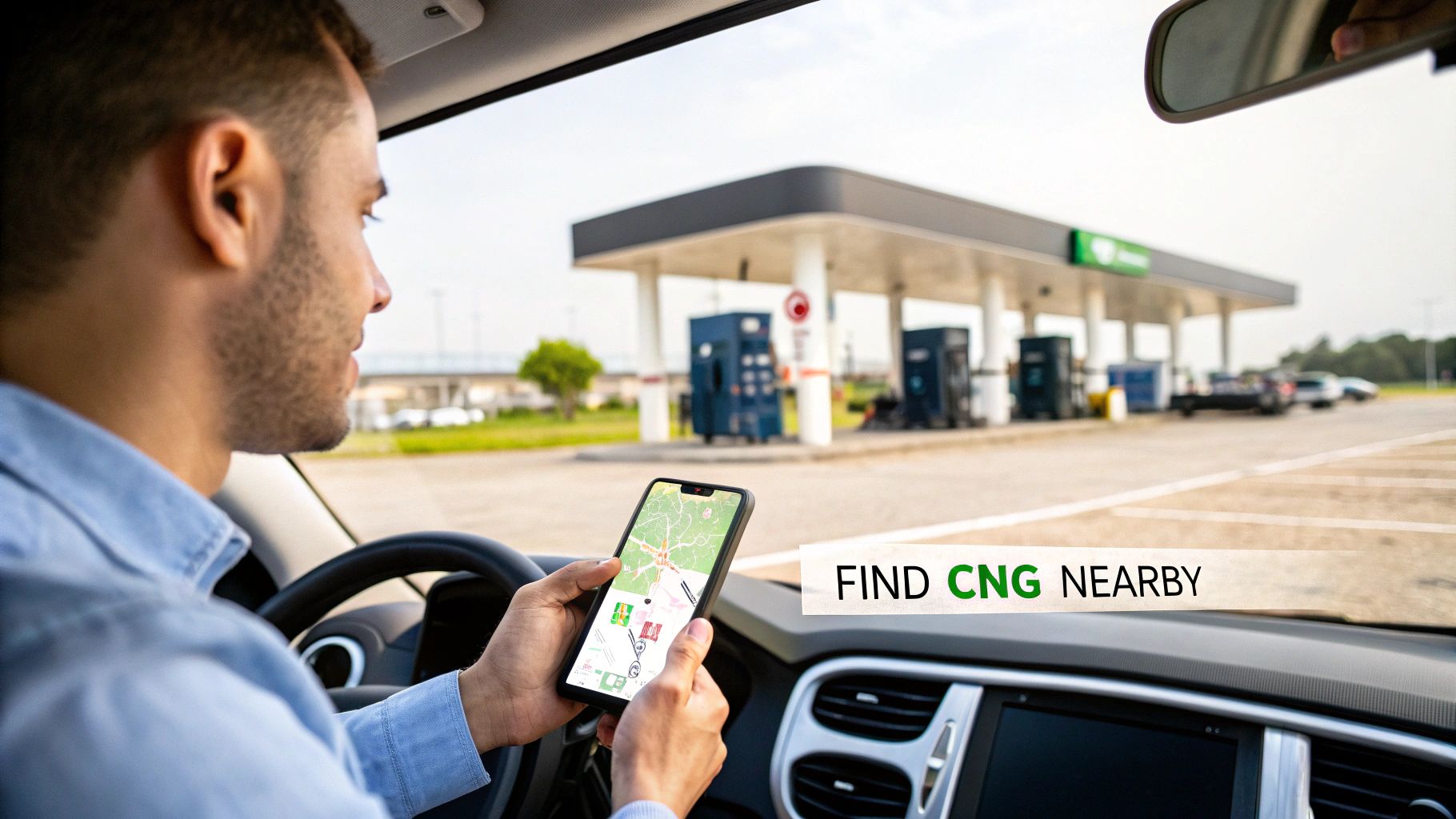
Finding a CNG fueling station shouldn't throw a wrench in your route planning. Honestly, the quickest and most reliable way to find one is by using the U.S. Department of Energy's Alternative Fuels Data Center (AFDC) Station Locator. For anyone managing a fleet, this tool is your best bet for getting a fast, accurate answer to the "where's the nearest CNG?" question.
Your Quick Guide to Finding CNG Fueling Near You
Time is money, especially when you have drivers on the road. Every minute spent hunting for a working, public CNG station eats directly into your profits. While we all use Google Maps or Waze for everyday driving, their information on specialty fuels like CNG can be hit-or-miss. You might get sent to a private depot, a station that’s temporarily down, or one that’s been closed for months. It’s a gamble you can’t afford to take.
This is exactly why I always point people toward specialized, government-backed tools first. The AFDC Station Locator isn't just another map—it's a robust database built with commercial operators in mind.
Picking the Right Tool for the Job
Just pulling up a map isn't enough. You have to know how to use the filters to your advantage, especially when you're planning a route for a $250,000 truck. Don't just search for a city; get specific to match what your fleet actually needs.
Here are the filters I tell every new fleet manager to use:
- Public Access: This is the big one. Make sure the station is actually open to your vehicles and not a private yard for a specific company.
- Hours of Operation: Nothing’s worse than a driver arriving at a locked gate at 2 a.m. Filtering for 24/7 stations is a must for long-haul or off-hours routes.
- Payment Methods: A simple but critical detail. Confirm the station takes your fleet cards or payment type before you send a driver. It saves a lot of frustrating phone calls.
The visual map on the AFDC site is incredibly helpful for seeing the big picture. It lets you spot "fueling deserts" and plan routes that stick to corridors with reliable CNG access.
A little proactive planning here turns fueling from a major headache into just another predictable stop. You eliminate the guesswork and keep your trucks—and your business—rolling smoothly.
Comparing CNG Station Locator Tools
While the AFDC is the gold standard, a few other apps are popular with drivers. Here’s a quick rundown to help you decide which one fits your needs best.
| Tool | Best For | Key Feature | Potential Drawback |
|---|---|---|---|
| AFDC Station Locator | Fleet managers for official, accurate route planning. | The most comprehensive and up-to-date government data. | The mobile interface can be a bit clunky compared to modern apps. |
| CNGnow | Drivers on the go needing a quick, simple interface. | User-submitted price updates and station status comments. | Relies on user-generated content, which can sometimes be outdated. |
| Waze | Real-time traffic routing combined with basic fuel search. | Integrates fuel stops into the fastest overall route. | CNG station data is often incomplete or inaccurate. |
| Google Maps | General-purpose navigation with some fuel-finding capability. | Ubiquitous and familiar to all drivers. | Lacks crucial details like public/private access or payment types for CNG. |
Ultimately, for the serious business of fleet management, the AFDC's tool provides the reliability you need. For drivers who want a secondary app on their phone, CNGnow is a solid choice for its on-the-ground user feedback.
What’s Behind the Growing CNG Fueling Landscape?
If you’ve searched for "CNG fueling near me" lately, you’ve probably noticed something: there are more options than ever before. This isn't a fluke. The network is growing because of serious investment, smart policy, and a real, practical demand from businesses looking for cleaner, more affordable fuel.
For fleet managers, seeing this bigger picture is crucial. It gives you the confidence that switching to CNG isn't just a short-term fix, but a solid, long-term strategy for your operations.
The appeal is simple. The low, stable price of natural gas has saved American commercial and industrial customers an estimated half a trillion dollars over the last ten years. Those are real savings that directly boost the bottom line, especially for the millions of small businesses that count on natural gas for everything from heating and cooking to running heavy equipment.
The Forces Driving the Expansion
So, what's actually fueling this growth? It’s a powerful combination of private investment and public support. Companies are building out the infrastructure to meet demand, while government programs are helping to speed up the move away from diesel and gasoline. This two-pronged approach is creating a dependable, resilient network.
Several key factors are pushing CNG into the mainstream:
- Corporate Sustainability Goals: More and more companies are setting ESG (Environmental, Social, and Governance) targets. Moving a fleet to CNG is one of the most direct ways to slash a company's carbon footprint.
- Government Incentives: Tax credits and grants make a huge difference. They help offset the initial cost of buying natural gas vehicles and building out fueling infrastructure, making the switch much more feasible.
- Energy Independence: Relying on domestic natural gas helps insulate businesses from the wild price swings of the global oil market. The result? A much more predictable fueling budget.
For a fleet manager, this means the CNG fueling station you rely on today is part of a growing ecosystem. It's not just a standalone pump but a node in an expanding web of energy infrastructure designed for the future of commercial transport.
A Market Built on Strong Numbers
The commitment here is real, and it’s backed by serious money. As of early 2026, the United States is home to 1,385 CNG refueling stations and 81 for liquified natural gas (LNG). That’s a clear signal of where the industry is heading.
Globally, the market tells a similar story. Valued at roughly USD 15 billion in 2025, the CNG refueling station market is expected to grow at a compound annual rate of 8% through 2033. You can dig deeper into the data on the clean transport industry's projected growth to see the full picture.
This steady expansion is exactly what fleet managers need to see. It means that as you grow your fleet, the fueling network will be there to support you. Whether you stick with public stations or start looking at mobile fueling, the market is sending a clear message: CNG is here to stay. That gives you the confidence to invest in the vehicles, knowing the support system is scaling right along with you.
Fixed Stations vs. Mobile Fueling: What’s Really Best for Your Fleet?
When you’re managing a fleet, your fueling strategy is about more than just finding the closest pump. The real question is an operational one: do you send your vehicles out to get fuel, or do you bring the fuel directly to them? This is the fundamental choice between relying on traditional fixed CNG stations and bringing in a mobile fueling service.
Going to a public station is the old-school way. It’s familiar, sure, but it also means burning paid driver hours and fuel just to get to the fuel pump. Every off-route mile adds up in wages, vehicle wear, and lost time. For a construction crew on a remote site or a city’s sanitation fleet parked in a central yard, those fueling trips can bleed efficiency and profits dry.
Mobile fueling turns that entire process inside out. Instead of your fleet running all over town to accommodate fueling infrastructure, the infrastructure comes right to your doorstep.
The Strategic Edge of Fueling On-Site
Picture this: your fleet of delivery trucks rolls back into the yard after a long day. Later that night, a mobile fueling truck arrives and fills every single vehicle. When your drivers clock in the next morning, their trucks are 100% fueled and ready to hit the road. No detours, no waiting in line, zero wasted time.
This “yard-fill” approach is a game-changer for a few key reasons:
- You reclaim lost hours. Drivers are no longer paid to sit at a pump or drive out of their way. They stay on their routes, doing the work that actually makes money.
- You can scale up or down. Need more fuel for a peak season or a big project? Just schedule a larger or more frequent delivery. It’s that simple.
- Fuel is always there. Forget worrying if a public station is down for maintenance or has a line a mile long. With a contracted service, your fuel supply is guaranteed.
Comparing Day-to-Day Operations
Think about a utility company scrambling to restore power after a major storm. They've set up a temporary command post in a town with no public CNG station. A fixed station is completely useless to them. But a mobile provider can dispatch a tanker directly to their staging area, keeping critical response vehicles fueled and operational around the clock.
It's not really about which method is universally "better." It's about which one fits the way your fleet actually works. For any fleet that returns to a central hub each day, the efficiency boost from mobile fueling is almost always a no-brainer.
No matter which route you take, safety is paramount. Adhering to strict electrical safety standards is non-negotiable for both permanent and temporary fueling setups. These are complex systems, and following established safety protocols is essential for protecting your people and your equipment.
Operational Comparison: Fixed vs. Mobile CNG Fueling
To really see the difference, let’s break down how each approach impacts your daily operations and bottom line. The table below shows a direct comparison between relying on public stations and having fuel delivered right to your yard.
| Factor | Fixed CNG Station | Mobile Fueling (e.g., Blue Gas Express) |
|---|---|---|
| Labor Costs | Higher due to driver time spent traveling to and from stations. | Lower as refueling occurs during vehicle downtime in the yard. |
| Flexibility | Limited to existing station locations and hours of operation. | High, with fuel delivered to your location on your schedule. |
| Capital Expense | Zero, as you are using public infrastructure. | Zero, as there's no need to build your own private station. |
| Route Efficiency | Lower, as routes must incorporate detours for fueling. | Higher, as vehicles can stick to their optimized routes. |
Ultimately, for many fleet managers, the endless search for "CNG fueling near me" can finally end right in their own parking lot.
How to Schedule On-Demand Mobile CNG Fueling
Bringing fuel directly to your yard instead of sending your fleet out to find it is a huge operational win. It's a significant shift, but getting set up with a mobile CNG provider isn't nearly as complicated as you might think. Honestly, the best way to look at it is like you're setting up a new utility for your business—one that’s incredibly reliable and tailored to your needs.
The first step is always the simplest: just reach out for a quote. A provider like Blue Gas Express will need some specific details about your operation to give you a realistic price. Having this info ready beforehand makes that first call much more productive and gets you an accurate quote faster.
Gathering Your Key Fleet Information
Before you dial or start typing, spend a few minutes pulling together some basic data on your fleet. You don't need to be precise down to the last decimal point, but solid estimates will make a world of difference.
Here’s what you’ll want to have handy:
- Daily Fuel Consumption: On an average day, what’s the total volume of CNG your fleet burns through? This is the single most important number for figuring out delivery size and frequency.
- Number of Vehicles: How many CNG trucks or other pieces of equipment are you refueling on-site?
- Vehicle Connection Types: Double-check the kind of fueling nozzles on your vehicles. Are they NGV1, NGV2, or something else? This is critical so the delivery truck shows up with the right gear.
- Desired Fueling Window: When is the ideal time to get this done? For almost everyone, it's overnight when the entire fleet is parked and idle.
Giving the provider this snapshot of your operation lets them immediately start thinking about a fueling plan that actually fits your schedule and budget. It’s the groundwork for a solid partnership right from the start.
This process is really as straightforward as it sounds.
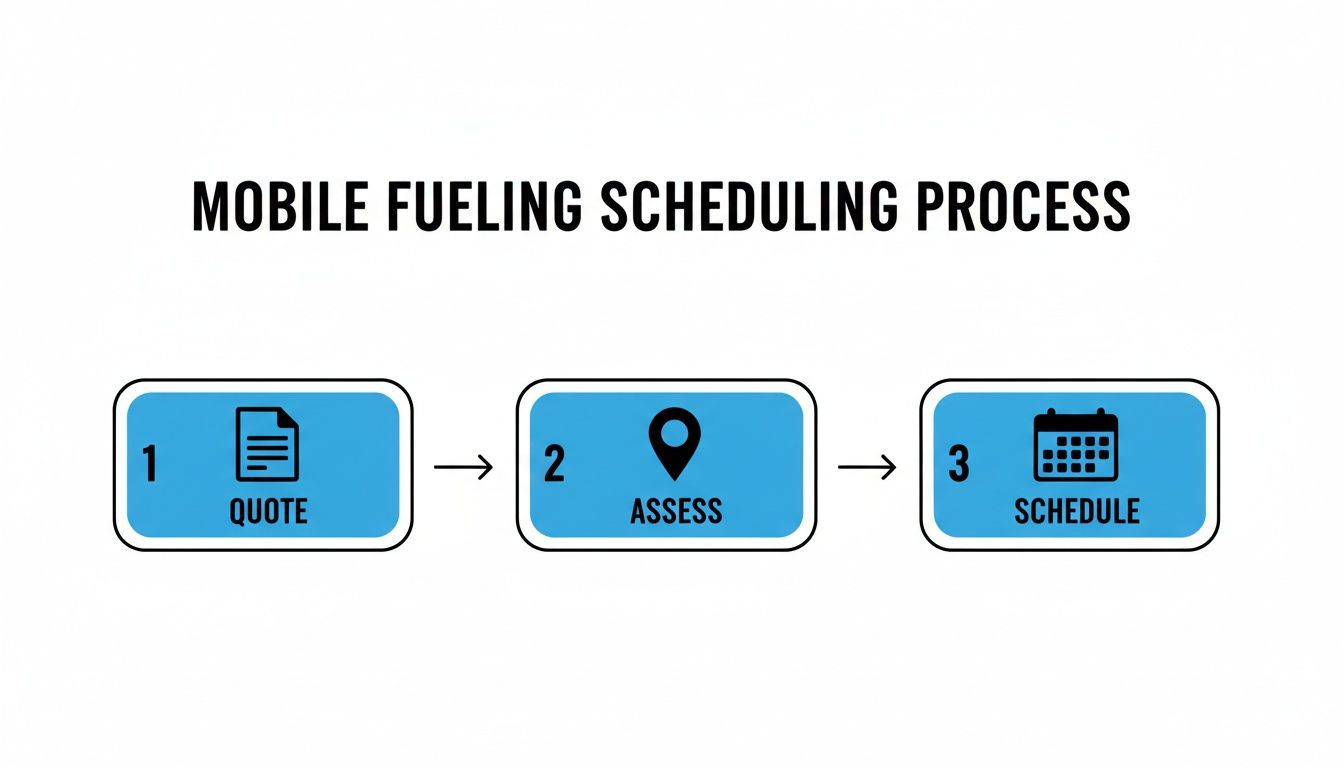
As you can see, it breaks down into three clear phases. It all starts with a simple request and moves logically toward a fully customized and scheduled service.
From Site Assessment to First Fill
Once you’ve talked through the numbers and have a quote, the next move is a site assessment. This is a non-negotiable safety and logistics check. The mobile fueling provider needs to be sure their delivery vehicle can get in, get the job done safely, and get out without any issues.
They’ll be looking at practical things like:
- Does the yard have a sufficient turning radius for a tanker truck?
- Is there a designated, level area where the truck can park during fueling?
- Can they access your vehicles without blocking your other operations?
Pro Tip: Before the assessment team even arrives, walk your yard and pick out what you think is the best spot. An area that's well-lit and away from the main traffic flow is ideal. Pointing this out shows you're on top of things and can really speed up the approval.
After your site gets the green light, all that's left is to get on the schedule. You can set up recurring deliveries based on what your fleet needs—daily, every few days, or just weekly. The whole point is to create a "set it and forget it" system. Your drivers stop worrying about finding a "CNG station near me," and the fuel just shows up, right on time, every time.
The Market Forces Driving the Shift to CNG
The rapid expansion of CNG fueling options isn't just happening by chance. It’s a direct response to some major economic and regulatory shifts that are completely changing the transportation game. If you’re a fleet manager, getting a handle on these trends confirms one thing: switching to CNG is a smart, long-term investment, not just a quick fix.
A huge piece of the puzzle is the constant tightening of emissions standards. Governments around the world are getting serious about air quality, and diesel engines are right in the crosshairs. This puts a ton of pressure on fleets to find cleaner alternatives, and CNG fits the bill perfectly as a practical, compliant fuel.
At the same time, we're seeing a massive corporate push for sustainability. Companies are setting big ESG (Environmental, Social, and Governance) goals, and their fleet's carbon footprint is a major part of that equation. Moving vehicles over to CNG is a concrete, reportable way to cut down on emissions and build a reputation as an environmentally conscious company.
The Economic Case for Natural Gas
Beyond the green credentials and regulatory hoops, the numbers just make sense. We’ve all seen how the price of diesel can swing wildly based on global oil markets, making it a nightmare to budget for. Natural gas, on the other hand, is a domestic resource with much more predictable pricing.
That stability means you can actually forecast your operational costs and see a lower total cost of ownership over the lifespan of your vehicles. For any business where fuel is a significant line item, that kind of predictability is a massive strategic win.
The proof is in the market's growth. In 2023, the global compressed natural gas market was valued at a staggering USD 159.87 billion. It’s expected to more than double, hitting USD 344.60 billion by 2030, all thanks to this growing demand. For a deeper dive into these numbers, the analysis from Grand View Research is an excellent resource.
What we're seeing is a powerful trifecta pushing CNG forward: intense regulatory pressure, a real commitment to corporate responsibility, and a clear-cut economic advantage. This is exactly what's fueling the expansion of both permanent and mobile CNG infrastructure, making your search for "CNG fueling near me" easier every single year.
Got Questions About Mobile CNG? We've Got Answers.
When you're exploring alternatives to the public "CNG near me" search, a few practical questions always pop up. We hear them all the time from fleet managers and site supervisors who are right on the edge of making a change.
Getting clear, straightforward answers on things like fuel quality, safety procedures, and contract terms is what gives you the confidence to move forward. Let's tackle the big ones head-on.
Is Mobile-Delivered CNG the Same Quality as Station Fuel?
Absolutely. This is probably the most common question we get, and the answer is simple: yes. The compressed natural gas delivered by a mobile service like Blue Gas Express comes from the very same utility pipelines as the gas at a fixed public station. It's the same fuel, just delivered differently.
We use sophisticated compression equipment and follow the same strict industry standards for purity and performance. Your engines won't know the difference, but your bottom line and your daily schedule certainly will.
What Are the Safety Protocols for Mobile Fueling?
Safety is everything. Mobile fueling operations are governed by rigorous protocols, and frankly, they often have to be even stricter than a self-serve public station because we're operating on your property.
Before we ever bring a truck to your site, we conduct a thorough site assessment. It’s non-negotiable.
- We check for safe access: Is there a clear, safe path for our delivery vehicle to get in, park, and get out without issue?
- We establish a staging area: We’ll work with you to designate a specific spot that's level, well-ventilated, and far from any potential ignition sources.
- Our technicians are certified pros: Fueling is only ever handled by highly trained experts who live and breathe this stuff. They follow a precise checklist for grounding, connecting, and monitoring every single fill.
The biggest advantage here is control. In your own yard, you control the environment. There’s no public traffic, no other customers, and the entire process is managed by a single, accountable team from start to finish. It's inherently a more controlled and predictable process.
How Flexible Are the Contracts?
Nobody wants to get stuck in a rigid, long-term contract that doesn't fit their business. We get it. Fleet needs are anything but static—a construction project might wrap up early, or you might suddenly win a new municipal contract. Flexibility is the name of the game.
Mobile fueling agreements are built around your actual needs. The terms are designed to let you adjust volume and frequency. You can scale up during your busy season and pull back when things are slower. The whole point is to build a partnership that works for you, not an ironclad agreement that holds you hostage. That initial conversation is all about your operational reality, ensuring the plan we build makes sense from day one.
And you can feel confident in this strategy long-term. With government policies and environmental regulations pushing for cleaner fuels, the market is booming. Forecasts predict the global CNG market could grow to anywhere from USD 132.32 billion to USD 344.60 billion in the next decade, with growth rates hitting as high as 11.8%. Stricter emissions rules are only going to speed things up. For more details, you can check out analyses of the competitive landscape of the global CNG market. This isn't a temporary trend; it’s a secure, forward-thinking move for your fleet.
Ready to end the search for "CNG fueling near me" for good? Blue Gas Express brings the fuel directly to your fleet, saving you time and money. Get a customized mobile fueling quote today!