

Yes, you can absolutely install a CNG filling station at home, but let's be clear: this isn't like installing a new appliance. It’s a serious undertaking that involves a hefty initial investment, a pretty complex installation process, and a web of safety regulations you'll need to navigate.
Frankly, it's a solution best suited for small commercial fleets that return to a central base every night. For the average homeowner, it's usually overkill. This guide will walk you through the real-world considerations to help you decide if the convenience and fuel savings are worth the significant hurdles.
Is a Home CNG Filling Station Right for You?
Picture this: you run a small fleet of five service vans. Every day, your drivers waste time and burn fuel just to get to a public CNG station. What if you could turn that overnight downtime into refueling time? A dedicated station at your home or business could be a game-changer, ensuring every vehicle is topped off and ready to go by morning.
Of course, this level of convenience doesn't come cheap, and it depends on a few non-negotiable factors. You'll need access to a high-capacity natural gas utility line and a solid electrical service—we're talking 240V, not your standard outlet. You also need a safe, well-ventilated space to house the compressor and other equipment.
This is not a weekend DIY project. You’ll be working with certified professionals who know how to handle the permitting process, local zoning laws, and critical safety codes like the NFPA 52 standard for vehicular fuel systems.
Weighing the Pros and Cons
The biggest draw here is the long-term savings on fuel. Compressed natural gas is almost always cheaper than gasoline or diesel—often by as much as 40-50%. If you have a fleet racking up serious mileage, those savings can add up fast and eventually offset the initial setup cost. Don't forget the operational efficiency you gain by cutting out those daily trips to public stations.
But the upfront cost is a major hurdle. A reliable compressor unit can set you back thousands of dollars, and that's just for the hardware. You still have to pay for professional installation, site prep, and all the necessary permits. It’s a significant financial decision that requires careful thought.
To make this a bit clearer, here's a quick rundown of what you're looking at:
Home CNG Refueling at a Glance
| Factor | Advantages | Challenges |
|---|---|---|
| Cost | Significant long-term fuel savings (40-50% less than gasoline/diesel). | High upfront investment in equipment, installation, and permits. |
| Convenience | On-site refueling eliminates trips to public stations, saving time and labor. | Requires dedicated space, 240V electrical, and a robust gas line. |
| Operations | Vehicles can refuel overnight, maximizing uptime and daily productivity. | Slower fill times compared to commercial stations (often overnight fills). |
| Installation | Permanent, reliable fuel source tailored to your fleet's needs. | Complex process requiring certified professionals and navigating strict safety codes. |
Ultimately, this table shows that a home CNG station is a strategic business decision. It demands a thorough cost-benefit analysis where you weigh the high initial investment against your fleet's specific fuel consumption and daily routes.
The key takeaway is simple: while technically possible, installing a home CNG station is a strategic business decision. It demands a thorough cost-benefit analysis comparing the high initial investment against your specific fleet's fuel consumption and operational patterns.
Understanding the Bigger Picture
The idea of home CNG refueling is part of a larger trend toward decentralized energy. The global market for natural gas filling stations was valued at $2.22 billion, largely because CNG is easier to store and more cost-effective than diesel, making it a great fit for urban fleets and potentially, residential use.
In the U.S. alone, there are over 1,300 CNG stations, and 46% of them cater to heavy-duty trucks. This shows a proven model of accessibility that could, one day, trickle down to our driveways. You can find more insights about the natural gas refueling market and its projected growth online.
Before you go all-in on a permanent setup, it's crucial to consider more flexible alternatives. For many businesses, especially those with temporary projects or unpredictable fuel needs, mobile CNG delivery services offer a much more practical and cost-effective solution without the long-term commitment. We'll explore all your options so you can make the smartest choice for your operation.
Understanding the Core Equipment and Infrastructure
Getting into the hardware for a home CNG setup can feel a bit overwhelming, but it boils down to one key piece of machinery: the CNG compressor. This is the real workhorse of your system. It takes the low-pressure natural gas already piped into your home or business and pressurizes it to the high levels your vehicle needs.
Think of it as a supercharged version of a workshop air compressor. It taps into your existing gas line, compresses the gas to around 3,600 psi, and then feeds it through a specialized hose directly into your vehicle's tank. That's the magic—turning your standard utility gas into a powerful, clean transportation fuel.
Slow-Fill Versus Fast-Fill Systems
The first big decision you'll make is choosing between a slow-fill and a fast-fill system. This choice really sets the stage for the cost, complexity, and physical space your setup will require.
A slow-fill system is what nearly everyone uses for home or small fleet applications. These units are designed to do their work over several hours, usually overnight. They're compact, surprisingly quiet, and connect right to your gas line without needing bulky high-pressure storage tanks. Imagine a small business with five delivery vans. The drivers come back, plug in the hoses, and by morning, every vehicle is fully fueled and ready to go. It’s simple and efficient.
On the other hand, a fast-fill system is built to mimic a public gas station. It fills a vehicle in just a few minutes. How? It compresses gas ahead of time and stores it in massive, high-pressure "cascade" tanks. When a vehicle needs fuel, the system dumps that pre-compressed gas at a high flow rate. This is a far more complex and expensive setup that takes up a lot of space, making it practical only for commercial operations where vehicles are in constant rotation and can't be down for hours.
For a homeowner with one Natural Gas Vehicle (NGV) or a small business fleet that comes back to base each night, a slow-fill system is almost always the way to go. It hits the sweet spot between cost, space, and convenience for an overnight refueling schedule.
The Essential Supporting Cast
The compressor is the star, but it needs a solid supporting cast to work safely and effectively. A complete home CNG station includes a few other non-negotiable components:
- A Dryer and Filter System: This is crucial. Before the gas even gets to the compressor, it has to pass through a dryer to strip out any moisture and impurities. This single step protects the expensive internal parts of your compressor and, just as importantly, your vehicle's fuel system from corrosion and damage down the road.
- A Dispensing Hose and Nozzle: This isn't your garden hose. It’s a specialized, high-pressure hose built to handle CNG safely. It's paired with a purpose-built nozzle that clicks onto your vehicle's port to create a perfect, leak-proof seal.
- Safety and Monitoring Equipment: Modern systems are loaded with safety features. You’ll find automatic shut-off valves that react to pressure changes, emergency stop buttons, and often methane detectors that will kill the power and gas flow instantly if a leak is ever sensed.
The decision-making process for a home system really flows from your specific needs to the final setup, as this chart illustrates.
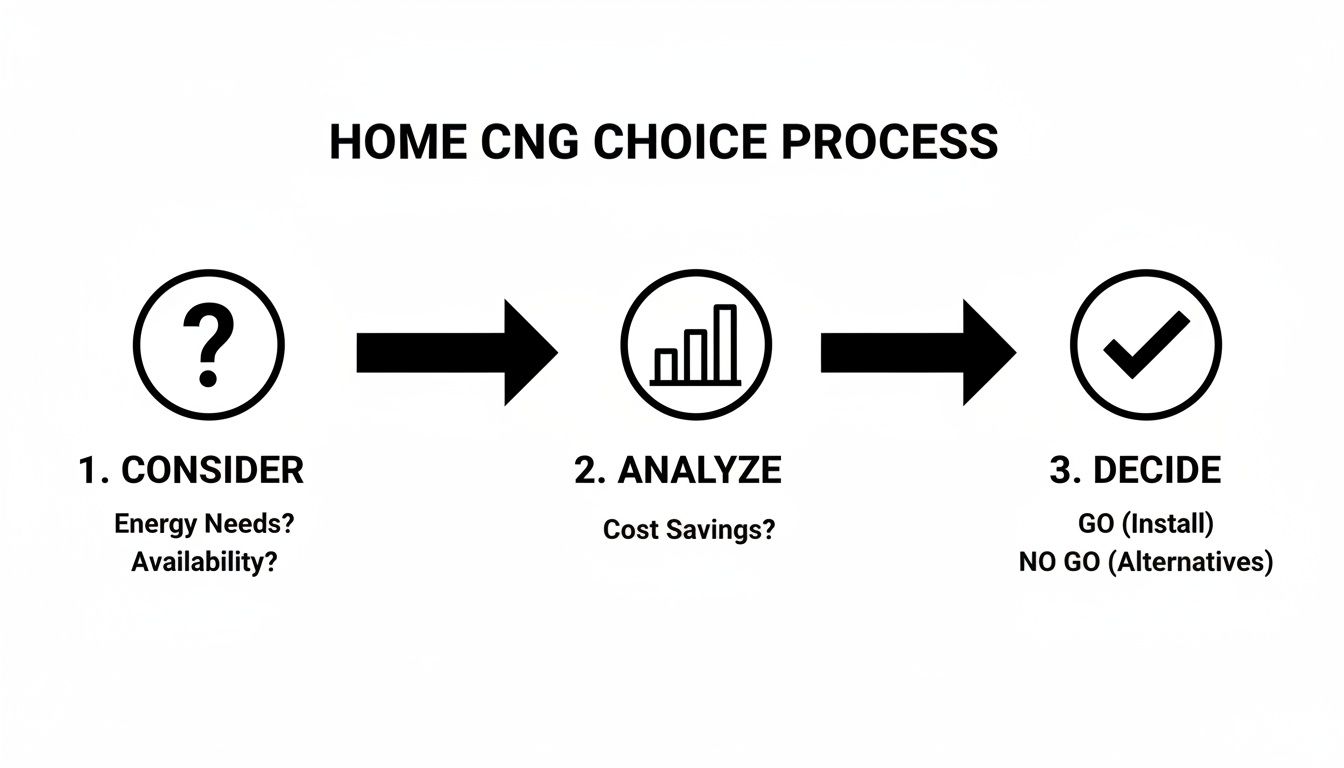
As you can see, a successful project starts with a clear-eyed look at your refueling habits long before you ever pick out the equipment.
Preparing Your Site for Installation
Getting your site ready is just as important as the equipment you choose. This isn't like installing a new washing machine; it's a serious infrastructure upgrade that requires planning. The first place to start is with your utilities.
Your compressor is going to need a dedicated 240V electrical circuit, the same kind of power an electric stove or a heavy-duty clothes dryer requires. A standard wall outlet won't cut it. You'll need a licensed electrician to run a new circuit from your main panel to wherever the compressor will live.
The natural gas supply is the next checkpoint. You absolutely have to get your local gas utility involved. They'll need to confirm that your service line has enough volume and pressure to run the compressor without starving your furnace or water heater. In some cases, they may need to upgrade your line from the street.
Finally, ventilation is a major safety priority. The compressor must be installed in a well-ventilated space to ensure that natural gas can never accumulate. This might be a roomy garage with good airflow, a dedicated outdoor shed, or even a secure enclosure on a concrete pad outside. Any experienced installer will help you pinpoint the best spot on your property that satisfies all local building and fire codes.
Navigating Permits, Safety, and Compliance
Let's be clear: installing a home or business CNG station is a serious undertaking, not a weekend DIY project. Think of it less like putting in a new appliance and more like adding a major utility service to your property. The whole process is governed by strict rules for a very good reason—the safety of you, your team, and your community. Navigating it correctly is absolutely non-negotiable.
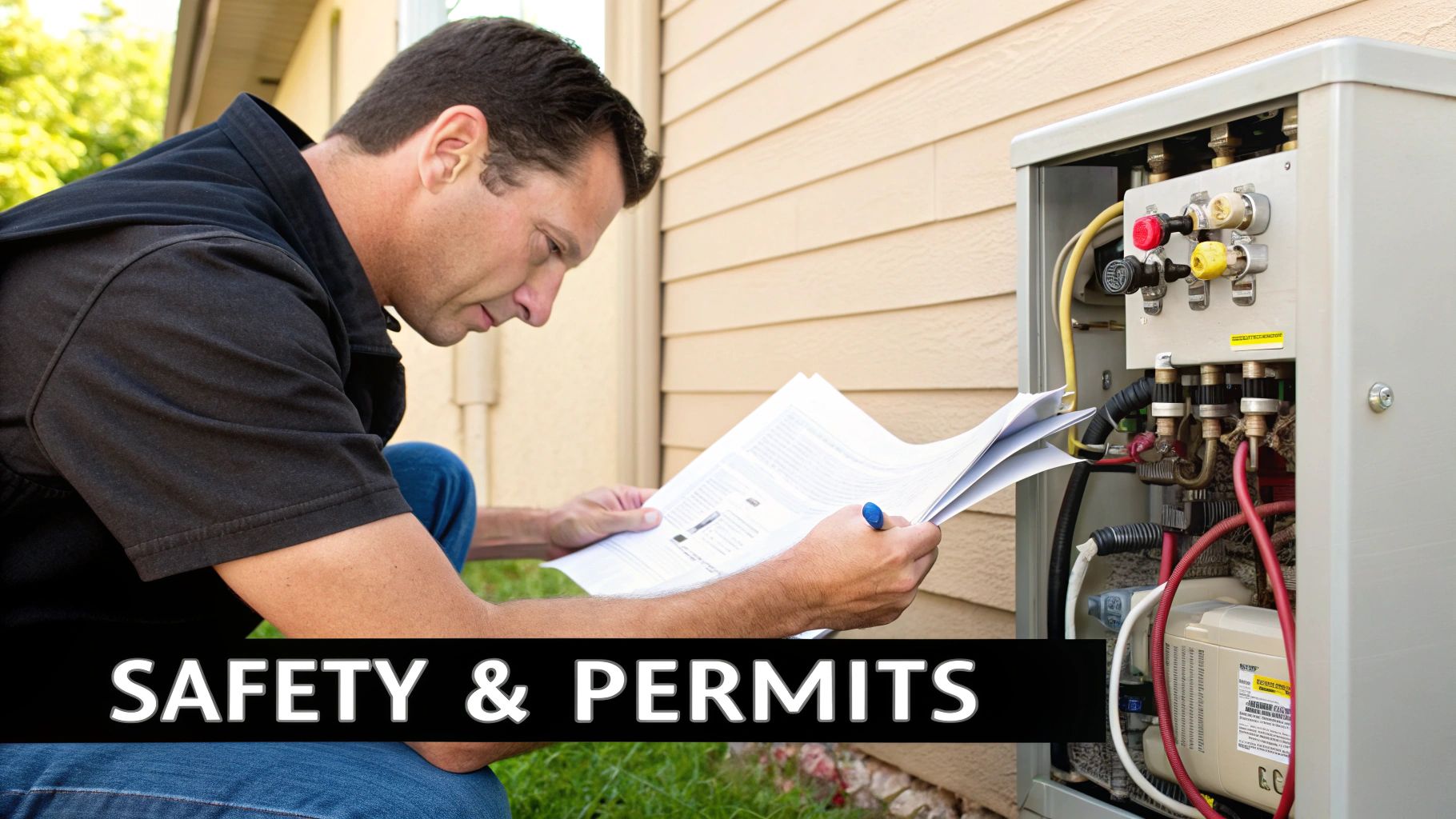
The journey starts long before any equipment shows up. Your first move is to dive deep into local regulations. This means getting on the phone with your municipal planning or zoning department to confirm that this kind of equipment is even allowed. Imagine the nightmare of spending thousands on a compressor, only to find out your property isn't zoned for private fueling infrastructure. It's a costly mistake, and it's entirely avoidable.
Once you clear that hurdle, your next stops are the local building department and the fire marshal. Each will have its own checklist of requirements you'll need to satisfy.
The Gatekeepers of Safety
Your certified installation partner will be your guide through this regulatory maze, but it's crucial for you to understand who the key players are and what they're looking for. This isn't just about getting a stamp of approval; it’s a collaborative effort to ensure a safe, compliant setup.
- Local Building Authority: They’ll be looking at your site plan to make sure the installation meets all structural and electrical codes. This includes checking for a proper foundation for the compressor and verifying that the dedicated 240V circuit is installed correctly by a licensed electrician.
- Fire Department: The fire marshal's job is all about preventing fires and ensuring emergency access. They'll scrutinize the equipment’s location to ensure it meets setback requirements—that is, minimum distances from buildings, property lines, and any potential ignition sources. They’ll also want to see proper ventilation and know exactly where the emergency shut-off valves are.
- Gas Utility Company: Before you can tap into their gas line, the utility company has to give the green light. They need to be sure your system won't negatively impact their grid and that the connection itself is made safely by a certified pro.
This whole process really underscores why you must work with installers who live and breathe standards like NFPA 52, the Vehicular Natural Gas Fuel Systems Code. This is the gold standard for CNG installations, and compliance isn't optional.
Your Safety Non-Negotiables
Beyond the paperwork, the physical safety hardware of your system is your frontline defense. Modern CNG filling stations are packed with multiple layers of protection that work automatically behind the scenes. Knowing what these are will give you real peace of mind.
Key safety components you should expect to see:
- Methane Detectors: These sensors are constantly sniffing the air. If they detect even a tiny amount of natural gas, they instantly trigger an alarm and shut the entire system down—cutting off both the gas supply and electricity.
- Emergency Shut-Off Valves: You'll often hear these called "E-stops." They are large, obvious buttons placed in easy-to-reach spots. One push will immediately halt the compressor and stop the gas flow in an emergency.
- Pressure Relief Devices: These are purely mechanical safeguards. They physically prevent the system from ever exceeding its maximum safe operating pressure, acting as a critical failsafe.
Before you even begin, it’s a smart move to get a handle on the potential dangers. Learning how to do a risk assessment helps you spot and manage these hazards, creating the foundation for a solid safety plan.
"Cutting corners on compliance isn't just risky; it's a recipe for disaster. A properly permitted and professionally installed system is the only way to ensure long-term safety and reliability for your on-site CNG refueling."
Ultimately, safety and compliance are two sides of the same coin. The permitting process verifies that your system is designed and installed the right way, while the onboard safety features and a consistent maintenance schedule ensure it keeps running safely for years to come. This diligent approach protects your investment, your property, and most importantly, your people.
Analyzing the True Cost of Home CNG Refueling
Figuring out the real price of a home CNG filling station goes far beyond the initial quote for the equipment. The total investment is a blend of the hardware itself, the skilled labor to install it, any necessary upgrades to your property, and the costs to keep it running. Looking at each piece of the puzzle is the only way to build a realistic budget and see what your long-term savings will actually be.
The compressor is, without a doubt, the single biggest upfront cost. Its price tag can swing wildly depending on its capacity and features. A basic slow-fill unit, perfect for a single car, might start around a few thousand dollars. But if you’re looking to refuel multiple vehicles, the more powerful systems can easily climb into the tens of thousands.
Breaking Down the Upfront Investment
Once you have a price for the compressor, there are several other critical, one-time costs to factor in. Professional installation isn't optional—this is specialized work involving high-pressure gas lines and electrical systems that must be handled by certified technicians to ensure everything is safe and up to code.
Your property might need some work, too. Many of these systems demand a dedicated 240V circuit, which means you’ll be calling an electrician to run new wiring from your main panel. If your existing natural gas line doesn’t have enough pressure, you’ll also be talking to your local utility company about an upgrade, and that comes with its own fees.
- Permitting Fees: Expect to work with your local municipality. They'll require permits for the electrical, gas, and any structural work to make sure every part of the installation gets inspected and signed off.
- Site Preparation: This could be as simple as pouring a concrete pad for the compressor or as involved as building a protective enclosure and improving ventilation in your garage.
When you're trying to nail down the true cost of setting up a home CNG station, you have to account for every installation expense, including groundwork or structural changes. For this part of the job, using a sophisticated estimating tool to accurately map out materials and labor can be a huge help. For instance, you could explore how an advanced platform like Exayard AI construction takeoff software can generate precise cost estimates for your project's construction needs.
Estimated Cost Breakdown for Home CNG Systems
To put some real numbers to this, let's compare the typical costs for a small residential system against a more robust setup designed for a small commercial fleet. Keep in mind, these are ballpark figures and will definitely change based on where you live and what your property needs.
| Cost Component | Slow-Fill System (Residential) | Fast-Fill System (Small Commercial) |
|---|---|---|
| Compressor Unit | $4,500 – $8,000 | $15,000 – $30,000+ |
| Installation & Labor | $2,000 – $5,000 | $5,000 – $10,000 |
| Electrical Upgrades | $500 – $2,000 | $1,500 – $4,000 |
| Permits & Fees | $500 – $1,500 | $1,000 – $3,000 |
| Site Prep / Enclosure | $500 – $3,000 | $2,000 – $7,000 |
| Estimated Total | $8,000 – $19,500 | $24,500 – $54,000+ |
As you can see, the leap from a personal setup to one that can handle even a small fleet is significant, impacting nearly every line item.
Accounting for Ongoing Expenses
Your investment doesn't end when the installation is complete. There are two main ongoing costs to bake into your budget: electricity and maintenance. That compressor is a powerful piece of machinery, and it will draw a fair bit of electricity while it runs, usually overnight. You'll see that on your monthly utility bill.
Regular maintenance is also absolutely critical for keeping the system safe and extending its life. This means routine filter changes, system inspections, and having a qualified technician service it periodically. It’s smart to budget for an annual service call to ensure your equipment stays in top shape for years.
The numbers show that home CNG is a smart move, especially since public infrastructure isn't keeping up with vehicle adoption. The U.S. has 1,385 CNG stations—just a 2% increase—and only 53% of those are open to the public. Meanwhile, the global market for CNG stations hit $8 billion in revenue and is projected to reach $13 billion by 2030. It’s a growing industry, and home refueling is where the real convenience lies.
Calculating Your Return on Investment
Ultimately, the reason to do all this is the return on investment (ROI). The math here is pretty simple: divide your total upfront cost by what you save on fuel each year. This tells you exactly how many years it will take for the system to pay for itself.
For example, if your total installation comes to $15,000 and you're saving $5,000 a year compared to what you spent on gasoline, your payback period is just three years ($15,000 / $5,000). After that, every dollar you save on fuel is pure profit. This is the bottom-line analysis that will tell you if the big initial investment makes financial sense for you.
When Mobile CNG Solutions Are the Smarter Choice
Let's be honest, a permanent CNG fueling station isn't the right fit for everyone. The steep upfront cost, the headache of site prep, and the long-term commitment just don't make sense for many operations. This is exactly where a more nimble approach—mobile CNG solutions—really shines.
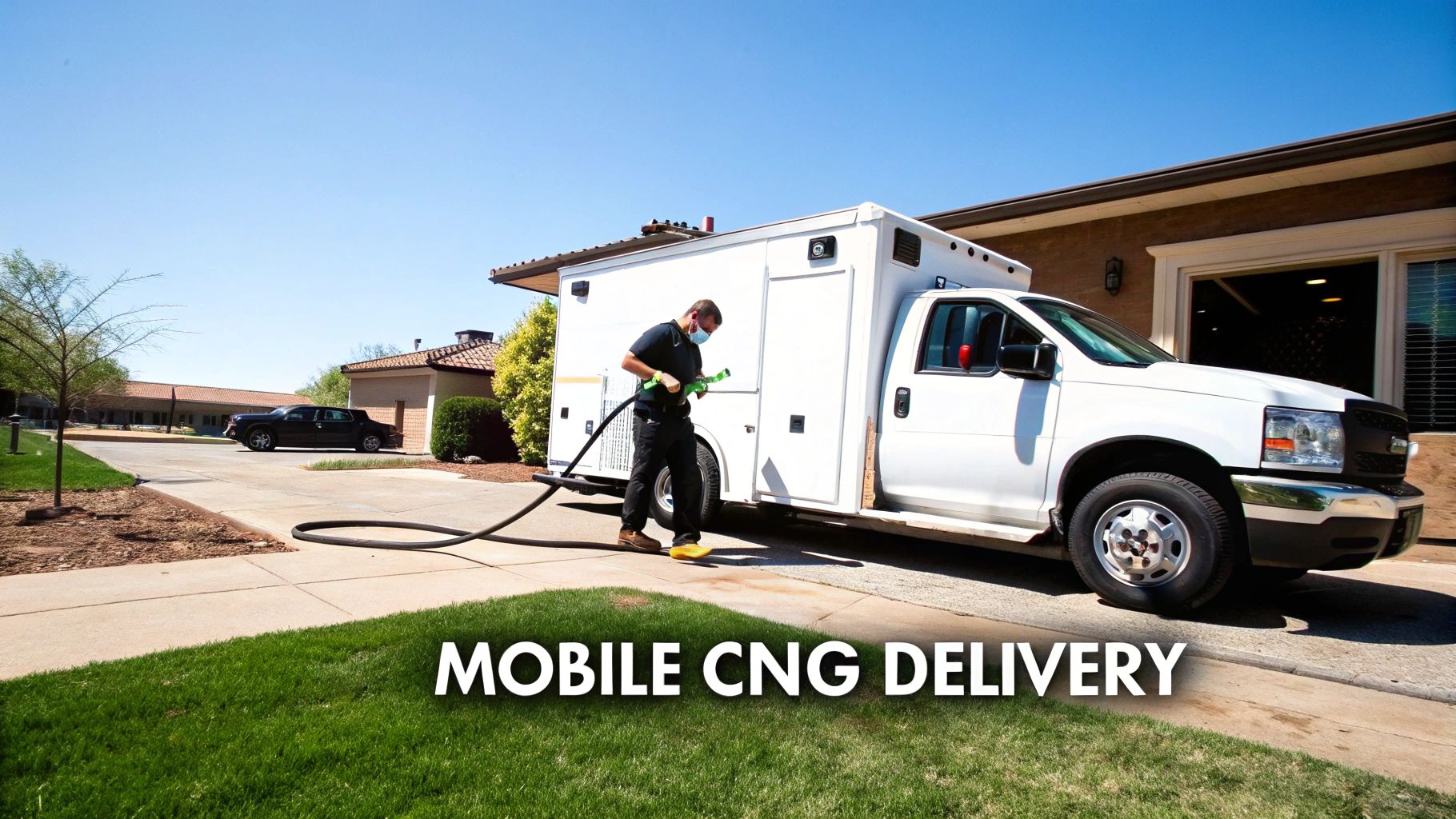
Think about a new housing development going up. The crew needs a steady supply of natural gas to run temporary heaters for curing drywall in the winter, but the permanent utility lines won't be live for months. Tearing up the ground to install a permanent station is a non-starter. This is a perfect job for mobile CNG delivery. A self-contained unit gets dropped on-site, provides the gas exactly when and where it's needed, and disappears once the job is done.
Bypassing Permanent Infrastructure Hurdles
One of the biggest wins with mobile CNG is that you get to skip the capital investment and permitting maze entirely. Instead of wrestling with zoning laws, building codes, and fire marshal inspections, you simply have fuel delivered as a service. It's a game-changer for any business with temporary or urgent energy needs.
Picture a factory facing an unexpected pipeline shutdown for maintenance. Halting production isn't an option. Mobile CNG units can be rolled out fast to keep boilers and other critical equipment humming along, bridging the gap until the main supply is back online. You don't buy any hardware, pour any concrete, or worry about long-term upkeep.
This on-demand model is all about energy resilience. Mobile CNG delivery effectively turns natural gas from a fixed utility into a flexible resource you can deploy anywhere, keeping your operations running without the heavy baggage of ownership.
This flexibility is also crucial for businesses whose fuel needs swing wildly. A mobile solution lets you scale your gas supply up or down on the fly, so you only pay for what you actually use. It’s a smart, lean strategy for companies that need to stay agile.
Ideal Scenarios for Mobile CNG Delivery
While a permanent station makes perfect sense for a large, established fleet with predictable routes, mobile solutions are built for situations driven by urgency, temporary needs, or general unpredictability. Their value becomes crystal clear when a permanent setup is either impractical or impossible to justify financially.
Here are a few classic examples where mobile CNG is the go-to:
- New Construction Projects: Powering temporary heat or generators before the permanent utility lines are connected.
- Emergency Backup: Keeping industrial plants online during natural gas pipeline outages.
- Seasonal Operations: Fueling agricultural equipment like crop dryers during harvest, without the dead weight of year-round infrastructure.
- Remote Job Sites: Powering equipment and generators in locations miles away from the nearest gas pipeline.
This approach is a lifesaver for construction firms and builders who can’t afford to wait on delayed gas line installations. For instance, mobile units from providers like Blue Gas Express are common sights in the Carolinas and Virginia, helping projects stay on track.
While personal home CNG is still a niche market—only 53% of U.S. stations are public—these mobile commercial services show a growing hunger for accessible natural gas. It's a win for sustainability, too. CNG vehicles produce 20-30% less CO2, and with 51% of stations now offering renewable natural gas (RNG), mobile delivery is a fantastic way to bring cleaner energy to more job sites. You can learn more about the growth of clean transport solutions and the impact they're having.
Making the Right Choice for Your Operation
So, how do you decide? It really boils down to your operational timeline and financial strategy.
A permanent station is a long-term asset. It’s the right call for a business with a stable, high-volume fleet that can absorb the upfront investment and see a clear return over several years.
On the other hand, a mobile solution is an operational expense. It’s perfectly suited for short-term projects, emergencies, or any time when protecting capital and moving fast are your top priorities. It gives you immediate access to CNG without the financial and logistical headaches, making it the smarter, more cost-effective choice for a huge range of commercial needs.
Your Top Questions About Home and Mobile CNG, Answered
Once you start looking into CNG refueling, whether it's a permanent setup at your base or relying on mobile delivery, some very practical questions always surface. Let's tackle the most common ones I hear from fleet managers and business owners to clear up any confusion and help you decide which path makes the most sense for your operation.
Think of this as the final checklist before you commit. We'll get straight to the point, so you can move forward with confidence.
How Long Does It Really Take to Refuel a Vehicle with a Home CNG System?
This is probably the most important thing to get your head around, as it’s a big shift from a gas station pump. Your typical home or small fleet cng filling stations at home are what we call slow-fill systems. They’re designed to do their work over several hours, not minutes.
You can expect a full fill-up to take anywhere from 4 to 10 hours. The exact time depends on your vehicle's tank size and the output of your specific compressor unit.
But here’s the key: that’s not a bug, it’s a feature. The whole system is built around the idea of overnight refueling. Your vehicles are sitting idle anyway, right? This process transforms that downtime into productive, automated refueling time. Your drivers park, plug in, and in the morning, every vehicle is full and ready to hit the road. No waiting, no manual oversight needed.
Can I Just Install a Home CNG Station Myself?
Let me be crystal clear on this one: absolutely not. This isn't like installing a new appliance or tackling a weekend project. Installing a CNG station is a highly specialized job that must be handled by certified, licensed professionals.
You're simultaneously working with two systems that are unforgiving of mistakes: high-pressure natural gas lines and dedicated high-voltage electrical circuits. A single improper connection could lead to a gas leak, fire, or worse.
A certified professional is non-negotiable. It’s the only way to ensure the system is installed safely, complies with all local codes (like NFPA 52), and keeps your manufacturer's warranty valid. Trying to install it yourself will instantly void that warranty.
What Happens if My Natural Gas Service Gets Interrupted?
That's a smart question and a valid concern for anyone depending on a single fuel source. If your utility company has an issue and your natural gas supply is cut off, your CNG compressor won't be able to run. But for most fleets, this is more of a minor inconvenience than a business-stopping catastrophe.
Why? Because the vast majority of vehicles converted to run on CNG are set up as bi-fuel systems. This means they can run on either natural gas or regular gasoline with just the flip of a switch. This bi-fuel capability is your built-in safety net. If the gas ever goes out, your operations don’t grind to a halt. Your drivers simply switch over to gasoline and carry on with their routes.
How Much Space Does a Home CNG Compressor Actually Take Up?
People are often surprised by how compact these units are. You’re not installing the massive equipment you see at a public truck stop. The physical footprint of a slow-fill CNG compressor is roughly the size of a standard water heater or a small commercial freezer.
As part of any professional installation, the technician will perform a site survey to find the perfect spot. Their main considerations will be:
- Proper Ventilation: To ensure natural gas can never accumulate.
- Safety Clearances: Meeting all setback requirements from buildings, ignition sources, and property lines.
- Utility Access: Making the connection to your gas and electrical lines as straightforward as possible.
Common spots include the corner of a well-ventilated garage, a dedicated outdoor shed, or a secure enclosure on a small concrete pad. Your installer will work with you to find the safest, most efficient location that checks all the regulatory boxes.
Is Mobile CNG Delivery a Realistic Option for a Single Homeowner?
For the most part, no. Mobile CNG services are really built for commercial and industrial customers with significant fuel needs. The logistics and pricing are based on delivering large quantities of gas to power things like construction site heaters, manufacturing plants, or an entire fleet of trucks during a pipeline outage.
If you’re just a homeowner with a single natural gas vehicle, a permanent slow-fill station is by far the more practical and affordable solution. Calling in a mobile tanker would be serious overkill and simply wouldn't make financial sense. Mobile CNG really comes into its own for temporary, high-volume, or emergency needs where a fixed station isn't an option.
For commercial or industrial operations facing natural gas pipeline delays or maintenance outages, a permanent station might not be the answer. Blue Gas Express provides reliable, on-demand mobile CNG and LNG solutions across NC, SC, TN, and VA, ensuring your project stays on schedule. Learn more about our temporary natural gas services and get a quote today.