

A CNG at home fueling station is your own private refueling setup. It connects directly to the natural gas line already running to your property, turning that utility into a personal fuel pump for your compressed natural gas (CNG) vehicles.
Why a Personal CNG Fueling Station Makes Sense
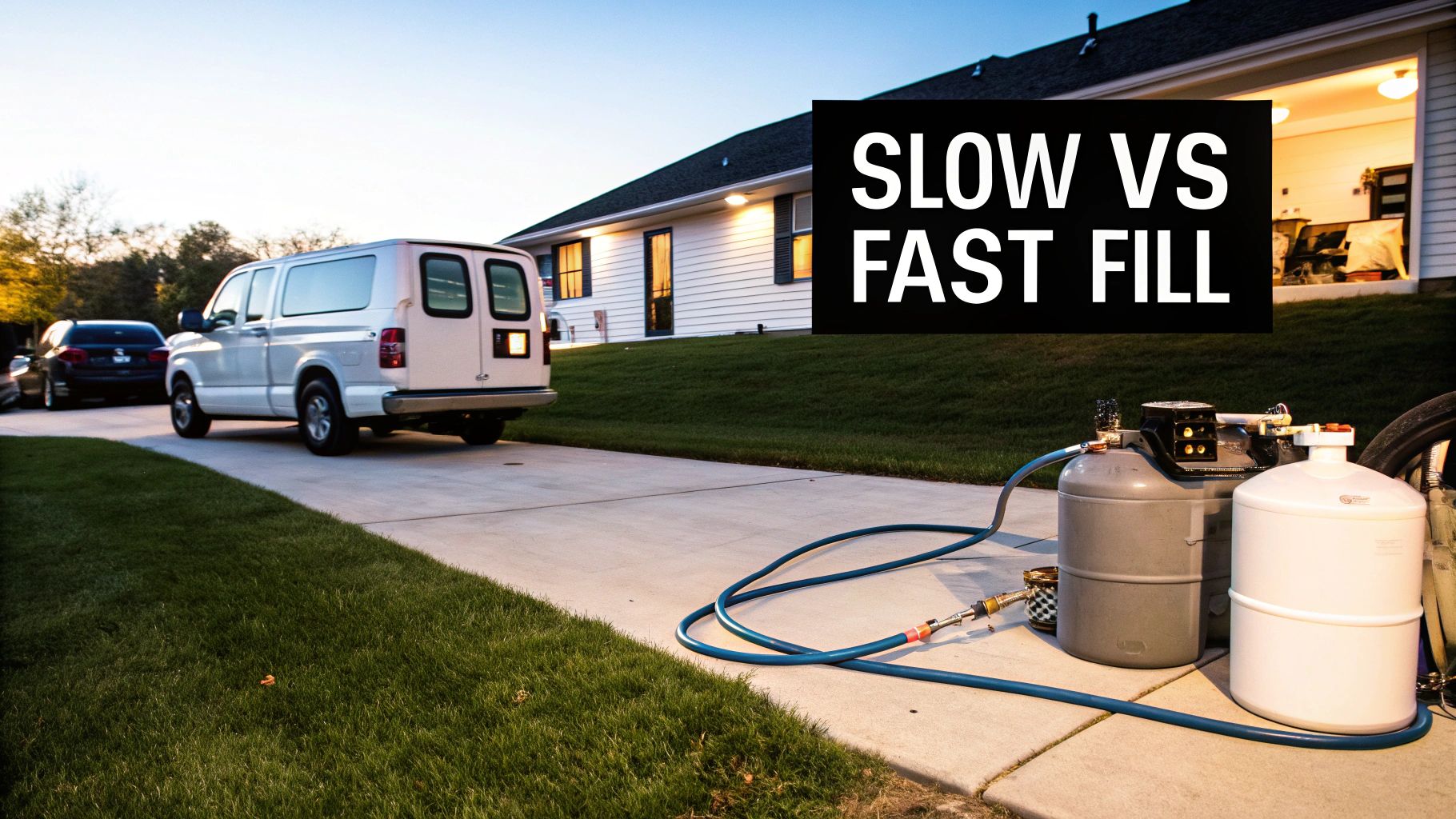
Picture having a cleaner, cheaper gas pump right in your own yard or at your business. For companies that run vehicle fleets in construction, logistics, or other industrial fields, this isn't a futuristic idea—it's a smart, practical move. A personal CNG fueling station is a powerful answer to unpredictable fuel prices and the hassle of finding public stations.
This shift to on-site fueling is all about taking back control. When you depend on public stations, you're at the mercy of their hours, locations, and whether the pumps are even working. An on-site system puts you in the driver's seat, cutting out wasted trips and making sure your fleet is fueled up and ready to roll when you are.
Gaining Control Over Fuel Costs and Operations
The financial upside is a huge part of the appeal. By installing your own station, you get access to the much lower and more stable price of natural gas, dodging the rollercoaster of gasoline and diesel prices. For instance, some businesses report paying an average of $1.10 per gallon equivalent for CNG—a massive savings compared to conventional fuels.
Think of it this way: owning your fueling station is like having a commercial coffee machine in the breakroom instead of paying for every employee to make a daily Starbucks run. The upfront cost starts paying you back pretty quickly through:
- Lower Fuel Bills: That consistent, lower per-gallon price makes a direct impact on your operational budget.
- Better Productivity: No more sending drivers on detours to refuel. That time is now spent on the job, where it counts.
- Smarter Fleet Management: You can refuel all your vehicles overnight, so every single one starts the day with a full tank, ready for work.
The biggest win here is predictability. By fueling from your property's natural gas line, you shield your budget from the wild price swings at the pump. This makes forecasting and financial planning a whole lot easier.
Bridging the Infrastructure Gap
As great as CNG is, the public station network can be sparse. A permanent CNG at home fueling station is the ideal long-term solution, but what do you do while you're navigating the planning, permitting, and construction? This is where temporary, mobile solutions are a game-changer.
For a construction site that doesn't have its utility lines in yet, or for a business in the middle of converting its fleet, mobile CNG suppliers can bring a "virtual pipeline" right to your doorstep. This service keeps your operations running smoothly without any interruptions, ensuring projects stay on schedule and avoiding expensive downtime. It makes the switch to CNG seamless, letting you reap the benefits of cheaper, cleaner fuel long before your permanent station is up and running.
Choosing Your System: Slow-Fill vs. Fast-Fill
When you're looking to set up your own CNG fueling station, the first big decision you'll face is whether to go with a slow-fill or a fast-fill system. This isn't just about how quickly you can top off a tank; it’s a choice that dictates your upfront cost, the complexity of the installation, and how you'll manage your fleet day-to-day. The right answer really comes down to how your vehicles operate.
The Slow-Fill Approach: Fueling While You Rest
Think of a slow-fill system like plugging in an electric vehicle overnight. It’s a slow, steady process designed for fleets that have predictable downtime, like delivery vans that return to the yard each evening. These setups use a smaller compressor to pull natural gas from your existing utility line and pump it directly into your vehicles over several hours.
This method is a perfect fit for any operation where vehicles are parked for long stretches, typically somewhere between 6 to 10 hours. Because the system compresses and delivers gas as needed without requiring massive high-pressure storage tanks, the whole installation is much simpler and easier on the budget.
The biggest wins with a slow-fill station are the lower initial investment and the less demanding infrastructure. You get to skip the hefty price tag and large footprint that comes with the high-pressure storage cascades essential for fast-fill systems.
Here’s what makes it attractive:
- Lower Upfront Cost: The equipment is less complex, which makes it a much more approachable option for smaller fleets or businesses keeping a close eye on capital expenses.
- Simpler Installation: With fewer major components to install, the setup is usually faster and causes less disruption to your daily operations.
- Reduced Strain on Utilities: The slow and steady draw of natural gas doesn't put a sudden, heavy load on your gas line, which often means you can avoid expensive utility upgrades.
For these reasons, slow-fill is a fantastic match for municipal fleets, school buses, and any service vehicles that run on a regular park-and-refuel schedule.
Ultimately, the choice comes down to whether you need the on-demand convenience of a public station or if the long-term control of an on-site system makes more sense for your logistics.
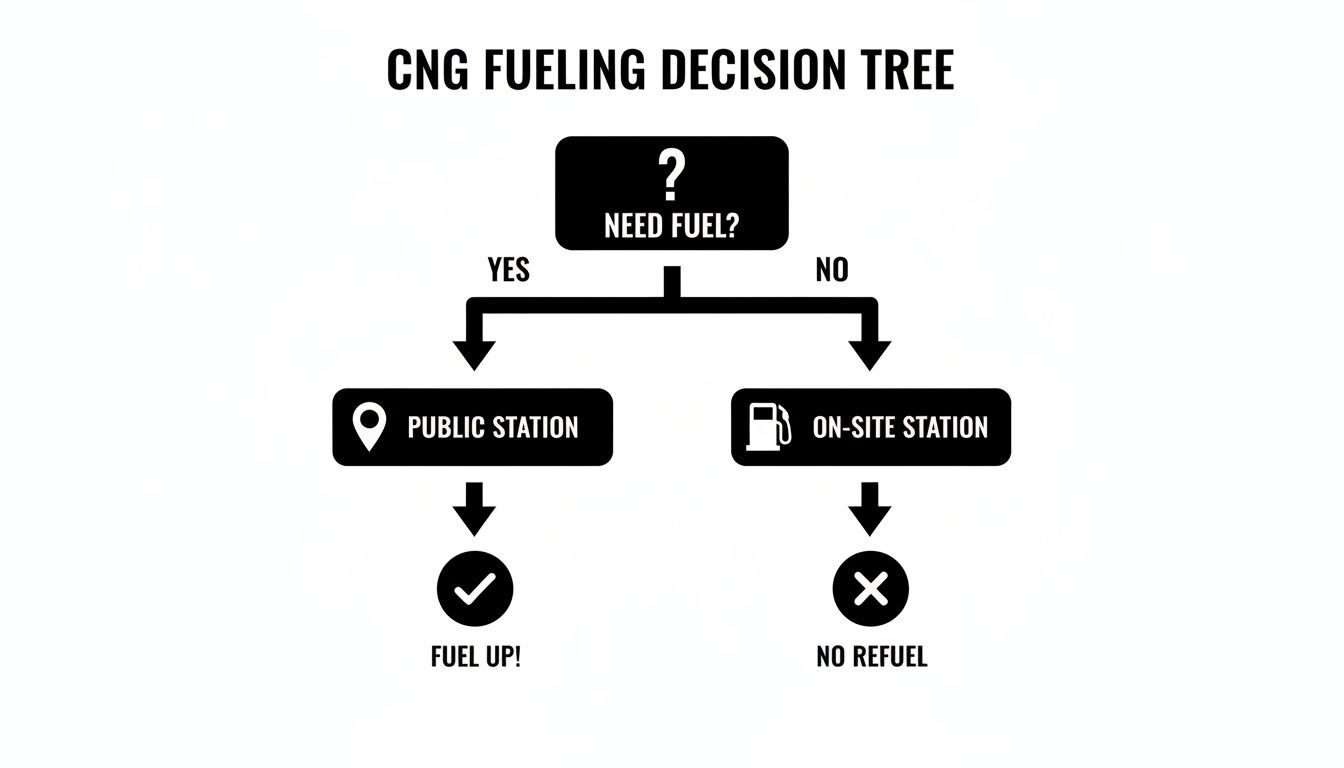
This decision tree really highlights the core benefit: an on-site station takes the daily scramble for public fueling completely out of the equation.
The Fast-Fill Alternative: When Speed is Everything
On the flip side, a fast-fill system is your equivalent of a traditional gas station. It’s all about speed, built to get a CNG vehicle refueled and back on the road in minutes—usually under 5 minutes for a standard car or truck. This kind of rapid turnaround is a must-have for operations like taxi services, short-haul trucking, or any fleet where vehicles can't afford to sit idle.
How does it work so quickly? Fast-fill stations use a much more powerful compressor to pressurize natural gas and store it in a series of large, high-pressure tanks known as a "cascade." When a driver pulls up, the dispenser draws gas directly from this ready-to-go reserve, delivering a huge volume of CNG in a very short time.
A fast-fill system prioritizes one thing above all else: speed. By keeping compressed natural gas stored and ready, it ensures your vehicles can refuel and get back to work with almost no downtime, just like they would at any commercial gas station.
But that convenience doesn't come free. The equipment—from the bigger compressor and the complex cascade storage to the high-flow dispenser—is significantly more expensive. The site prep is also a much heavier lift, often demanding a larger concrete pad, more robust electrical service, and sometimes a higher-capacity natural gas line from your utility provider.
While the public fueling network is growing, having your own system gives you unmatched control. It's estimated that by early 2026, the United States will have 1,385 CNG stations. The catch? Only 53% of them will be open to the public, leaving a huge gap for commercial and industrial users. A private station is the most direct way to serve the 120,000 natural gas vehicles on U.S. roads and bypass that public infrastructure crunch. You can read the full research on natural gas station growth to see just how vital private fueling is becoming.
Comparing Slow-Fill and Fast-Fill CNG Systems
To make the choice clearer, here’s a side-by-side comparison of the two main types of CNG fueling systems. This should help you quickly see which one aligns best with your fleet's operational needs and your budget.
| Feature | Slow-Fill System | Fast-Fill System |
|---|---|---|
| Refueling Time | 6-10 hours (overnight) | Under 5 minutes (on-demand) |
| Best For | Fleets with predictable downtime (e.g., buses, delivery vans) | High-turnover fleets (e.g., taxis, short-haul trucks) |
| Upfront Cost | Lower | Significantly higher |
| Infrastructure | Smaller compressor, no storage cascade, simpler site prep | Large compressor, high-pressure storage cascade, extensive site prep |
| Utility Impact | Low, steady draw on gas and electric lines | High-demand spikes requiring potential utility upgrades |
| Footprint | Smaller and more compact | Larger, requires significant space for equipment and tanks |
Each system has its place. Your decision will hinge on balancing the immediate need for speed against the long-term value and lower initial cost of a slower, more methodical fueling strategy.
What Goes Into a Home CNG Fueling Station?
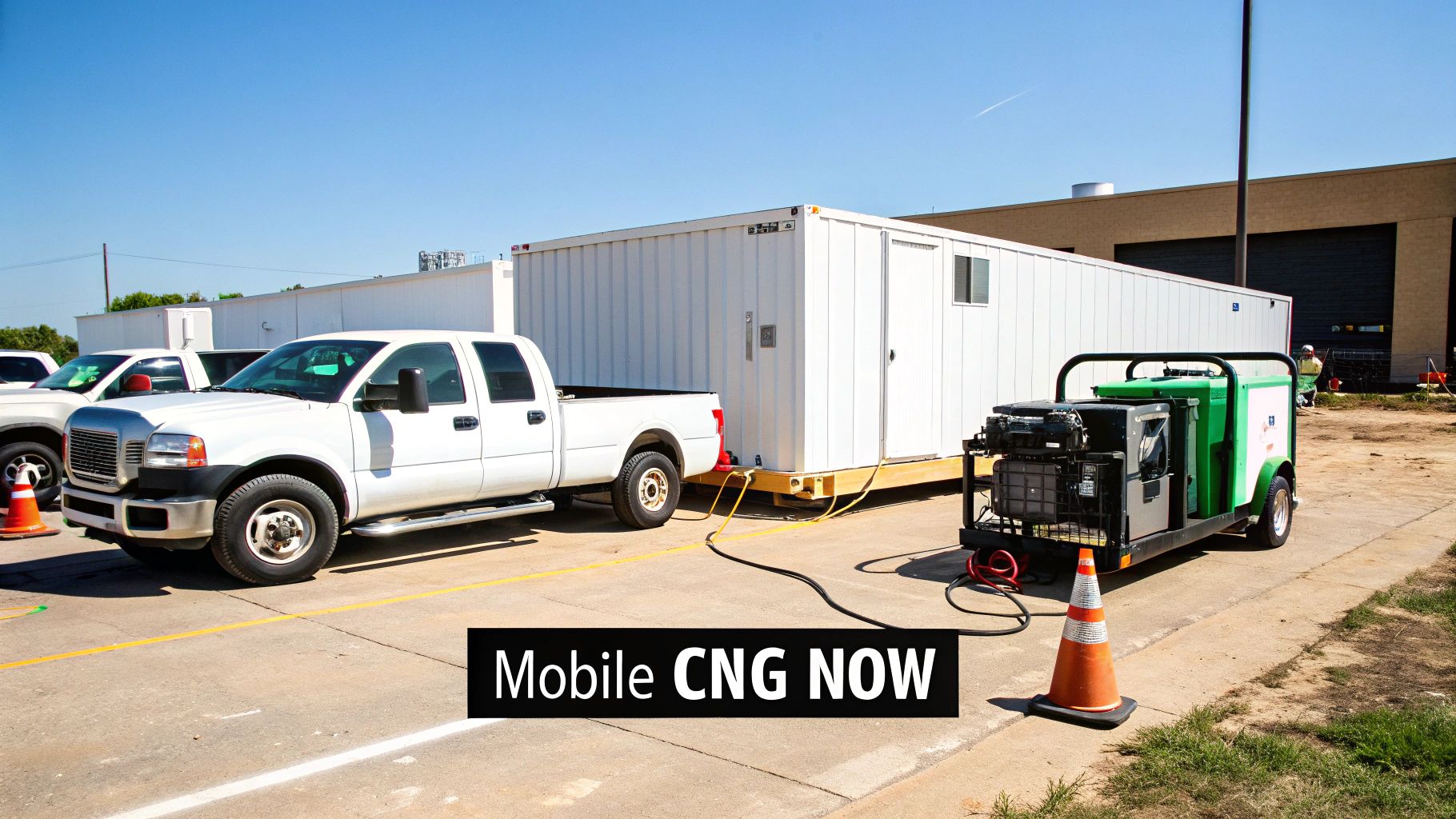
Turning the idea of a cng at home fueling station into a reality means getting familiar with the hardware. While the engineering is complex, the basic components are pretty straightforward. Each piece of equipment has a critical job to do, working together to safely convert the natural gas from your utility line into high-pressure vehicle fuel.
Think of it as your own personal, scaled-down fueling depot. It takes a standard utility resource and transforms it into a ready-to-use transportation fuel, right on your property. Let's walk through the essential machinery you’ll need.
The Compressor: The Heart of the System
The compressor is the absolute centerpiece of any private CNG station. It's the workhorse that does all the heavy lifting. Its function is simple to understand but incredibly powerful: it pulls in low-pressure natural gas from the utility main and squeezes it to extremely high pressures, typically between 3,000 and 3,600 psi, ready for your vehicle's tank.
You can think of it as a supercharged bicycle pump. Just as a pump forces air into a tire, a CNG compressor packs natural gas molecules incredibly tight, concentrating their energy. This is what allows you to store enough fuel in a vehicle to get a practical driving range. The compressor's size and power are the main factors that determine whether you'll have a slow-fill or a fast-fill setup.
These units are becoming more and more common as businesses look for ways to control their fuel supply. The global market for CNG compressors was already at USD 3.7 billion in 2023 and is projected to hit USD 5.6 billion by 2032. This isn't just a niche product; it's a key piece of the puzzle for fleets aiming for energy independence. You can see more on the growth of the CNG compressor market and what's driving it.
Critical Support Equipment
Beyond the compressor, a few other components are non-negotiable for a safe, reliable station. Each part has a specific role in making sure the gas is clean, dry, and delivered properly.
- Gas Dryer/Filter: The natural gas from your utility line isn't perfectly pure; it contains moisture and trace contaminants. A gas dryer acts like a powerful dehumidifier, stripping out this water vapor to prevent rust and icing inside your vehicle’s fuel system—a must-have, especially in cold climates.
- Storage Tanks (Cascade): This is the game-changer for fast-fill systems. A cascade is a bank of high-pressure cylinders that acts as a reservoir, holding compressed gas ready for dispensing. When you refuel, the gas flows directly from these tanks, delivering a fill-up in minutes.
- Dispenser and Hose: This is the part you'll interact with every day. Just like the pump at a gas station, the dispenser includes the nozzle, hose, and meters needed to safely transfer the high-pressure gas from the system into your vehicle.
Infrastructure and Site Requirements
Installing a cng at home fueling station is about more than just buying the equipment. You have to prepare the site to support it safely and permanently. Getting the groundwork right is just as important as picking the right hardware.
A successful installation is built on a solid foundation. Neglecting the foundational needs—like proper electrical service and gas line capacity—can lead to performance issues, costly retrofits, and safety hazards down the road.
Before any equipment shows up, you need to verify your site can handle it. This means confirming you have:
- Adequate Natural Gas Supply: Your existing utility line must be able to deliver enough volume and pressure to feed the compressor without affecting other gas appliances on your property. A professional assessment from the utility company is the first step.
- Sufficient Electrical Service: CNG compressors are power-hungry, especially the larger ones needed for fast-fill systems. This usually requires a new, dedicated, heavy-duty electrical circuit run directly to the station.
- A Concrete Pad: This heavy machinery vibrates when it runs. A stable, level concrete foundation is essential to mount the equipment securely and ensure safe, long-term operation.
Getting Real About Costs, Permits, and Safety
So, you've decided a cng at home fueling station might be the right move. That's the exciting part. Now comes the practical side of things: figuring out the real cost, navigating the maze of permits, and making sure everything is rock-solid when it comes to safety.
These three pieces aren't just checkboxes; they are the foundation of a successful project. Getting them right from the start saves you from massive headaches, unexpected costs, and serious risks down the road. Let's break down what you’re really looking at.
The Financial Reality of a Private CNG Station
Let’s talk numbers. The price tag on a private CNG station can swing wildly depending on what you need. It’s not just the cost of the compressor itself—you have to think about the total, all-in price.
A simple, slow-fill unit for one or two vehicles might seem affordable, with equipment costs running between $5,000 and $15,000. But that's just the starting point. Once you add the cost of trenching for gas lines, pouring a concrete pad, upgrading your electrical service, and paying a certified installer, the final bill is more likely to land in the $20,000 to $40,000 range.
Need to refuel faster or service a whole fleet? That’s when the investment really climbs. Fast-fill systems need bigger, more powerful compressors and a whole bank of high-pressure storage tanks to get the job done quickly.
A commercial-grade fast-fill station isn't a small purchase. You're looking at a cost that can easily hit six figures, often anywhere from $100,000 to well over $500,000, depending on how many vehicles you need to fill and how fast you need to do it.
While that sounds steep, it’s important to see it as a capital investment, not just an expense. For example, one county government invested $1.4 million in their fast-fill station. That’s a big number, but they now pay an average of just $1.10 per gallon equivalent for CNG, which adds up to massive savings over time. You have to do the math and see how quickly the long-term fuel savings will pay back that initial outlay.
The Paperwork Gauntlet: Permitting and Approvals
Before you can even think about breaking ground, you’ve got to tackle the paperwork. This isn't a step you can rush or skip. Trying to build without the right permits is a surefire way to get hit with stop-work orders and hefty fines. The whole point of this process is to ensure your station is legal, compliant, and, most importantly, safe for everyone.
You'll be dealing with a few key players on your permitting journey:
- Local Building and Zoning Departments: These are the folks who check your site plans to make sure your station’s location and construction design follow all the local rules.
- The Local Fire Marshal: This is probably your most important stop. The fire marshal will pour over your plans, looking at everything from fire suppression systems and emergency shut-offs to the exact placement of every component.
- Your Natural Gas Utility: You can't just tap into the gas line. The utility company has to sign off on the connection, making sure your existing service can handle the load from the compressor without affecting your neighbors.
Thinking about safety regulations is a global concern. For instance, understanding guidelines like the UK Fire Risk Assessment Legal Requirements shows just how seriously safety planning is taken everywhere.
Making Safety and Code Compliance Your Top Priority
When it comes to a cng at home fueling station, safety isn't just a priority—it's everything. You're dealing with a flammable fuel at very high pressures, so there is absolutely no room for cutting corners. The rulebook for this in the U.S. is NFPA 52, the Vehicular Gaseous Fuel Systems Code.
This document is the bible for CNG station design and operation. It lays out incredibly specific, detailed rules designed to minimize every conceivable risk. It’s not just a set of suggestions; it’s a list of requirements.
Here are some of the key things NFPA 52 dictates:
- Component Placement: The code spells out exactly how far your compressor and storage tanks have to be from property lines, buildings, and roads. This creates a critical safety buffer.
- Ventilation: Your setup must have enough airflow, whether from natural breezes or powerful fans, to make sure gas can’t build up if there’s a leak.
- Emergency Shut-Off Systems: You’re required to install big, red, easy-to-find emergency shutdown (ESD) buttons. Hitting one of these instantly kills the gas and power to the entire system.
- Certified Equipment: Every single piece of your station—from the compressor and tanks to the hoses and nozzles—must be officially tested and certified by a lab to handle high-pressure natural gas safely.
By giving cost, permits, and safety the serious attention they deserve, you set yourself up for success. You’ll be able to budget correctly, plan your project without nasty surprises, and build a fueling station that’s not just efficient, but fundamentally safe.
Bridging the Gap with Temporary CNG Solutions
So, what do you do when you need CNG power right now, but your permanent fueling station is still months away? This is a classic dilemma for construction projects and industrial sites. Waiting on permits, utility hookups, or equipment deliveries can bring everything to a grinding halt, burning through time and money.
This is exactly where temporary, mobile CNG solutions come in. Instead of putting your operations on pause, you can bring the fuel directly to where you need it. Think of it as a "virtual pipeline"—a flexible, on-demand energy source that keeps things moving without being chained to permanent infrastructure.
Mobile CNG providers deliver compressed natural gas on specialized trailers, essentially setting up an instant fueling point on your site. It’s the perfect way to power generators at a new build, fuel a temporary fleet of vehicles, or keep a factory running through a planned utility shutdown.
When Mobile CNG is a Must-Have
Some situations almost scream for a temporary fix. Project managers often run into delays that are completely out of their hands, and a mobile CNG setup ensures these roadblocks don’t derail the whole project.
Here are a few real-world scenarios where this service is an absolute lifesaver:
- Permitting Purgatory: The approval process for a permanent cng at home fueling station can drag on. Mobile units let you start using CNG fuel while you're waiting for the official green light.
- Utility Lag Time: If the local gas utility is weeks or months out from installing the high-capacity lines you need, a virtual pipeline gets you the fuel today.
- Short-Term Gigs: For a one-off construction job or a seasonal operational spike, building a permanent station just doesn't add up. Temporary delivery is the logical, cost-effective choice.
- Emergency Power: When a storm knocks out the grid, mobile CNG can be deployed quickly to fire up critical generators and keep essential services online.
This kind of flexibility is a game-changer. The global CNG market was valued at a huge USD 159.9 billion in 2023 and is expected to climb to USD 344.6 billion by 2030. For businesses in construction and industry, temporary mobile CNG helps avoid expensive downtime and supports the very sectors driving this growth. With 46% of U.S. stations already built for heavy vehicles, these scalable mobile units are perfectly positioned to handle generator and fleet demands. You can discover more insights about the global CNG market and its future.
The Strategic Edge of a Virtual Pipeline
Bringing in a temporary CNG provider isn't just about plugging a hole; it's a smart move that protects your timeline and your bottom line. It lets you start enjoying the cost savings of natural gas long before your permanent setup is ever finished.
The main takeaway is simple: your operational needs don't have to wait for anyone. A mobile solution puts you in control of your schedule, not the utility companies or permitting offices.
For instance, a home builder can get occupancy permits faster by using mobile CNG to test a building's heating and appliance systems before the permanent gas line is even active. In another case, an industrial plant can prevent pipes from freezing during a winter construction phase by running temporary heaters on mobile CNG.
This "bridge" solution gives you the best of both worlds. You can forge ahead with plans for a permanent station while immediately cashing in on the cleaner, more affordable energy CNG offers. It takes the "all or nothing" pressure off the table and creates a smooth, seamless path to fuel independence.
Your Questions About Home CNG Fueling, Answered
Thinking about installing a CNG fueling station is a big step, and it’s natural to have a lot of questions. We’ve been there. Let’s walk through some of the most common things people ask to clear up the details on cost, installation, safety, and what to do when your site just isn't ready for a permanent setup.
How Much Does a Home CNG Fueling Station Cost?
The price tag for a home CNG station isn't a single number—it's a wide range that depends entirely on what you need it to do.
For a small, residential-style slow-fill system perfect for fueling one or two cars overnight, you can expect the compressor unit itself to start somewhere between $5,000 and $10,000. But that's just for the hardware. When you factor in the complete installation—including the necessary electrical work, potential gas line upgrades, and the whole permitting dance—the total project cost can easily climb to $15,000 or more.
Now, if you're looking at a commercial-grade fast-fill station that can top off multiple vehicles in just a few minutes, you’re in a different league. These systems need serious horsepower with powerful compressors and large storage tanks.
For a commercial fast-fill setup, the total cost often lands between $100,000 and over $500,000. This price is shaped by things like how many dispensers you need, your total gas storage capacity, and the size of the compressor.
For any business, it’s absolutely critical to account for all the associated costs—site prep, engineering studies, ongoing maintenance—to get a realistic picture of the total investment.
Can I Really Install a CNG Fueling Station at My House?
Yes, you can, but it’s a tightly regulated process. Residential CNG units are almost always small, slow-fill systems designed to refuel your vehicle over several hours, usually while you sleep.
Before you even think about buying one, you have to do your homework. First, your property needs to have a natural gas supply that can handle the compressor's demand without starving your furnace or water heater. Second, the installation has to nail every safety standard, from proper ventilation to specific placement away from anything that could cause a spark.
Honestly, the most important first step is to talk to your local planning department, the fire marshal, and a certified installer. Residential setups often get a lot more scrutiny than commercial ones simply because they’re right next to where people live.
What Are the Main Safety Requirements for Installation?
When it comes to CNG, safety is everything. The rulebook for this is the National Fire Protection Association's NFPA 52 Vehicular Gaseous Fuel Systems Code. This is the bible for designing and operating these systems safely.
The code lays out several non-negotiable rules:
- Buffer Zones: Equipment has to be installed a specific minimum distance from buildings, property lines, and roads to create a safe clearance.
- Proper Grounding: The whole system must be perfectly grounded to kill any chance of static electricity or sparks igniting gas.
- Good Ventilation: The area needs enough airflow to scatter any potential gas leaks quickly and safely, preventing dangerous buildups.
- Emergency Shutdown (ESD): You must have clearly marked, easy-to-reach emergency shutdown buttons that can instantly cut the gas and power.
On top of that, every single piece of equipment—from the compressor down to the hoses and nozzles—must be certified for high-pressure CNG. The installation itself has to be done by technicians who are qualified and experienced with these systems. And once it's in, regular inspections and maintenance are mandatory to keep it running safely for years.
How Do I Know If I Have a Gas Leak?
While a professional installation is incredibly safe, you should always know the signs of a natural gas leak. Natural gas itself has no smell, so utility companies add a chemical called mercaptan to give it that unmistakable "rotten egg" or sulfur smell.
But you can't just rely on your nose. Ever noticed how a strong smell seems to fade after a few minutes? That’s called olfactory fatigue, and it can happen with mercaptan, too. That’s why installing fuel gas alarms is such a critical safety layer.
According to NFPA 715, the standard for this equipment, these alarms are set to go off when gas concentration hits just 25 percent of the lower explosive limit (LEL). This gives you a crucial early warning, buying you precious time to get out safely.
If you even think you might have a leak:
- Put out any open flames immediately.
- Don’t touch any electrical switches, appliances, or even your phone.
- Get everyone out of the building and away from the area.
- Once you're a safe distance away, call your gas company or 911.
What If My Project Site Doesn't Have a Natural Gas Line?
This is a really common problem, especially for new construction sites, remote industrial operations, or properties just waiting for utilities to be extended. In these situations, a permanent CNG at home fueling station is off the table, at least for now.
This is exactly where mobile or temporary CNG solutions come in. Specialized trailers can deliver compressed natural gas right to your site, creating what’s often called a "virtual pipeline."
This kind of service lets you fuel your CNG fleet, run generators, or power other equipment without being tied to the grid. It’s a smart way to prevent expensive project delays and keep your operations moving until that permanent gas service finally gets connected.
Is a delay in your natural gas hookup slowing you down? Don't let it. Blue Gas Express delivers temporary mobile CNG and LNG solutions to keep your projects powered and on schedule. Get the fuel you need, right when you need it, by visiting https://bluegasexpress.com today.