

Corrosion is the slow, relentless enemy of any buried metal. It's an unseen force, a natural electrochemical process that can lead to catastrophic pipeline failures if left unchecked. Cathodic protection systems for pipelines are the go-to technology to fight this battle, acting as a silent guardian that ensures the long-term safety and integrity of our most critical infrastructure. The entire principle is surprisingly elegant: it turns the whole pipeline into the protected element within a controlled electrochemical cell.
The Silent Guardian Protecting Our Pipelines
Picture a steel pipeline buried in the ground. The mix of soil, moisture, and shifting oxygen levels creates the perfect recipe for corrosion to take hold and start eating away at the metal. This isn't just a simple maintenance headache; a corroding pipeline is a ticking clock, posing a huge risk to both public safety and the environment. Cathodic protection is engineered to stop this destructive process in its tracks.
Here's a simple way to think about it. Corrosion happens when tiny, naturally occurring electrical currents flow from one spot on the pipeline to another through the surrounding soil. The spot that loses the current—the anode—is where the metal corrodes. The area that receives that current—the cathode—is naturally protected. A cathodic protection system cleverly hijacks this natural phenomenon.
By introducing its own, more powerful and controlled electrical current, the system forces the entire pipeline to become the cathode. This makes the pipe immune to corrosion. Instead, the destructive process is shifted over to a separate, sacrificial component that is designed to be corroded and eventually replaced.
Why This Technology Is So Critical
It’s hard to overstate just how essential these systems are. They're a non-negotiable part of modern infrastructure management and are absolutely vital for keeping oil, gas, and water pipelines running safely. Without them, operators would be trapped in a cycle of constant, costly repairs and unacceptable risks.
The market for cathodic protection is growing steadily for a reason. In the United States alone, the market is expanding at a CAGR of 5%, a direct response to the country's vast and aging pipeline infrastructure and the stringent regulations that govern it.
This spending is fundamental to guaranteeing the safety and extending the life of one of the world's most extensive pipeline networks. You can learn more about the cathodic protection market trends on futuremarketinsights.com.
The One-Two Punch of Protection
A crucial point to understand is that cathodic protection rarely works alone. It's almost always paired with a high-performance protective coating on the pipeline itself, creating a powerful, two-pronged defense.
- The Primary Barrier (Coating): The pipeline's coating is the first line of defense. It acts as a physical shield, isolating the steel from the corrosive soil. But let's be realistic—no coating is ever perfect. Tiny defects, scrapes, and nicks, often called "holidays," are almost guaranteed to happen during handling and installation.
- The Active Shield (Cathodic Protection): This is where the CP system steps in. It acts as an active shield, zeroing in on those exact points of exposed steel. The protective current naturally flows to these small flaws in the coating, making the entire defense incredibly efficient and effective.
This combination of a passive barrier and an active shield creates a robust, long-term solution that keeps a pipeline structurally sound for decades. In this guide, we'll dig deeper into exactly how this silent guardian works its magic.
How Corrosion Actually Works on a Pipeline
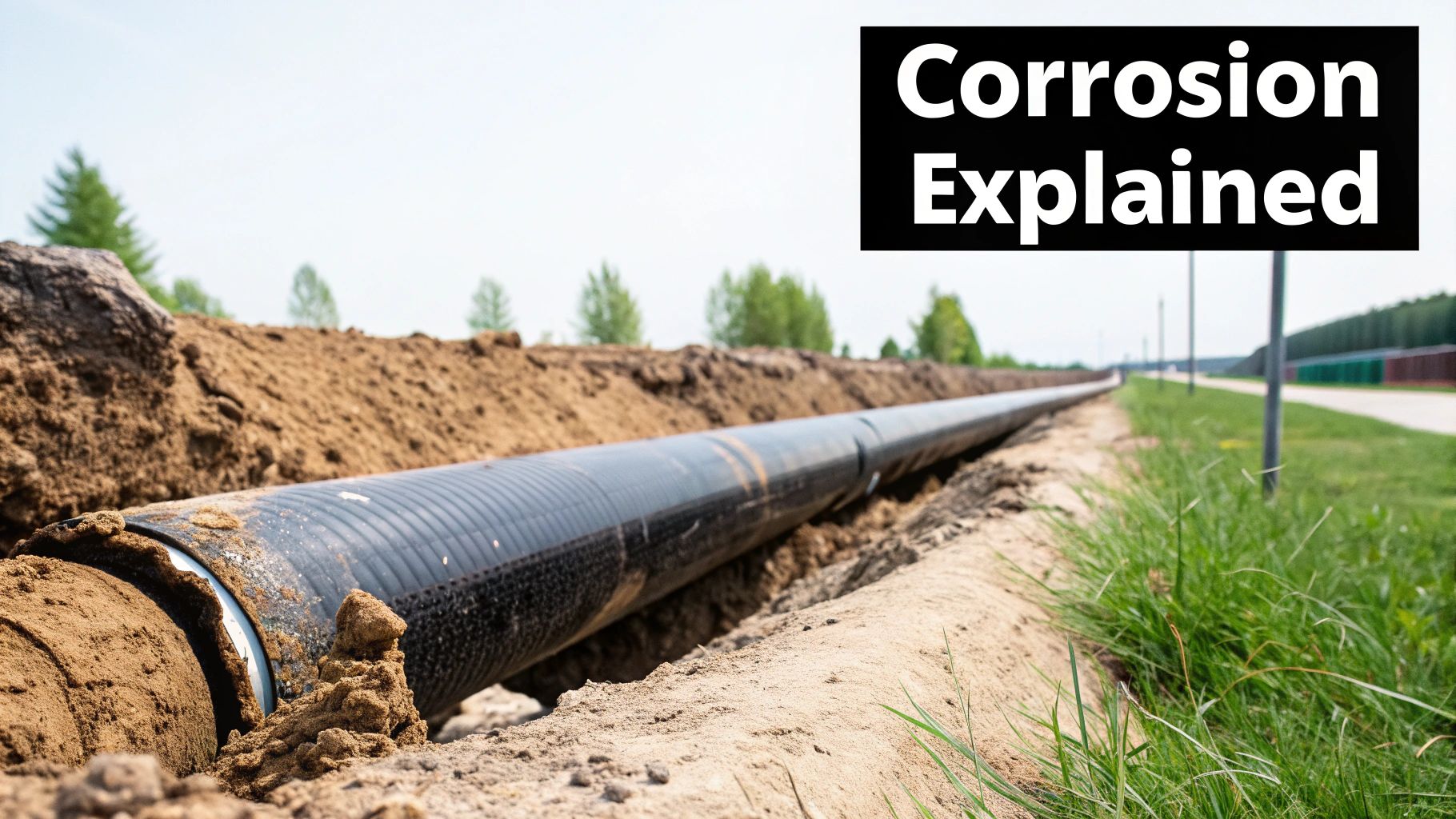
To really get a grip on how cathodic protection systems for pipelines do their job, you have to understand the enemy: corrosion. It’s not just rust. It’s a sneaky electrochemical process that basically turns your pipeline into a tiny, self-destructing battery.
Think about a steel pipe buried in the ground. No matter how perfectly it was manufactured, its surface has microscopic differences. Combine that with variations in the soil—pockets of moisture, changes in pH, or differing oxygen levels—and you’ve got the perfect recipe for electrical hotspots to form all over the pipe.
These hotspots create two distinct types of sites on the metal: anodes and cathodes. The anode is where the metal literally gets eaten away. The cathode is the protected area. Together, with the soil and the pipe itself, they form a "corrosion cell," a natural battery that starts running all on its own.
The Four Elements of a Corrosion Cell
Here's the key: for corrosion to even start, four things absolutely have to be in place. If you take away just one of them, the whole destructive process stops dead. This is the exact principle that cathodic protection exploits.
These four components are:
- Anode: This is the "hotspot" on the pipeline where steel starts to dissolve. It releases positively charged metal particles (ions) into the soil and leaves behind electrons. This is where you see pitting and metal loss.
- Cathode: Another spot on the pipe with a different electrical charge. It acts like a magnet for the electrons released by the anode. The metal here is safe, but it's what keeps the whole damaging reaction going.
- Metallic Path: The pipeline itself is a fantastic conductor. It provides an easy highway for electrons to travel from the anode to the cathode.
- Electrolyte: The moist soil surrounding the pipe. This completes the circuit by allowing the charged metal ions to travel between the anode and cathode.
When all four are present, a tiny direct current (DC) starts to flow. It leaves the pipe at the anode, travels through the soil to the cathode, and returns through the pipe wall. This is the corrosion current. And where it leaves the pipe is precisely where your pipeline begins to fail.
Turning the Entire Pipeline into a Cathode
So, how do we stop it? The whole idea behind a cathodic protection system is to overpower this natural, destructive circuit. We do this by introducing a new, much stronger electrical current.
By applying this external current, we can force the entire surface of the pipeline to act as the cathode. When the whole pipe is a cathode, there are no anodic sites left. No anodes mean no metal loss. It's that simple. The pipeline becomes a passive receiver of protective current, shutting down the corrosion reaction entirely.
The core idea is simple but powerful: If you can make the entire pipeline surface a cathode, you can stop corrosion. The system achieves this by introducing a new, highly attractive anode that sacrifices itself to protect the much more valuable asset.
This is the science behind cathodic protection systems for pipelines. Instead of just letting nature take its course and slowly destroy the pipe, we install a controlled system where a purpose-built component corrodes instead. It's an elegant solution that keeps the pipeline intact for decades, protecting the product inside and preventing environmental damage. With this foundation, we can now look at the two main ways we accomplish this: sacrificial anodes and impressed current systems.
Choosing Your Protection: Sacrificial vs. Impressed Current
When it's time to protect a pipeline from corrosion, you’re faced with a big decision: which type of cathodic protection system is the right tool for the job? It really boils down to two main strategies: sacrificial anodes and impressed current systems. The choice isn't random—it depends heavily on the pipeline's size, its environment, and what you need from it long-term.
Both methods achieve the same end goal—forcing the pipeline to become a cathode so it can’t corrode—but they get there in completely different ways.
Think of a sacrificial system as a bodyguard. You attach a piece of more reactive metal directly to the pipe, and it intentionally takes the corrosive hit, slowly degrading over time while the pipeline stays safe. It’s a simple, set-it-and-forget-it approach.
An impressed current system, on the other hand, is more like an active, powered force field. It uses an external power source to pump a steady, protective electrical current onto the pipeline. This isn’t a passive defense; it’s an active system that overpowers the natural corrosion process with brute electrical force.
The Simplicity of Sacrificial Anodes
A Sacrificial Anode Cathodic Protection (SACP) system is beautifully straightforward. It runs on the basic principles of a battery (a galvanic cell), so it doesn't need any external power to work.
We typically use alloys of zinc, aluminum, or magnesium for these anodes. These metals are naturally more eager to give up electrons than steel is. When you connect one to a pipeline in the soil, you create a new corrosion circuit where the anode becomes the "hot spot." It willingly dissolves—or "sacrifices" itself—over many years, leaving the pipeline untouched.
This inherent simplicity makes SACP a fantastic fit for certain situations:
- Smaller Pipelines: They are perfect for shorter pipe segments or smaller-diameter lines where you don't need a massive amount of protective current.
- Well-Coated Pipelines: If a pipeline has a top-notch coating with very few defects, sacrificial anodes are an efficient way to protect those tiny exposed spots.
- Crowded Corridors: Because they operate at a very low voltage, they’re far less likely to cause electrical interference with other buried pipes or cables nearby. This is a huge plus in busy industrial areas.
The downside is that this passive nature is also a limitation. The driving voltage is low and fixed, so you can't adjust it if conditions change—like if the coating gets damaged over time, demanding more current. Plus, the anodes have a finite lifespan, usually 10 to 30 years, and eventually, you'll have to dig them up and replace them.
The Power of Impressed Current Systems
For a more powerful and flexible solution, we turn to Impressed Current Cathodic Protection (ICCP). This setup uses anodes made from extremely durable materials, like high-silicon cast iron or mixed metal oxides, which are designed to last for decades without dissolving away.
These anodes are hooked up to the positive side of a DC power source, typically a rectifier that converts standard AC power into the DC current we need. The negative side is connected to the pipeline. The rectifier then actively pushes a large, controlled current through the anodes and onto the pipe, providing powerful, reliable protection.
The real game-changer with an ICCP system is its adjustability. A technician can literally just turn a dial on the rectifier to dial the protective current up or down, adapting to the pipeline's needs over its entire service life.
This power and control make ICCP the go-to choice for bigger challenges:
- Large, Bare, or Poorly Coated Pipelines: These systems can deliver the high currents required to protect huge surface areas of exposed steel.
- Long-Distance Pipelines: A single ICCP system can protect many miles of pipeline, something sacrificial anodes simply can't do.
- Tough Environments: In dry, rocky, or sandy soil where electricity doesn't flow easily, the high driving voltage of an ICCP system can easily push through the resistance.
The trade-off, of course, is more complexity. You need a reliable source of power, the initial installation is more expensive, and the system requires more hands-on monitoring to make sure the rectifier is running properly.
Comparing the Two Approaches Side-by-Side
Making the right call between these two types of cathodic protection systems for pipelines means carefully weighing the pros and cons. This decision will influence everything from the upfront budget to the long-term maintenance schedule.
To make it clearer, here's a direct comparison of the two systems.
Sacrificial Anode vs Impressed Current Systems
| Feature | Sacrificial Anode (SACP) | Impressed Current (ICCP) |
|---|---|---|
| Power Source | None required; self-powered galvanic cell | External DC power source (rectifier) |
| Driving Voltage | Low and fixed (typically 0.5V to 1.7V) | High and adjustable (up to 50V or more) |
| Anode Lifespan | Finite; designed to be consumed (10-30 years) | Very long; slow consumption rate (often 30+ years) |
| Ideal Application | Well-coated, small-diameter, or short pipelines | Large, long-distance, or poorly coated pipelines |
| Interference Risk | Very low | Higher; requires careful design to avoid issues |
| Maintenance | Minimal; periodic potential readings | Regular rectifier checks and adjustments |
| Initial Cost | Generally lower | Higher due to power supply and installation |
Ultimately, there's no single "best" answer. Sacrificial systems offer elegant simplicity for smaller, well-defined projects, while impressed current systems provide the raw power and control needed for large, complex infrastructure. The right choice is the one that best matches the specific technical needs and operational realities of your pipeline.
Designing and Installing Your CP System
A successful cathodic protection system isn't just about the hardware; it’s born from meticulous planning long before the first anode ever touches the dirt. Think of it less as a simple installation and more as a custom-engineered defense. Getting the design and installation right is the single biggest factor in determining whether you get decades of reliable protection or a costly, ineffective mess. This process is a blend of boots-on-the-ground fieldwork, careful engineering, and smart component placement.
It all kicks off with a deep dive into the pipeline's environment. You can't possibly protect a structure without first understanding the specific threats it's up against. That means the project always starts with pre-design surveys to gather the raw data that will dictate every decision from here on out.
Conducting Essential Field Surveys
Before any equipment is even considered, engineers have to become detectives, investigating the soil where the pipeline lives. The single most important clue they’re looking for is soil resistivity. This is a measure of how easily an electrical current can flow through the ground, and it changes everything.
Think of it this way: low-resistivity soil, like wet clay, is a superhighway for current. High-resistivity soil, like dry, rocky ground, is more like a stubborn country road.
This one measurement directly shapes the entire system design:
- Current Demand: Corrosive, low-resistivity soils are aggressive and demand a lot more protective current to keep the pipeline safe.
- Anode Placement: You have to choose and place anodes strategically to overcome the soil’s natural resistance.
- System Type: In extremely high-resistivity soil, a sacrificial anode system might not have enough oomph to do the job, pushing the design toward a more powerful impressed current system.
The other critical piece of the puzzle is the pipeline's coating quality. No coating is perfect. Even the best ones have tiny flaws, sometimes called "holidays," which are prime targets for corrosion. By assessing the coating's integrity, engineers can calculate precisely how much current the CP system needs to supply. A pipe with a fantastic coating might only need a trickle of current, while a poorly coated or bare one will be a current hog.
Calculating Current and Placing Anodes
With the survey data in hand, the real engineering begins. The main goal here is to calculate the total current required to protect the entire pipeline. It's a careful balancing act—you need enough current to stop corrosion dead in its tracks, but not so much that you waste power or, worse, cause electrical interference with other nearby buried structures.
This calculation leads directly to the next big decision: where to put the anodes. The objective is to spread the protective current evenly across the entire surface of the pipe. How you do this depends entirely on whether you've chosen a sacrificial or impressed current system.
- With sacrificial systems, anodes are typically installed very close to the pipe. For new pipelines, you'll often see bracelet anodes clamped right onto the pipe itself, offering highly localized protection.
- For impressed current systems, the anodes are grouped together in what we call "anode beds." These can be shallow beds buried near the pipeline or, for covering long distances, deep anode beds installed in vertical boreholes that can go hundreds of feet down. This ensures a broad, even blanket of current over many miles of pipe.
This infographic gives a great high-level overview of the decision-making process.
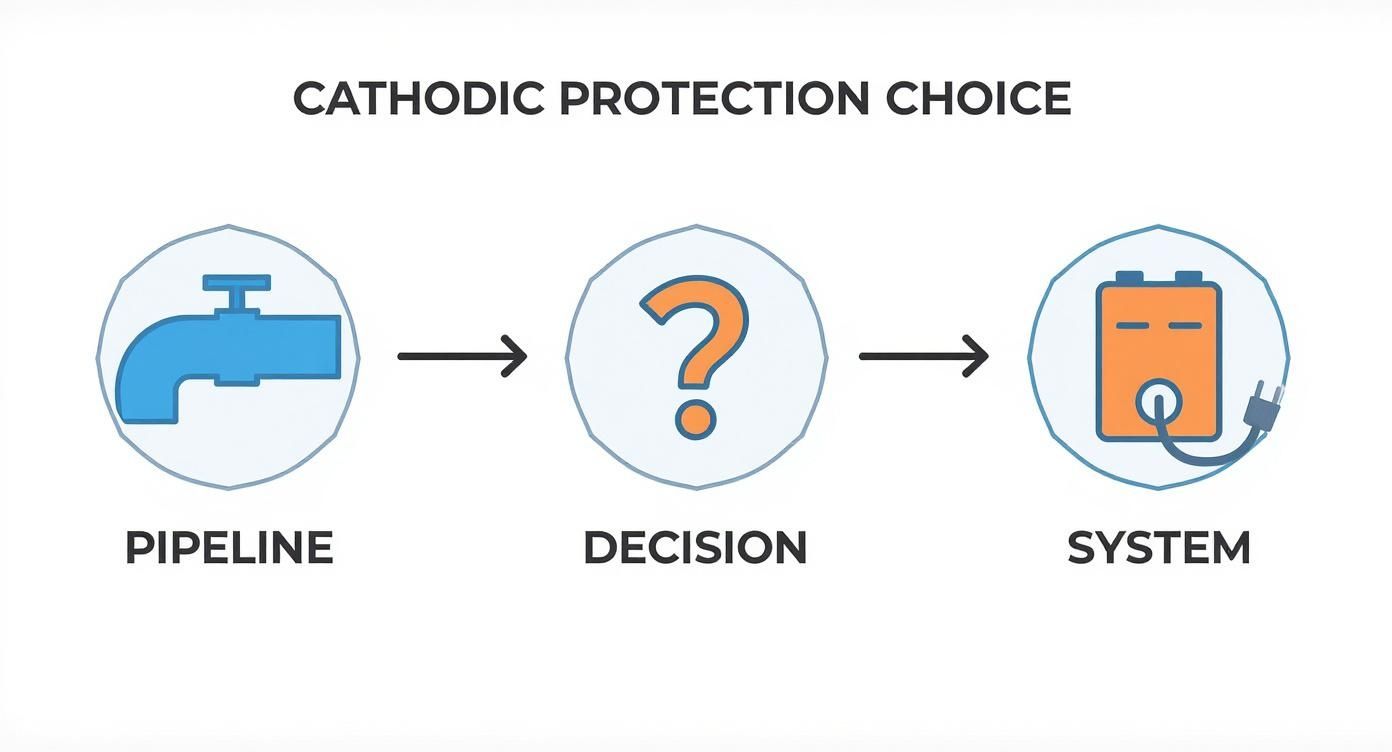
As you can see, the choice between a passive sacrificial system and a powered impressed current system really comes down to the pipeline's specific needs and the environment it's in.
Installing for Long-Term Monitoring
Finally, any CP system worth its salt is designed to be monitored from day one. During the installation phase, test stations are installed at regular intervals all along the pipeline. These simple-looking posts are absolutely essential for the life of the system, giving technicians a convenient access point to hook up their equipment and take readings.
Without good test stations, you're flying blind. Verifying that your system is actually working becomes a guessing game. These are your windows into the health of the underground system, allowing for the pipe-to-soil potential readings that prove protection is being achieved.
From the initial soil survey to the final test station installation, every step is linked. A shortcut in one area will inevitably compromise the entire system down the line. It's a powerful reminder that expert design and precise execution are the only way to build a truly lasting defense against corrosion.
Here's the rewritten section, designed to sound completely human-written and natural:
How to Monitor and Maintain Your System
Putting in a top-notch cathodic protection system is a huge step, but it’s definitely not a "set it and forget it" deal. Think of it more like a vital piece of medical equipment—it needs regular check-ups to make sure it’s still protecting your pipeline as intended. Consistent monitoring and maintenance are what keep that system working for decades, stopping small problems before they balloon into catastrophic failures.
This isn’t a static process, either. The world around a pipeline is always changing. Soil conditions can shift, coatings break down over time, and even the best system components will eventually age. A solid monitoring program is your early warning system, giving you the hard data you need to keep that protective current dialed in just right.
Taking the Pulse with Pipe-to-Soil Potential Surveys
The most fundamental health check for any cathodic protection setup is the pipe-to-soil potential survey. This is how we quite literally "listen in" on the pipeline to see if it's getting enough protective current to keep corrosion at bay. The whole process boils down to taking precise voltage measurements between the pipeline and the soil it's buried in, usually at specific test stations set up along the route.
A technician will use a high-impedance voltmeter and a stable reference electrode (a special tool they place on the ground) to measure the electrical potential. That reading tells us everything we need to know: is the pipeline "negative" enough compared to the soil around it? If it is, we know the system is working.
Industry standards give us clear benchmarks for what "protected" actually looks like.
- The -850 Millivolt Standard: When you see a reading of -850 millivolts (mV) or more negative, you can be confident the steel is protected. This is the gold standard, confirming the pipeline is now the cathode and corrosion has been stopped in its tracks.
- The 100 Millivolt Polarization Shift: Another tried-and-true method is to check for a 100 mV shift. You measure the potential with the system off, then turn it on and measure again. If you see at least a 100 mV change, you know the current is having a real protective effect.
These surveys, often done annually (or more in high-risk zones), give you a clear snapshot of how the system is performing and help you zero in on any spots that might be under-protected.
Keeping a Close Eye on System Components
Beyond checking the pipeline's potential, you have to inspect the hardware itself. This is especially true for impressed current systems, where the rectifier is the heart of the whole operation.
You can think of a rectifier's output log like a patient's medical chart. Steady voltage and amperage readings mean you've got a healthy system. But a sudden drop in current? That could point to a nicked cable. A sudden spike? That might mean new coating damage on the pipeline is suddenly drawing a lot more current.
With sacrificial anode systems, things are simpler, but you can't ignore them. Those anodes are designed to be consumed, so the main job is to track how much life they have left. As they deplete, the protection they offer dwindles, and eventually, they'll need to be replaced. Those regular potential surveys are the best way to see that gradual decline and plan accordingly.
Routine maintenance is fantastic at catching common culprits before they cause real trouble, like:
- Electrical Interference: New construction nearby—another pipeline or even power lines—can mess with your system's current.
- Anode Depletion: Sacrificial anodes don't last forever. You have to monitor them so you can replace them on schedule.
- Coating Damage: A backhoe hit or just soil stress can scrape the coating, creating "holidays" that demand more protective current.
- Cable Breaks: Damage to the wiring connecting an anode or rectifier can knock out protection for an entire section of pipe.
At the end of the day, a proactive maintenance plan isn't just a good idea—it's essential. It’s what ensures your cathodic protection system works, keeps you compliant with regulations, and truly safeguards your pipeline for its entire service life.
Got Questions About Pipeline Cathodic Protection? We've Got Answers.
Even after you get the hang of how cathodic protection systems for pipelines work, a lot of real-world questions pop up. It’s one thing to understand the theory, but another thing entirely to manage these systems in the field.
Let’s tackle some of the most common questions that engineers, asset owners, and field techs run into. Getting these details right is what separates a well-managed pipeline from a ticking time bomb.
How Long Does a Cathodic Protection System Last?
This is probably the number one question, and the answer is: it depends entirely on the type of system you have.
H3> Sacrificial Anode Systems
A sacrificial anode system is built to be consumed. Think of it like a zinc block on a boat propeller—it corrodes away so the expensive part doesn't have to. The lifespan comes down to the anode's material and weight, plus how hard it has to work (how much current it needs to supply).
Under typical soil conditions, these systems are designed for a 10 to 30-year lifespan. Once the anode is gone, the protection stops cold. The only fix is to dig it up and replace it.
Impressed Current Systems
An impressed current system, on the other hand, is designed to go the distance. The rectifier, cables, and other hardware are built to last as long as the pipeline itself, which can easily be 50 years or more.
The anodes in these systems are made of tough, slow-corroding materials that last much longer than their sacrificial cousins. They will eventually need to be replaced, but we're talking a much, much longer timeline. The key with either system is regular monitoring to see how things are holding up and to plan replacements before you lose protection.
Why Are Coatings So Important with Cathodic Protection?
It’s easy to think of coatings and cathodic protection (CP) as two separate things, but they're actually a team. A high-quality coating is always your first line of defense.
The coating acts as a physical barrier, keeping the corrosive soil and water away from the steel pipe. But here's the catch: no coating is perfect. It’s inevitable that tiny scratches, nicks, or pinholes (we call them “holidays” in the industry) will happen during transport and installation.
That’s where cathodic protection shines. It acts as the backup, focusing its protective current only on those tiny, exposed spots. This partnership is what makes the whole system so efficient. A good coating can slash the amount of current needed for full protection by over 99%.
This teamwork makes protecting miles of pipeline affordable. Without a coating, the sheer amount of power needed would be astronomical, requiring a massive and costly CP system. On the flip side, if a coating starts to break down over time, the CP system has to work harder. Technicians will see the current demand spike, which is a classic sign that it's time to investigate the coating's health.
Does Cathodic Protection Work on All Pipelines?
Cathodic protection is a game-changer, but it’s not a universal solution. It’s specifically designed to protect ferrous metals—like the carbon steel used in most pipelines—that are buried in soil or submerged in water (an electrolyte).
It’s completely ineffective on non-metallic pipelines. Materials like HDPE, PVC, or fiberglass simply don't corrode in the same electrochemical way, so a CP system would do absolutely nothing for them.
The other non-negotiable requirement for cathodic protection systems for pipelines is electrical continuity. The protective current needs a clear, unbroken path to travel down the entire pipeline. If you have insulating joints or flanges that isolate sections, they'll stop the current in its tracks. To get around this, technicians install bonded cables or jumpers across those gaps to give the current a bridge to cross.
How Do You Know If a CP System Is Working?
You can’t just look at a pipe and see if it's protected. Verifying that a CP system is doing its job requires specific measurements. The gold standard is a pipe-to-soil potential survey.
A technician uses a portable reference electrode and a high-impedance voltmeter to measure the voltage between the pipe and the soil at various test stations along the route. The numbers tell the story. Industry bodies like NACE International (now AMPP) have set the standards for what "protected" looks like.
- -850 mV "On" Potential: The most common benchmark. If you get a reading of -850 millivolts or more negative while the CP system is running, you're in good shape. It means the pipe is polarized enough to stop corrosion.
- 100 mV Polarization Shift: This method confirms the CP system is actively influencing the pipe. You measure the difference between the pipe's natural voltage and its "instant off" voltage (taken milliseconds after you interrupt the current). A shift of at least 100 millivolts proves the system is having a significant protective effect.
For impressed current systems, you also have to do regular checks on the rectifier itself. Technicians log the voltage and current output to make sure the unit is stable. Any wild swings can point to problems like a damaged cable, a failing anode, or a degrading coating that needs a closer look.
When your project faces delays from natural gas line installations, waiting isn't an option. Blue Gas Express provides mobile CNG and LNG solutions to keep your operations running without interruption. Ensure your projects stay on schedule by visiting us at https://bluegasexpress.com to learn how we deliver reliable, temporary natural gas right where you need it.