

Beneath California's sprawling cities and landscapes lies a hidden circulatory system, a massive subterranean network of natural gas pipelines powering millions of homes and businesses. Think of it like a highway system: massive transmission lines are the interstates, while smaller distribution lines act as the local streets delivering fuel right where it's needed. For anyone in construction or industry, understanding this system isn't just trivia—it's critical.
The Anatomy of California's Gas Grid
California’s energy infrastructure is built on a complex web of over 100,000 miles of steel and plastic pipelines. This isn't one single system, but a dynamic, two-tiered structure designed to move massive amounts of energy efficiently across the state.
This network is the lifeblood for everything from heating our homes to running heavy manufacturing. When that supply is disrupted, the consequences ripple outward. Construction projects, in particular, can grind to a halt, unable to get a certificate of occupancy or commission vital equipment like boilers and generators.
Transmission Lines: The Gas Superhighways
At the top of the chain are the transmission pipelines. These are the I-5s and Highway 101s of the gas world—large-diameter, high-pressure conduits designed for one purpose: moving staggering volumes of natural gas over long distances.
They transport gas from production fields or interstate connections, delivering it to major hubs, power plants, and large industrial facilities. Because they operate under such high pressure, their safety and integrity are an absolute priority for operators and regulators.
Distribution Lines: The Neighborhood Streets
Branching off from these gas superhighways are the distribution pipelines. If transmission lines are the freeways, think of distribution lines as the local streets and cul-de-sacs that snake through our communities. These are smaller, lower-pressure pipes that form the dense grid beneath our cities and towns.
Their job is to handle the final-mile delivery to:
- Residential Homes: Keeping furnaces, water heaters, and stoves running.
- Commercial Buildings: Powering everything from restaurants and hospitals to office heating.
- New Construction Sites: Supplying the energy needed to bring building systems online.
For a project manager, this distinction is everything. A problem on a major transmission line can cause widespread outages. But an issue with a local distribution line—the one your project needs to connect to—can be just as devastating, creating targeted delays that can throw timelines and budgets into chaos.
Understanding this network is at the heart of project planning. A simple delay in connecting to a local distribution line can stop a multi-million dollar construction project in its tracks, making a reliable gas source non-negotiable for hitting your deadlines.
Who Manages the California Gas Pipelines?
A few key utility companies oversee this vast network, each managing its own service territory. The two giants in the state are:
- Pacific Gas & Electric (PG&E): Serving most of Northern and Central California, PG&E manages an enormous system of both transmission and distribution lines.
- Southern California Gas Company (SoCalGas): As the primary provider for Southern California, SoCalGas operates one of the nation's most extensive distribution networks.
These are the gatekeepers. They handle everything from routine maintenance and safety checks to planning and installing new service connections. For any construction project, getting them involved as early as possible is one of the most important steps you can take.
The Reality of Pipeline Outages and Project Delays
California’s natural gas network is a marvel of engineering, but it’s far from invincible. For anyone running a construction or industrial project, banking on a perfectly steady gas supply is a gamble. The reality on the ground is that this massive, aging infrastructure faces constant stress from age, the environment, and simple human error.
An unexpected pipeline leak or service interruption can halt a project in its tracks. What begins as a minor utility problem can quickly snowball into a full-blown crisis, causing work stoppages, creating safety hazards, and costing a fortune. These aren't just what-if scenarios; they happen all the time, and the data tells the story.
How Often Do Problems Actually Happen?
With a network this vast, incidents are a matter of when, not if. Old pipes, accidental damage from excavation, and equipment failures are just a few of the reasons service gets cut. This is the critical variable that too many project plans fail to account for.
The numbers paint a clear picture. Over a recent 13-year span, California saw 495 pipeline incidents across its gas transmission, distribution, and hazardous liquid lines. A huge chunk of those involved the natural gas grid, which tells you just how common these vulnerabilities are.
To put a finer point on it, let's look at the major players.
Major California Gas Pipeline Operators and Incident Overview (2010-2021)
When you look at the operators responsible for keeping the gas flowing, you start to see where the risks lie. The table below breaks down the incident data for the major gas utilities in California, showing a direct correlation between network size and the frequency of problems.
| Operator | Pipeline Miles Managed | Total Gas Incidents Attributed | Key Incident Consequences |
|---|---|---|---|
| Pacific Gas & Electric (PG&E) | 50,012 miles | 143 | Major property damage, service interruptions, injuries, fatalities. |
| SoCalGas | 48,818 miles | 83 | Significant service disruptions, property damage, major leak events. |
| San Diego Gas & Electric (SDG&E) | 15,223 miles | 13 | Localized outages, minor property damage. |
| Southwest Gas | 8,088 miles | 5 | Primarily minor leaks and service interruptions. |
As the data shows, Pacific Gas & Electric (PG&E) managed the state’s largest network and also accounted for a staggering 58.6% of all 244 gas transmission and distribution incidents during this period. While this is partly a function of scale, it underscores the importance of knowing your provider's track record. You can dive deeper into these pipeline safety trends and operator performance metrics to get a better sense of the risks in your specific area.
This infographic gives you a simple breakdown of the two main types of pipelines that make up the system.
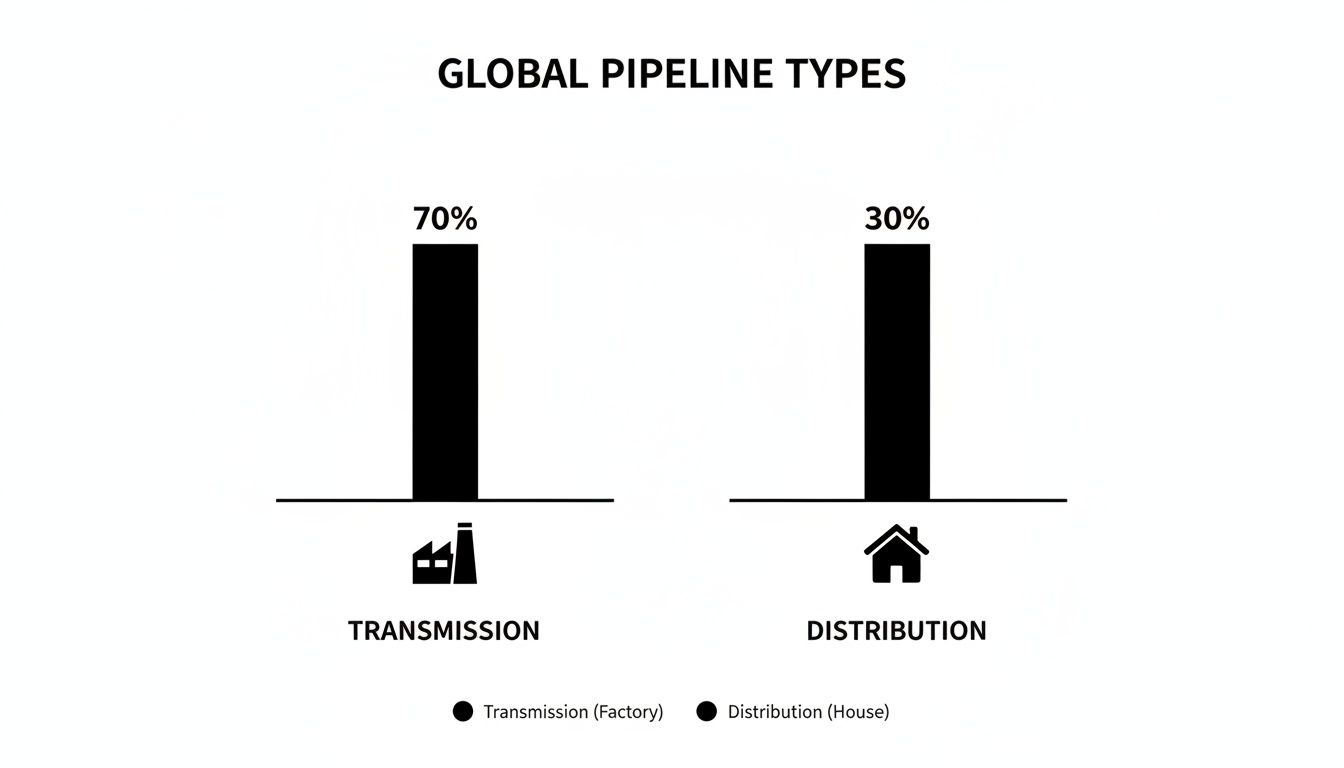
You have the massive transmission lines acting as the freeways for natural gas, and then the smaller distribution lines that are like the local roads bringing it right to your project's doorstep.
The Domino Effect on a Construction Site
Let’s make this real. Picture a large commercial building, just weeks away from completion. The schedule is razor-thin, and getting the certificate of occupancy depends on firing up the huge boilers and HVAC systems. To do that, you need natural gas.
Then the project manager gets the call: the permanent gas meter installation is delayed. The utility is swamped, and a paperwork issue with an easement has pushed the connection back by three months.
All of a sudden, the entire project is hanging by a thread. No gas means the boilers stay cold. Without the HVAC running, the building can't pass final inspections. The project is dead in the water, bleeding money with every passing day.
This one hiccup sets off a chain reaction of expensive problems:
- Financial Penalties: The developer starts getting hit with late-delivery penalties from tenants who were supposed to be moving in.
- Idle Crews: The drywall and flooring crews are sent home, but you’re still on the hook for their mobilization costs.
- Compromised Materials: If it's winter, the lack of heat can ruin drywall, warp hardwood floors, and damage other materials that can't handle the cold.
This isn't some rare, worst-case scenario. It’s a story I’ve heard from project managers all over California. When your timeline is completely dependent on a single utility, you’ve created a massive point of failure.
Proactive Planning is Non-Negotiable
Simply crossing your fingers and hoping the utility shows up on time is not a strategy. The data on pipeline incidents and connection delays makes it crystal clear: you have to have a backup plan.
The first step is to really understand the risks tied to the specific California gas pipelines that serve your site. Know the operator, and know the history of the infrastructure in the area. But the most important step? Have a reliable alternative—like a temporary mobile gas solution—ready to go. That way, a utility delay becomes a minor inconvenience, not a project-killing disaster.
Navigating the Complexities of Gas Line Interconnection

Connecting a new project to the local gas grid should be simple, but the reality on the ground is often anything but. For project managers trying to tap into California gas pipelines, the experience feels less like a utility hookup and more like wading through a bureaucratic swamp full of hidden delays.
Getting a handle on this journey is the first real step toward keeping your project's timeline from going off the rails.
Think of it like getting a complex building permit. It’s not a single event; it's a sequence of handoffs and approvals, each one a potential chokepoint. The moment you submit that initial application, you’re in a queue managed by massive utility providers juggling thousands of requests with finite resources.
The Standard Interconnection Process
While the specifics might differ slightly between giants like PG&E and SoCalGas, the road from application to an active gas meter follows a fairly standard, linear path. Every step has to be completed before the next can begin, meaning a single delay creates a domino effect that can wreck your entire construction schedule.
Here’s what that journey typically looks like:
- Initial Service Request: This is your formal application where you submit detailed plans, load calculations, and site info. This is also the first place things go wrong—incomplete or inaccurate data can get your application kicked to the back of the line.
- Engineering and Design: The utility’s engineers take your plans and design the connection. They figure out pipe sizes, pressures, and the exact route from the main line to your meter location.
- Easement and Right-of-Way: This is a classic snag. If the new pipeline has to cross property that isn't yours or the utility's, you need legal agreements called easements. This stage alone is notorious for dragging on for months.
- Permitting and Approval: The utility, and sometimes your team, has to get the necessary permits from city or county agencies for all the excavation and construction work.
- Construction and Installation: Once all the paperwork is signed and stamped, the utility finally schedules its crews to do the physical work—trenching, laying pipe, and making the connection.
- Final Inspection and Meter Set: After the line is installed and passes a pressure test, a final inspection is done. Only then is the meter officially set and the gas turned on.
Where Projects Get Stuck
Knowing the steps is one thing, but knowing where the landmines are is what really matters. A few key chokepoints are responsible for the vast majority of delays that stretch a project from an optimistic six months to a painful year or more.
One of the biggest hurdles is simply utility crew scheduling. California's major utilities have massive backlogs. Your project, no matter how important to you, is just one of many in their queue. It's not at all uncommon for a project to be fully approved and then sit for months waiting for a crew to become available, especially if storm damage or emergency repairs elsewhere demand their attention.
Then there are the surprises buried underground. During excavation, crews can hit conflicting utility lines, solid rock formations, or even culturally sensitive artifacts. Any of these discoveries brings work to an immediate halt, often requiring new engineering plans and a whole new round of permits.
The interconnection process is a marathon, not a sprint. A single missing document or an unexpected underground obstacle can easily add three to six months to your schedule, turning a manageable timeline into a costly waiting game.
Proactive Strategies to Minimize Delays
You can't control the utility's entire process, but you're not helpless. The single most important thing you can do is start the application process as early as humanly possible—ideally, long before you even break ground. This gives you a much-needed time buffer.
Constant, clear communication with your utility representative is also key. Don't be afraid to follow up regularly. Make sure they have every piece of paper they need and get a realistic sense of their timeline for each stage.
Ultimately, the best defense is a good contingency plan. Assume the permanent connection will be delayed. By identifying and pre-qualifying a temporary mobile gas provider ahead of time, you ensure that a utility hiccup doesn't stop you from commissioning equipment, getting your certificate of occupancy, or keeping your facility running. It turns a potential crisis into a manageable bump in the road.
How California's Changing Climate and Energy Goals Are Reshaping the Gas Grid
It’s not just aging pipes and routine maintenance that dictate the future of California’s natural gas network. Two massive forces are at play: our changing climate and a deliberate, statewide pivot in how we use energy. These aren't abstract concepts; they are creating a new reality on the ground for anyone planning a major project. Understanding this bigger picture is key to sidestepping future headaches and making smarter energy choices.
On one hand, you have direct physical threats. California's weather is getting more extreme and unpredictable. Wildfires, floods, and landslides are no longer once-in-a-generation events, and they pose a real danger to pipeline integrity. A buried pipeline might seem insulated from the world above, but the "atmospheric rivers" we've been seeing can saturate the ground, leading to soil erosion or even liquefaction that can compromise the very foundation a pipe rests on.
Along the coast, the slow-motion threat of sea-level rise is just as serious. Critical pipeline segments are located in low-lying areas, making them prime targets for saltwater corrosion and damage from storm surges. These climate risks introduce a new level of unpredictability, increasing the chances of a service disruption that could bring a construction site or an industrial facility to a halt.
A Deliberate Move Away From Natural Gas
At the exact same time, California is actively working to wean itself off natural gas. This isn't happening by accident. It's a strategic, policy-driven push toward electrification—think more EVs, heat pumps replacing furnaces, and induction cooktops in new homes. Every one of these shifts is designed to systematically reduce our long-term need for natural gas.
This planned decline in demand puts gas utilities in a tough spot. Why make massive, long-term investments in expanding a network for a customer base that's intentionally shrinking? It just doesn’t make financial sense. As a result, proposals for new gas infrastructure will likely face tougher scrutiny, and decisions about where to focus maintenance on existing lines could change, potentially impacting reliability in certain areas. Looking at how other regions handle environmental shifts can be insightful, for instance, by examining the European Union's transition away from F-gases in switchgear.
This is the core dilemma: Utilities have to balance the immense cost of keeping an aging system safe while facing the economic reality of a market that is actively being engineered to shrink.
What This Means for Your Project
So, what’s the practical takeaway for a project manager or a plant operator in California? Simply put, you can no longer take the gas grid for granted. The combination of environmental risk and shrinking demand makes a powerful argument for building energy flexibility directly into your project plans from day one.
The official numbers back this up. State forecasts show California's natural gas demand is set to fall from an average of 4,931 million cubic feet per day (MMcf/d) to just 3,593 MMcf/d by 2040. That’s a compound annual decline of 2.0%—a steady drop reflecting the big push toward renewables. You can dig into the specifics of California's future gas demand in the official reports.
In this new environment, waiting months or even years for a permanent connection to a grid with an uncertain future is a risky bet. This is where non-permanent solutions like mobile natural gas become so valuable. It gives you an agile way to get the energy you need, bypassing infrastructure vulnerabilities and keeping your project moving forward in a state where the entire energy system is in flux.
Using Mobile Gas Solutions to Bridge Supply Gaps
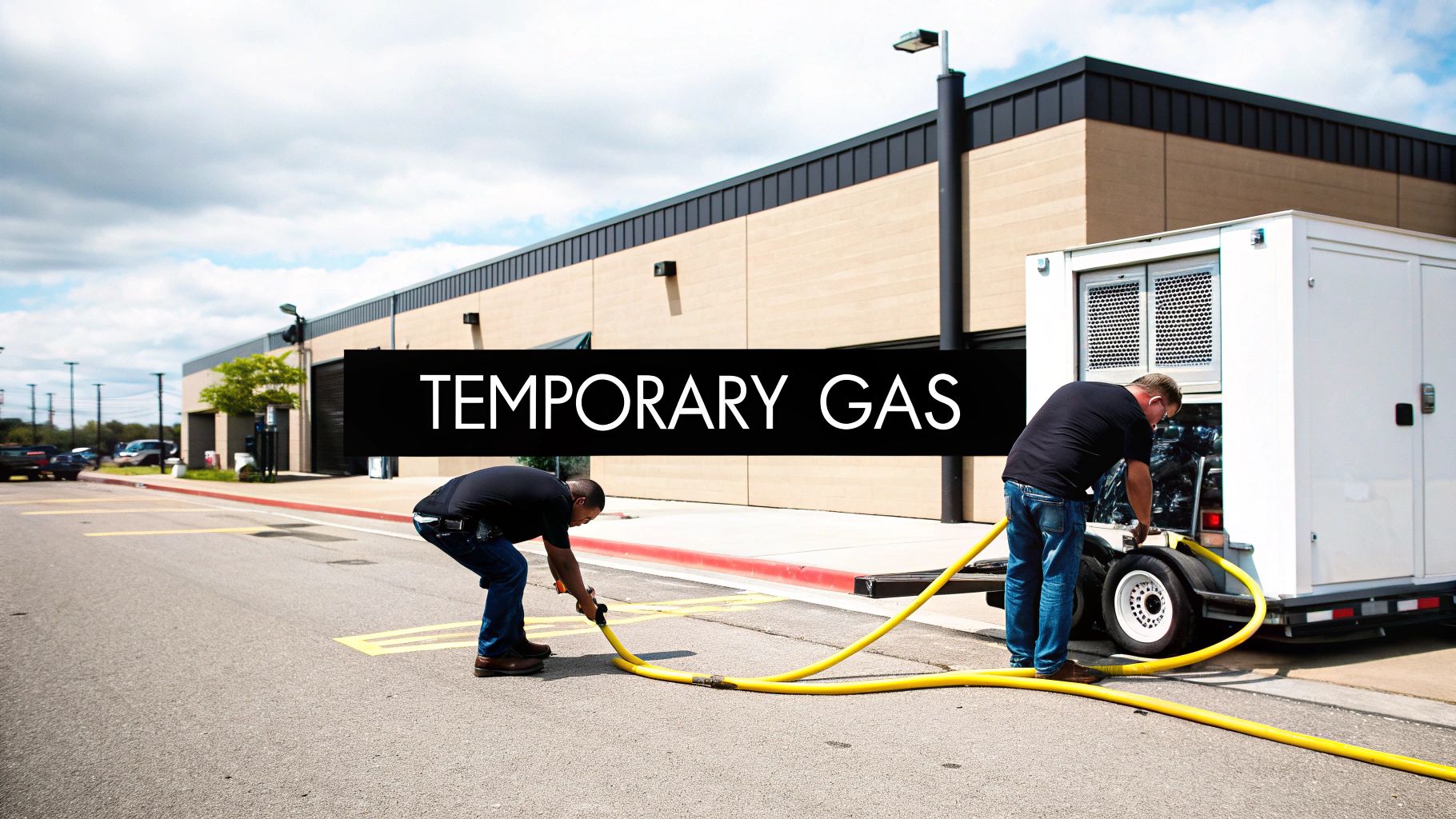
You’re nearing the finish line on a major project. The building is up, the equipment is installed, but the permanent connection to a California gas pipeline is still months away. Your deadline, however, is next week. So, what’s the move?
This is precisely where mobile natural gas solutions come in. They turn a potential project-killing disaster into a simple logistical step. Think of these services as the energy equivalent of a temporary bridge, seamlessly spanning the gap when the permanent road is still under construction.
This "bridge" arrives on wheels, delivering compressed natural gas (CNG) or liquefied natural gas (LNG) directly to your site. It’s a fast, flexible, and powerful way to get the fuel you need, right when you need it, completely bypassing the long, uncertain timeline of the traditional utility interconnection process.
Real-World Scenarios for Mobile Gas
This isn't just a theoretical fix; it’s a practical solution deployed every day across California to solve expensive, time-sensitive problems. Its versatility makes it a go-to for any situation where waiting on a utility hookup just isn't an option.
Here are some of the most common applications we see:
- Securing a Certificate of Occupancy: Before you can get that all-important Certificate of Occupancy, most jurisdictions require the building’s heating and hot water systems to be fully operational. A temporary gas supply lets you fire up the boilers and pass those final inspections on your own schedule.
- Commissioning Generators and Equipment: Industrial facilities and large commercial buildings often have gas-powered generators or complex machinery that need to be tested before going live. Mobile gas provides the fuel to run those tests and get everything validated.
- Preventing Freeze Damage: In the colder months, a new building without heat is a sitting duck for burst pipes and damaged materials. Temporary gas keeps the heat on, protecting hundreds of thousands of dollars in assets from costly damage.
- Bridging Utility Outages: Even established facilities face disruptions. Planned maintenance or unexpected damage to California gas pipelines can shut down your operations in an instant. Mobile solutions act as an immediate backup fuel source, ensuring you don't miss a beat.
The Strategic Advantage of Speed and Flexibility
The single biggest benefit of a mobile gas solution is speed. While a permanent gas line interconnection can easily take 6 to 18 months, a temporary gas trailer can often be on-site and operational within days—or even hours in an emergency. That rapid response is what saves projects from the crushing financial weight of downtime.
A delay in your gas connection isn't just a scheduling hiccup; it's a financial bleed. Every day a multi-million dollar project sits idle waiting for a meter, the costs in labor, penalties, and lost revenue can be staggering. Mobile gas stops that bleeding immediately.
This kind of flexibility puts project managers back in control of their timelines. Instead of being at the mercy of the utility's schedule, you can dictate your own operational readiness. It’s absolutely critical for time-sensitive projects like opening a new hospital, a manufacturing plant, or a large residential complex where every single day of delay hits the bottom line.
By planning for a temporary solution from the outset, you build resilience directly into your project schedule. It transforms the question from "What if the utility is late?" to "How do we stay on track regardless?"
A Practical Checklist for Mitigating Gas Supply Risks
Knowing the risks is one thing; doing something about them is what separates a successful project from a stalled one. Let's turn what we've learned about California's gas grid into a practical game plan. Following these steps can help you get ahead of potential problems, protecting your budget and your timeline from the get-go.
The idea is simple: anticipate the hurdles before you're forced to jump over them. By building these contingencies into your project plan from day one, you stay in control, regardless of what the utility's backlog or an old pipeline throws at you.
1. Engage the Utility Immediately
This is your first, most critical move. Don't wait until you're about to break ground. Your very first call, right at the start of the planning phase, should be to the local gas utility to submit your application for a new connection. This simple action is the best way to create the time buffer you'll almost certainly need to absorb the bureaucratic and scheduling delays that are part of the process.
2. Build a Realistic Timeline Buffer
Whatever initial timeline the utility gives you, don't bank on it. Based on my experience with common chokepoints—permitting, finding available crews, and negotiating easements—it's just smart planning to add at least 30-50% more time to your schedule for the gas interconnection. If they tell you six months, you should be planning for nine. It's better to be pleasantly surprised than financially blindsided.
3. Assess Local Pipeline Vulnerabilities
Not all parts of the california gas pipelines network are created equal. You need to do a little homework on your specific project location. For instance, climate change is a growing wildcard; models show that sea-level rise could put critical coastal pipelines at risk of flooding and corrosion during major storms. You can dig into a detailed assessment to understand these kinds of threats by reading the full research on climate impacts on California's energy infrastructure.
On that note, utilities are starting to adopt more advanced monitoring techniques. Many are finding that mastering remote visual inspections is a powerful way to get ahead of integrity issues and keep the system running safely.
Your project's success depends on moving from dependency to self-sufficiency. Acknowledging the grid's limitations and preparing for them is the most effective strategy for ensuring your project stays on track and on budget.
4. Pre-Qualify a Temporary Gas Provider
This is your ace in the hole. The last thing you want is to be scrambling for a solution when the utility finally informs you of a major delay. Instead, identify and vet a mobile natural gas provider well in advance. Get quotes, understand how quickly they can deploy their equipment, and keep their number handy.
This proactive step means that if you need an energy bridge to get you through a delay, you can have a temporary solution on-site in days, not weeks. Your project keeps moving, and you don't miss a beat.
Your Questions, Answered
When you're dealing with California's natural gas network, a lot of questions pop up, especially when a construction project is on the line. We get it. Here are some straightforward answers to the questions we hear most often from project managers and industrial clients just like you.
How Long Does It Really Take to Get a New Commercial Gas Line in California?
Let's be blunt: it takes a while. From the moment you submit your application to the day gas is flowing, you're realistically looking at anywhere from 6 to 18 months. Sometimes even longer.
That timeline is packed with engineering reviews, permitting hoops, and trying to get on the schedule of swamped utility crews. Delays are almost a given—whether from a small paperwork error, a tough easement negotiation, or something unexpected discovered on-site. This is exactly why a solid backup plan, like mobile gas, is essential for any project with a hard deadline.
What Usually Causes Natural Gas Pipeline Outages?
Gas pipeline outages in California happen for a few key reasons, some you can see coming and some you can't. More often than not, it boils down to one of these culprits:
- Excavation Damage: This is the big one. A construction crew hits a line they didn't know was there. It happens more than you'd think.
- Equipment Failure: The network is vast and parts of it are aging. Valves, connectors, and other components can simply wear out.
- Corrosion: Older steel pipes are in a constant battle with the elements, and corrosion can eventually cause leaks that require a shutdown.
- Mother Nature: California isn't exactly a calm state. Landslides, floods, and of course, earthquakes can all wreak havoc on buried pipelines.
Even planned maintenance can take you offline temporarily. Having a reliable backup energy source is just smart planning.
Can Temporary Natural Gas Work for My Project?
Almost certainly, yes. Temporary natural gas solutions, whether it's CNG or LNG, are incredibly adaptable. They can be configured to deliver the precise volume and pressure you need for just about any commercial or industrial job.
We’ve seen mobile gas do it all: providing heat to cure drywall for final building inspections, commissioning massive generators, firing up industrial boilers during a pipeline cut, and even serving as the primary fuel for hospitals and data centers during an emergency.
Should I Just Wait for the Utility or Get a Temporary Solution?
Waiting on the utility is a gamble, and the stakes are high. Every day you wait past your deadline can mean thousands of dollars in delay penalties, lost revenue, and blown budgets. It's a massive financial risk, especially when you have a firm move-in date or a production line that needs to start.
Think of a temporary gas solution as an insurance policy for your timeline. It gives you the power to stay on schedule, get your inspections passed, and sidestep those crippling financial penalties. It’s less of an operational cost and more of a strategic investment in keeping your project on track.
Don't let utility delays put your project on hold. Blue Gas Express delivers rapid-response mobile natural gas to keep you moving forward. Learn how we bridge the gap and keep you on schedule.