

Imagine having your own personal fuel pump right in your garage. You could tap into your home's natural gas line and fill up your vehicle overnight, completely skipping the gas station. This is the big idea behind home CNG fueling stations, and it's catching the eye of homeowners and home builders alike.
The appeal is obvious. You refuel your Natural Gas Vehicle (NGV) while you sleep, much like plugging in an electric car.
The Reality of Personal CNG Fueling at Home
The dream of a personal fueling station is powerful. For a homeowner, it means ultimate convenience and the potential for real savings on fuel costs over the long haul. For a builder, offering this as a feature can be a unique selling point for new homes, especially where natural gas is cheap and plentiful. It hits all the right notes for buyers looking for energy independence and greener living.
But let's be realistic. The journey from a great idea to a functioning home CNG fueling station is loaded with practical hurdles that have kept it from becoming common. These systems aren't like installing a new dryer; they're complex pieces of equipment that require serious planning and professional know-how.
Major Roadblocks to Consider
Before you get too far down the road, you need to understand the significant challenges that often stop residential CNG projects in their tracks.
- High Upfront Cost: This is usually the first deal-breaker. The compressor equipment and the professional installation can easily cost tens of thousands of dollars, which is simply too steep for most household budgets.
- A Labyrinth of Rules and Permits: You're dealing with a high-pressure fueling system, which means navigating a maze of local building codes, fire safety standards (like NFPA 52), and approvals from your gas utility. This process can be a bureaucratic nightmare.
- Infrastructure Delays: Here's a classic catch-22, especially in new construction. The main gas line to a new home or development might not be turned on for months. You can't install, test, or even get gas appliances commissioned for an occupancy permit without a live gas feed.
This is where the feasibility of a permanent home station often breaks down. The very delays that plague new construction projects can make a fixed CNG system impractical from the start.
This brings us to a more practical conversation. When a permanent installation gets bogged down by utility delays or red tape, you have to look at other options. This is where a service like mobile CNG delivery comes in, offering a flexible way to bridge the gap. It can provide a temporary natural gas supply to get appliances running, pass inspections, and keep a project moving forward when the permanent gas line is still out of commission.
Exploring Your On-Site CNG Fueling Options
So, you're thinking about installing a personal CNG fueling station? You've basically got two main routes you can take. Each one is built for a different kind of user, so the right choice really boils down to how you plan to use your vehicle and what you need in terms of speed, space, and upfront cash.
The "Set It and Forget It" Approach: Residential CNG Compressors
For most homeowners, the go-to solution is a residential CNG compressor. The best way to think about this is like plugging in your electric car or your phone overnight. It's a slow-and-steady process that’s all about convenience, not speed.
These units are typically mounted on a wall in your garage and hook directly into your home's existing low-pressure natural gas line. Over a period of about 8 to 10 hours, the machine compresses the gas and slowly fills up your vehicle's tank. You just pull in, hook up the hose, and head inside. The next morning, you're ready to go with a full tank. Simple as that.
The "Gas Station at Home" Approach: Cylinder Cascade Systems
Your other option is a cylinder cascade system. This is less like charging a battery and more like having a few full scuba tanks ready to go. You get that instant fill-up, but it's a much bigger setup. This is why you don't see them in many residential garages; they're more common for small business fleets or anyone who can't afford to wait for an overnight fill.
A cascade system is essentially a bank of large, high-pressure storage cylinders that are already filled with CNG. When you need to refuel, you're just transferring that pre-compressed gas from the big tanks to your vehicle's tank. The whole process can take just a few minutes, which is a world of difference from the slow-fill compressor.
The real trade-off is clear: a compressor makes high-pressure gas on the spot for a slow, overnight fill. A cascade system stores a bunch of high-pressure gas for a quick fill whenever you need it.
This decision isn't made in a vacuum, though. As you weigh your options, you'll run into three big factors: the high cost, the web of regulations, and the emergence of mobile solutions that might sidestep the whole installation mess.
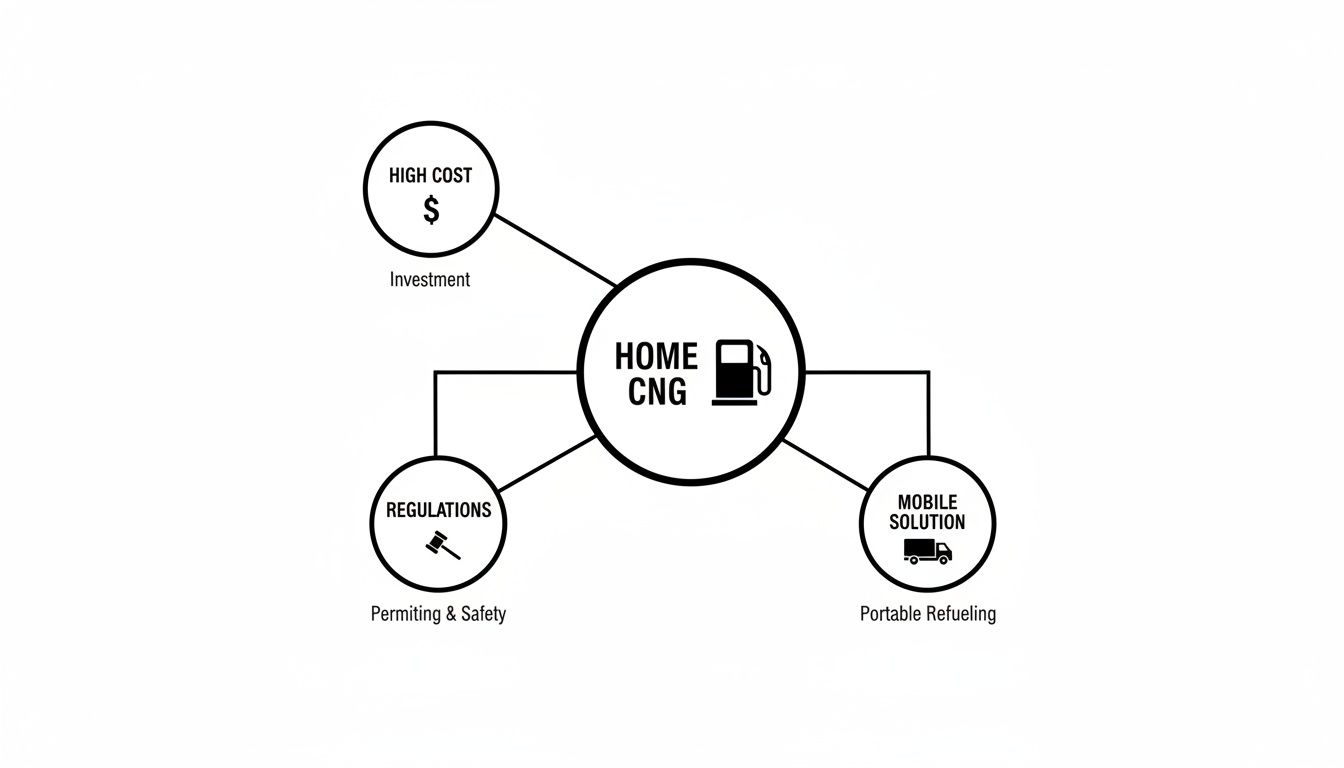
This diagram really hits home that while having your own fueling setup is an attractive idea, the financial and bureaucratic hurdles are significant. They're often big enough to make people look for more flexible alternatives.
Home CNG System Types At a Glance
To make the choice clearer, let's put these two systems side-by-side. The table below breaks down the key differences that will likely sway your decision one way or the other.
| Feature | Residential CNG Compressor (Slow-Fill) | Cylinder Swapping / Cascade System |
|---|---|---|
| Refueling Time | 8-10 hours (overnight) | 5-10 minutes (fast-fill) |
| Best For | Daily commuters, single-vehicle households | Small fleets, multi-vehicle homes, users needing quick turnarounds |
| Upfront Cost | Lower | Significantly Higher |
| Space Required | Minimal (small wall-mounted unit) | Substantial (requires space for a bank of large cylinders) |
| Convenience | High (automated overnight fueling) | High (fast, on-demand fueling) |
| Installation | Simpler; ties into existing gas line | More complex; involves heavy equipment and storage setup |
Ultimately, the right system is the one that fits your life. A compressor is perfect for a predictable daily routine, while a cascade offers flexibility and speed at a much higher price point.
What's the Day-to-Day Reality?
The system you install will directly shape your daily routine. Let's get practical about what living with each one is like.
With a Residential Compressor: This is the ultimate in hands-off convenience for the typical 9-to-5er. You park in the garage every night anyway, so connecting a hose becomes second nature. The trade-off? If you have an unexpectedly busy day and run low on fuel, there’s no quick top-off. You’re waiting until the next morning.
With a Cylinder Cascade: This setup feels much more like having a private gas station. Need a quick fill before heading out for an unplanned trip? No problem. Have multiple CNG vehicles in the family? You can fill them one after the other. But this convenience comes at a steep cost, both in dollars and in the dedicated real estate it demands on your property.
For the vast majority of homeowners just looking to fuel their personal car, the slow-fill compressor strikes the right balance. It delivers the convenience of waking up to a full tank without the massive cost and complexity of a cascade system.
Navigating Permits, Codes, and Site Requirements
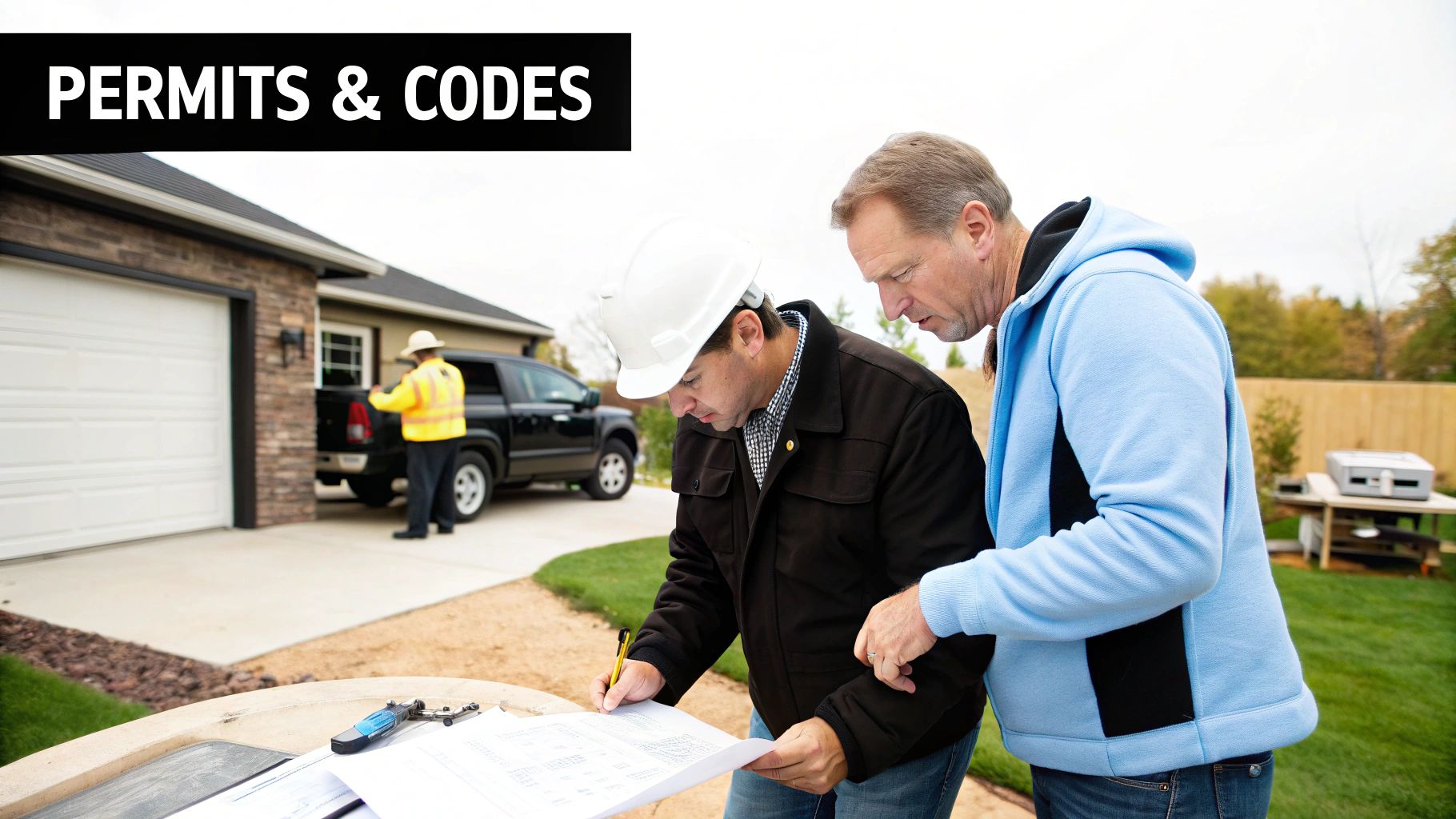
Let's be clear from the start: installing a cng fueling station at home isn't a weekend DIY project. It’s a serious construction upgrade that involves high-pressure gas, strict safety rules, and a whole lot of official paperwork. You have to think of it less like plugging in a new dryer and more like adding a new utility service directly to your property.
This process is strict for a very good reason. We’re talking about compressed natural gas, and the regulations are there to protect you, your family, and your neighbors. Trying to cut corners isn’t just risky—it can lead to massive fines and could even void your homeowner's insurance policy.
Understanding the Regulatory Landscape
Your first step is to wrap your head around who you'll be dealing with. A certified professional installer will be your best friend here, but as the property owner, it pays to know the key players.
You can expect your project to be reviewed by:
- The Local Building Department: They'll make sure the installation meets all structural and electrical requirements.
- The Local Fire Marshal: Their focus is purely on safety—proper ventilation, fire prevention, and emergency shut-offs.
- Your Natural Gas Utility: They need to sign off that your home's gas line can handle the extra demand without issue.
Key Takeaway: Don't view the permitting process as a roadblock. It's a critical safety net. Every signature from an inspector is an expert confirming your system is installed to strict, life-saving standards.
Getting through this all starts with knowing the rules for your specific area. For example, a solid grasp of local building codes is non-negotiable for a compliant project, as what's required in one town can be completely different from the next.
Core Site and Code Requirements
While every jurisdiction has its quirks, a set of fundamental requirements applies nearly everywhere, most of them based on standards like the National Fire Protection Association (NFPA) 52. Your installer won't even start the work until they've confirmed your property meets these criteria.
Critical Site Checklist:
- Proper Location and Clearances: You can’t just stick the compressor unit anywhere. It needs to be a specific distance from ignition sources (think furnaces or water heaters), windows, and doors. It also needs to be sited somewhere it won't get hit by a car.
- Adequate Ventilation: This is a big one for the fire marshal. Whether it's in a garage or an outdoor shed, the space needs enough airflow so that if a leak ever did occur, the gas (which is lighter than air) can escape harmlessly.
- Dedicated Electrical Circuit: A home CNG compressor is a powerful piece of equipment. It needs its own dedicated electrical circuit, put in by a licensed electrician, to avoid overloading your panel and creating a fire risk.
At the end of the day, this whole process hammers home why a professional installation is the only way to go. A certified expert does more than just hook up pipes—they make sure your system is safe, legal, and compliant from the moment it's switched on.
The Financial Reality of Home CNG Stations
Let's talk numbers. The idea of having your own personal fuel pump is undeniably cool, but installing a CNG fueling station at home is a serious financial decision. To figure out if it really makes sense for you, we need to get past the novelty and dig into the real-world costs.
When you break it down, the total financial picture has three main parts.
The Upfront Price Tag
The first hurdle, and it's a big one, is the initial capital investment. This isn't like buying a new washing machine; you're essentially adding a piece of industrial infrastructure to your home. The compressor unit alone can set you back anywhere from $5,000 to over $10,000, depending on its size and features.
Then there's the installation. For safety and code compliance, you absolutely need certified gas fitters and electricians to do this work. That professional installation will add another $2,000 to $4,000 (or more) to the bill.
Ongoing Costs to Keep It Running
Once your system is up and running, your expenses don't stop. The most noticeable ongoing cost will be the electricity needed to power that high-pressure compressor. So, while you're saving on vehicle fuel, you'll see a definite bump in your electric bill. How much depends on your local utility rates and how often you're filling up, but you have to factor this into your savings equation.
Beyond the power bill, you've got to budget for regular maintenance. These are sophisticated machines, and they need professional service to stay safe and efficient. Think annual inspections, filter changes, and replacing seals—all necessary to protect your investment and ensure the system lasts, adding a predictable yearly cost to your budget.
Calculating Your Payback
So, when do you actually start saving money? The payback for a home CNG station comes down to a simple question: how long will it take for your fuel savings to offset that hefty upfront cost?
Your return on investment (ROI) really boils down to two things:
- The Price Gap: The bigger the difference between the price of gasoline and your residential natural gas rate (plus the electricity to compress it), the faster you’ll break even.
- How Much You Drive: If you’re a high-mileage daily commuter, you’ll see a much quicker return than someone who just drives a few miles a week. The more you drive, the faster the savings pile up.
For the average homeowner, the payback period can easily stretch beyond a decade. Frankly, that makes the financial case pretty tough to justify. The economics start to look a lot better for a small business running a fleet of two or three vehicles from a central location, where the combined mileage can slash that payback time significantly.
While the global natural gas fueling station market is projected to boom, growing from USD 15 billion in 2025 to USD 45 billion by 2033, the at-home residential piece of that pie is tiny—less than 3% of the market. This really highlights the economic reality for individual homeowners. Right now, heavy-duty commercial fleets are driving over 70% of the demand for CNG. You can explore the full market dynamics to understand these trends in more detail.
Mobile CNG Delivery: A Flexible and Immediate Solution
Let's be realistic: for many projects, a permanent natural gas installation just isn't practical. The high upfront costs, the lengthy permitting process, and the absolute need for an active utility connection can bring a project to a screeching halt. When you're up against those kinds of roadblocks, you need a flexible alternative that gets you natural gas now. That’s exactly where mobile CNG delivery shines.
Think of it like a giant power bank for your construction site or business. Instead of waiting months for the utility to get you connected, a self-contained, fully-equipped CNG unit is brought right to you. This kind of service is a total game-changer in high-stakes situations where every day of delay costs real money.
When Mobile Delivery Makes Perfect Sense
Mobile CNG is the perfect problem-solver for those specific, critical moments that builders and businesses run into all the time. It’s designed to provide an immediate, temporary natural gas supply without locking you into a long-term commitment.
Here are a few scenarios where it's the ideal fit:
- Commissioning New Construction: Builders need to fire up furnaces, water heaters, and generators to pass inspections and secure a certificate of occupancy. Mobile CNG lets them do that even when the main gas line isn't live yet.
- Bridging Utility Delays: It’s common for a new development to wait months for the local utility to connect the gas infrastructure. Mobile CNG keeps the project moving forward on schedule.
- Emergency Pipeline Maintenance: If a business gets hit with a surprise pipeline outage, mobile delivery can keep operations online, preventing incredibly costly downtime.
This approach turns a major infrastructure headache into a straightforward logistics task. Instead of being at the mercy of the utility's schedule, you get a reliable gas supply delivered exactly when and where you need it.
The benefits are clear. Deployment can happen in a matter of hours, not months, and the service can be scaled to match your exact fuel requirements. Most importantly, it requires zero long-term capital investment in permanent equipment.
This on-demand flexibility is a world away from the fixed nature of traditional cng fueling stations at home. While the United States has seen its public fueling network grow to over 1,385 CNG stations—with 53% of those open to the public—the infrastructure for permanent home-based stations is still exceptionally rare. These private installations make up less than 1% of the total, a tiny fraction held back by high costs and regulatory hurdles.
You can discover more insights about the national CNG infrastructure on TransportProject.org. Mobile delivery simply bypasses all those barriers, giving you an agile and immediate solution for your temporary needs.
Your Practical Decision-Making Checklist
So, how do you decide between installing a permanent CNG station at home and opting for a more flexible route like mobile delivery? It all boils down to asking the right questions. Let's cut through the technical jargon and financial spreadsheets to create a simple framework for making the best call, whether you're a homeowner, a builder on a tight schedule, or a utility partner.
Answering these questions honestly will help you look past the cool factor of having your own personal fuel pump and land on a solution that actually works for your life and budget.
Key Questions for Your Project
Take a moment to really think through each of these. Your answers will paint a clear picture of what you truly need versus what could become a costly and complicated distraction.
What’s my real, day-to-day fuel demand?
Are you a super-commuter who’s constantly on the road, or do you just need a short-term gas supply to get a construction project over the finish line? A permanent station really only pencils out for consistent, long-term, high-volume use.Do I have the right space and utility connections?
This isn’t a DIY weekend project. A certified installer will need to confirm you have a well-ventilated spot that meets all the clearance codes. They’ll also check for an adequate natural gas line and a dedicated electrical circuit. If you don't have these, a permanent install is a non-starter.Have I actually talked to my local permitting office and fire marshal?
Don't assume anything. A quick phone call with the local authorities will tell you exactly what codes you're up against, how long the process takes, and what roadblocks you might hit in your specific area. Do this before you spend a dime.Is my need temporary or permanent?
This is the big one. If you just need gas to get appliances commissioned for a certificate of occupancy, or to get through a months-long utility delay, a permanent station is complete overkill. Mobile delivery was literally invented for these kinds of problems.
The right choice is the one that fits your timeline and goals. A permanent station is a long-term infrastructure investment. Mobile delivery is an immediate, targeted fix for a temporary problem.
It's worth noting that while the global CNG market is massive—valued at USD 92.21 billion—home fueling stations are just a tiny slice of that pie. Even in countries like China and India where CNG is popular, residential units have less than 5% penetration because they’re expensive and complex. This really drives home the point that for most people, a permanent setup is a niche solution. You can dig deeper into the global CNG market trends on Data Bridge Market Research. This framework will help you figure out if you're in that niche or if a flexible alternative is the smarter way to go.
Your Top Questions About Home CNG Answered
Even with all the technical details laid out, you probably still have some practical questions about what it’s really like to have a CNG fueling station at home. Let's tackle some of the most common ones that come up for builders and homeowners.
How Safe Is a CNG Fueling Station at Home?
This is usually the first question on everyone's mind, and for good reason. Home CNG systems are built with multiple, redundant safety features, like automatic shut-off valves and pressure relief devices designed to prevent problems before they start. It's also worth remembering that natural gas is lighter than air. In the rare event of a leak, it rises and dissipates quickly, which is a major safety advantage over gasoline vapor that pools on the ground and creates a fire hazard.
That said, all this built-in safety relies on one critical factor: professional installation. These systems must be installed by certified technicians who follow the NFPA 52 code to the letter. Trying to DIY this kind of project isn't just a bad idea—it's incredibly dangerous, illegal in most places, and will instantly void your warranty. Regular professional check-ups are also non-negotiable to ensure every safety component is working perfectly.
The Bottom Line: When installed and maintained by a certified pro, a home CNG station is very safe. The real danger comes from trying to cut corners on installation or maintenance, which is something you should never do with high-pressure gas.
Is a Home CNG System Better Than an EV Charger?
This really boils down to your vehicle and what you need it to do. If you drive a CNG-powered work truck or a heavy-duty van, you know that the power and range often beat what today's EVs can deliver. In that scenario, having a home CNG system to refuel overnight is a game-changer.
On the other hand, the upfront cost for a CNG setup is way higher than for a Level 2 EV charger. For the average person driving a standard passenger car, the math just works out better for electric. With lower installation costs, a massive selection of EV models, and simpler infrastructure, home EV charging is the more straightforward and accessible choice for most households.
Can I Power a Construction Site with Mobile CNG?
Absolutely. In fact, this is one of the most powerful applications for mobile CNG. Imagine your construction project is ready for inspection, but you're still waiting on the utility to connect the permanent gas line. You can't run the HVAC systems, fire up the water heaters, or test the permanent generator without fuel.
A mobile CNG unit is the perfect temporary fix. It lets you power everything you need to pass those critical inspections, keep your project on schedule, and get that certificate of occupancy without being at the mercy of the utility company's timeline.
What Is the Biggest Hurdle to Installing a Home CNG System?
Without a doubt, the two biggest roadblocks are the high cost and the regulatory headaches. The initial price tag for the compressor, storage tanks, and the certified installation can easily run over $20,000. That's a steep investment for the average homeowner.
Then there's the red tape. You have to navigate a maze of local zoning ordinances, building permits, and fire safety codes. This isn't something you can figure out on your own; it requires a specialist and can drag the process out for months. This one-two punch of high cost and bureaucracy is exactly why permanent cng fueling stations at home are still a niche solution.
When a permanent installation gets bogged down by delays or just doesn't make sense for your project, you need a flexible alternative to stay on track. Blue Gas Express delivers mobile CNG right to your site, giving you the natural gas you need, exactly when you need it. See how our temporary gas services can bridge the gap and keep your project moving forward.