

When it comes to getting CNG fuel for your operations, you've basically got three ways to go: use public stations, build your own private depot, or have it delivered right to your job site. Each one solves a different problem, whether you're running a fleet of trucks or firing up equipment at a construction site that's still waiting on a utility line.
Figuring out which path is right for you is the first real step toward locking in a reliable, cost-effective energy supply.
Your Three Main Options for Sourcing CNG Fuel
Think of it like getting water for a big project. You could tap into the city's main line (public stations), drill your own well for a permanent supply (private station), or have a tanker truck bring it in for a temporary job (mobile delivery). None of these is inherently better than the other; the best choice just depends on what you're trying to accomplish.
Your decision will come down to a few key things: the scale of your operation, where you're located, and whether this is a short-term need or a long-term plan. This choice directly impacts your upfront investment, your ongoing fuel costs, and all the logistics that go with it.
Breaking Down Your Choices
Let's unpack these options. They aren't just different ways to get fuel—they're completely different strategies for managing your energy.
- Public CNG Stations: These are just like regular gas stations, but for natural gas. They're a great fit for vehicle fleets that stick to common routes. The big plus? No capital investment on your part. The downside? You're entirely dependent on the existing public network.
- Private Fueling Stations: This is the go-big option. Building your own on-site station is a long-term play for large, centralized operations. It gives you total control over your fuel supply and costs, but it comes with a serious price tag for construction and permitting.
- Mobile On-Site Delivery: This is your flexible, get-it-done-now solution. We call it a "virtual pipeline"—specialized trailers bring CNG directly to your location. It's perfect for bridging the gap until utilities are connected, powering temporary equipment, or handling emergencies without needing to build a thing.
This decision tree gives you a quick visual on how to pick the right CNG source for your needs.
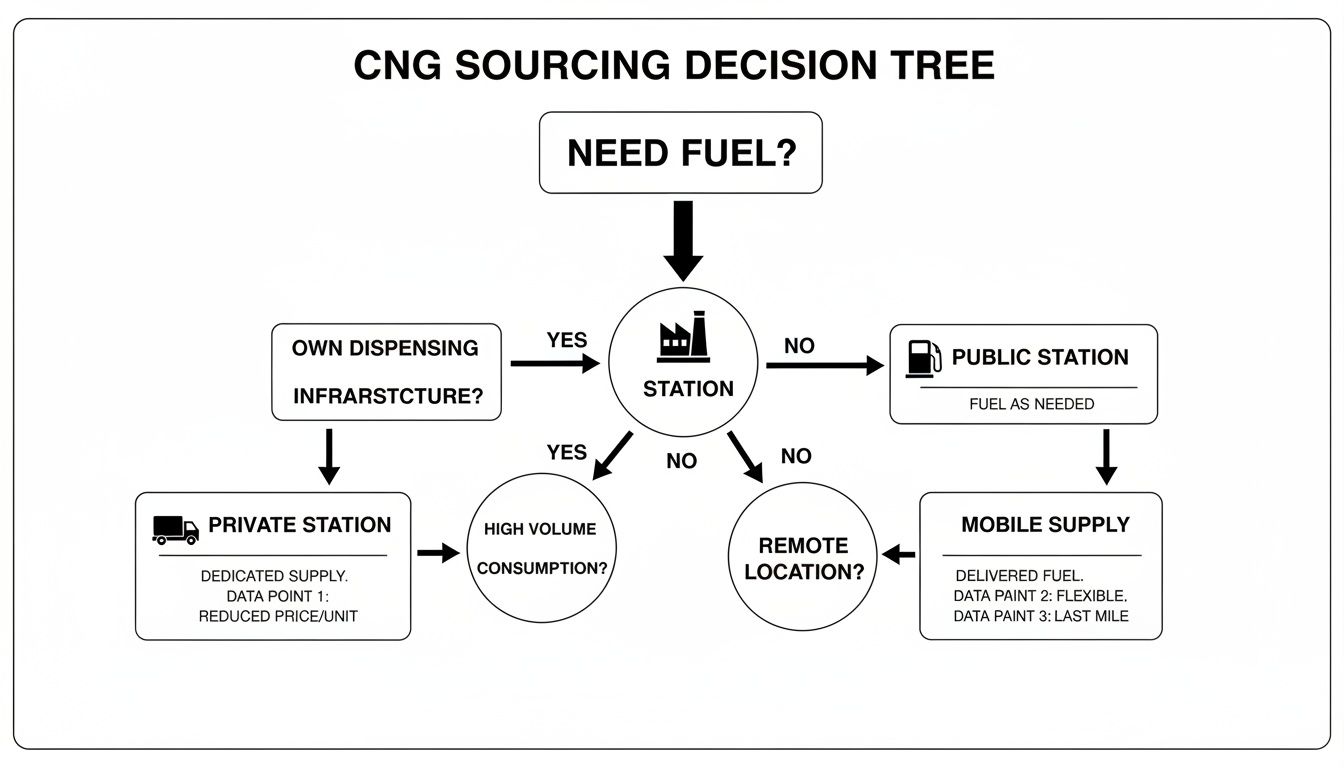
As you can see, a simple question—"Need Fuel?"—quickly branches out into clear solutions designed for fleets, permanent industrial sites, or temporary projects.
CNG Fuel Sourcing Options at a Glance
To make it even clearer, here's a quick breakdown of how these three methods stack up against each other.
| Sourcing Method | Ideal For | Key Benefit |
|---|---|---|
| Public Stations | Vehicle fleets on established routes | No upfront capital investment |
| Private Stations | Large, centralized fleets or facilities | Long-term cost control and supply security |
| Mobile On-Site Delivery | Temporary projects, utility gaps, emergencies | Speed, flexibility, and zero infrastructure cost |
Each method has its place, and the table helps highlight where your operation might fit best.
The real takeaway here is that your fueling strategy has to match your business goals. For a construction manager on a tight deadline, mobile delivery is a lifesaver. For a logistics company running a hundred trucks out of one hub, a private station could be a brilliant long-term investment.
Ultimately, one of these three paths will be the right fit for your operation. In the next sections, we'll dive deeper into each one, giving you the details you need to move from simply understanding your choices to making the right one with confidence.
When your business runs on compressed natural gas (CNG), the big question is always: where do you get the fuel? For most companies, especially those with fleets to manage, the answer usually involves a fixed fueling station. This looks a lot like what we’re all used to with gasoline, but you have two main choices: using public stations or investing in your own private one.
The simplest way to get started is by using the public station network. It’s exactly what it sounds like—your drivers pull up, fill up, and pay at the pump. This approach is fantastic for smaller fleets or for companies just dipping their toes into natural gas because there's zero upfront capital investment needed for fueling equipment. You just pay as you go.
The trade-off, of course, is that you’re completely dependent on where those public stations are located.
Tapping into the Public CNG Station Network
Finding a public place to buy CNG fuel is much easier than it used to be. The trick is simply planning your routes so drivers are never too far from a fill-up. Great tools are available for this, like the U.S. Department of Energy’s Alternative Fuels Data Center (AFDC) Station Locator, which shows you exactly where to go.
And that network is bigger than you might think. As of early 2026, there are nearly 1,400 CNG stations across the United States ready to fuel the clean transport industry. The best part? 53% of them are open to the public, making it pretty simple for any fleet to get what it needs. A solid 46% of these stations are also equipped for heavy-duty Class 8 trucks, which is a game-changer for logistics and industrial companies hauling materials through states like North Carolina, South Carolina, Tennessee, and Virginia. You can explore additional insights into the growing CNG market to get a better feel for the landscape.
Despite the convenience, relying on public stations has a few catches:
- Route Dependency: Your trucks have to stick to routes that have stations. No station, no go.
- Price Volatility: You're paying retail prices at the pump, which can change without notice.
- Potential for Congestion: Popular stations can get crowded, leaving your drivers waiting in line.
Because of this, public stations are a perfect match for fleets that run the same predictable routes day in and day out. But if your operations are more spread out or unpredictable, you might feel a bit constrained.
The Strategic Value of Private Fueling Stations
For larger, more centralized operations, the ultimate move is building your own private station right on your property. Think of it like a factory installing its own power generator—it’s a serious investment, but it gives you total control and long-term security.
A private station is built right at your home base, whether that’s a trucking depot, a city's waste management yard, or a massive distribution center. The number one advantage here is gaining unparalleled control over your fuel supply and costs.
When you buy natural gas directly from the utility and compress it yourself, you cut out the retail middleman. This lets you lock in more stable, long-term pricing and can save you a tremendous amount of money over the station's lifetime, often more than paying back the initial cost.
Having your own station brings a few other major perks to the table:
- Guaranteed Availability: The fuel is always there for you. No more worrying about a public station being down or dealing with long lines.
- Optimized Refueling: You can set up the station exactly how you need it and schedule refueling for overnight or other off-peak times to keep things moving efficiently.
- Smarter Fleet Management: On-site fueling makes logistics a breeze and gets rid of the wasted time and "deadhead" miles your drivers spend just looking for fuel.
Deciding to build your own station is obviously a big step. It requires a significant upfront investment in equipment and construction, plus you’ll need to handle the permitting process and plan for regular maintenance. But for any organization with a sizable fleet and a long-term strategy, the return—both in dollars saved and operational strength—can be massive. It effectively turns fuel from a fluctuating expense into a managed, predictable asset.
Mobile CNG Delivery: The "Virtual Pipeline" Solution
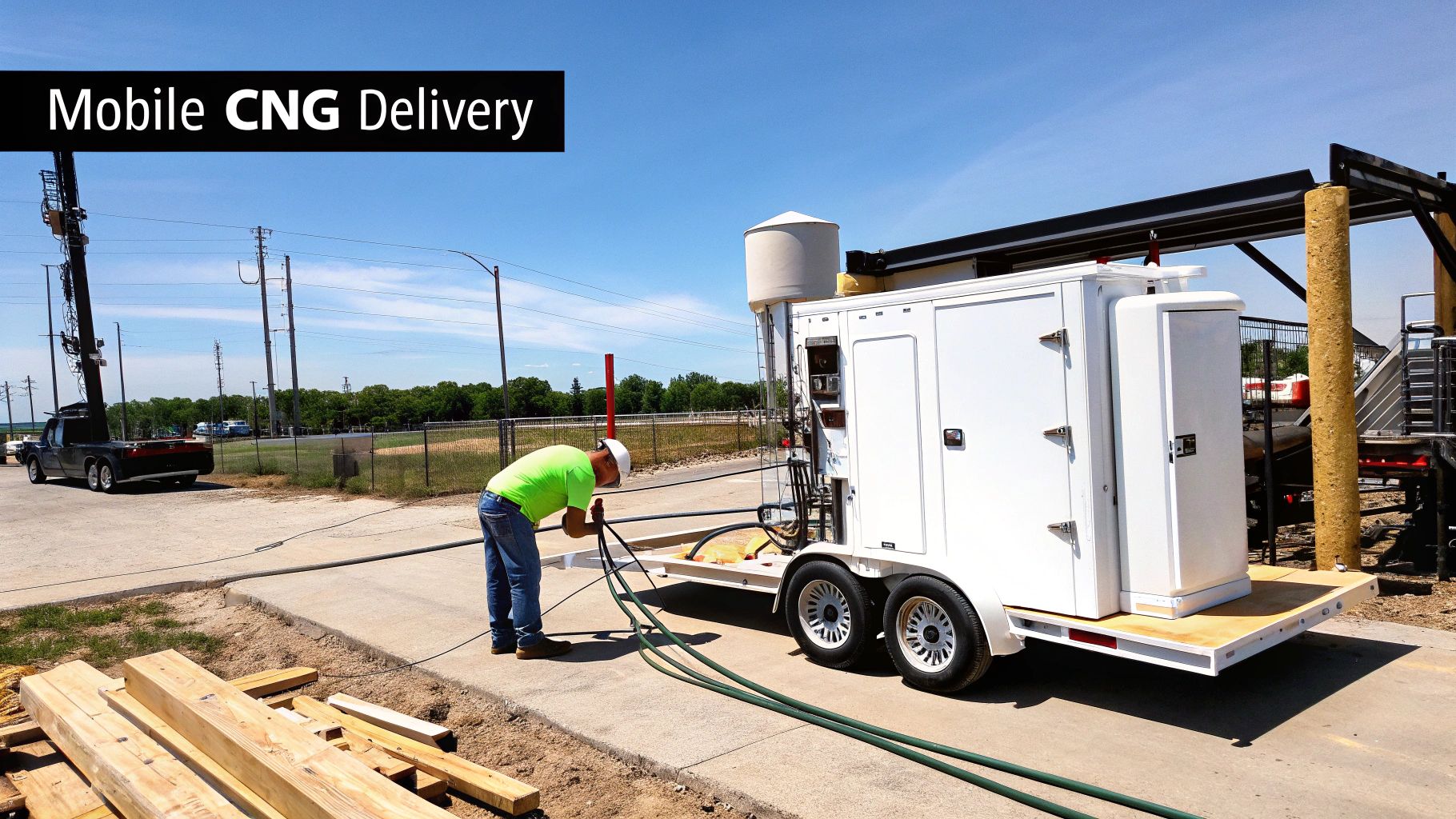
What happens when your job site is miles from the nearest natural gas pipeline? Or what if the utility connection you were promised is suddenly months behind schedule? These are common problems that can bring a project to a screeching halt, costing you time and money. Mobile CNG delivery is the answer, offering a flexible and immediate way to close those infrastructure gaps.
This clever approach is often called a "virtual pipeline." Instead of relying on a physical pipe in the ground, we use specialized trailers to bring compressed natural gas directly to you. These mobile units become your temporary, on-demand energy source, bridging the gap until permanent utilities are ready or service is restored.
Think of it less as a simple convenience and more as a critical lifeline. It frees you from depending on fixed infrastructure and delivers the power you need, right when and where you need it.
Why a Virtual Pipeline Is a Game Changer
Let's get practical. Imagine you're a construction manager on a new residential development. The homes are built, but the local utility is a staggering six months behind on installing the gas main. Without gas, you can't commission the generators, test the heating systems, or get that all-important Certificate of Occupancy.
Every day of delay means bleeding money and dealing with unhappy homebuyers. This is the perfect situation for a virtual pipeline. A mobile CNG provider like Blue Gas Express can roll a temporary unit onto the site, supply the fuel to get all systems commissioned, and help you secure the permit. The entire project stays on track.
Or consider an industrial facility. A manufacturing plant might have a planned utility outage scheduled right in the middle of winter. Without a backup plan, production stops, and you risk frozen pipes causing catastrophic damage. Mobile CNG delivery provides a seamless, temporary fuel source to keep the boilers hot and the assembly line moving.
What these examples really show is how mobile delivery turns a potential crisis into a manageable logistics task. It ensures you can keep working, prevents expensive shutdowns, and helps you hit deadlines that would otherwise be impossible.
Key Applications for Mobile CNG
The sheer flexibility of a virtual pipeline makes it a great fit for a huge range of industries and situations. When businesses integrate this solution, following smart fleet management best practices is key to ensuring the service is reliable and cost-effective.
Here are just a few of the most common reasons companies choose to buy CNG fuel through mobile delivery:
- Construction Site Power: Providing temporary heat to cure concrete, run on-site generators, and commission HVAC systems long before the utility company shows up.
- Utility Outage Bridging: Supplying natural gas to critical facilities like hospitals, factories, or large commercial buildings during planned maintenance or unexpected pipeline interruptions.
- Pipeline Integrity Testing (Pigging): Using CNG to pressurize sections of new or existing pipelines to test their integrity and confirm they are safe to operate.
- Emergency Response: Quickly deploying fuel to power essential infrastructure, such as communication towers or emergency shelters, after a natural disaster.
In every one of these cases, the ability to bring the fuel directly to the point of need is what makes the virtual pipeline so incredibly valuable.
A virtual pipeline isn't just about delivering fuel; it's about delivering operational certainty. It removes the 'what if' from your project planning, whether that's 'what if the utility is delayed?' or 'what if there's an unexpected outage?'
How the Process Works
Getting set up with mobile CNG is a surprisingly straightforward process built for speed. It all starts with a quick assessment of your energy needs—we figure out how much fuel you'll need and at what pressure. From there, the provider sends a specialized high-pressure tube trailer to your location.
Once on-site, a trained technician connects the trailer to your equipment using a pressure reduction system. This rig safely "steps down" the gas pressure from the trailer to the exact level your machinery needs to run. The mobile unit essentially becomes your private gas main, delivering a steady, reliable fuel flow.
The whole system is built for safety and efficiency. A good provider handles all the logistics for you, from transport and setup to permitting and ongoing monitoring. It’s a turnkey approach that lets you focus on your real job while the energy supply is managed by experts, giving you the power to get things done without missing a beat.
How to Arrange for Temporary CNG Fuel Delivery
Getting a temporary CNG supply delivered to your site is a lot more straightforward than most people think. When you need to buy CNG for a short-term project, it's not about wrestling with complex supply chains. It’s a clear, logical process. Once you break it down, arranging for a "virtual pipeline" becomes a simple matter of logistics, free from guesswork and delays.
Let's walk through the entire process, from figuring out your needs to the final hookup. Following these steps ensures your provider has everything they need to deliver a safe, reliable, and perfectly timed energy solution for your site.
Step 1: Define Your Energy Needs
Before picking up the phone, you need a solid handle on what you actually require. This isn't just about saying, "I need gas." It's about putting real numbers to that need. A good provider can certainly help you dial in the specifics, but coming to them with a good baseline makes the whole process faster and more accurate.
Think of it like ordering concrete for a job site. You wouldn't just ask for "a truckload." You'd specify the exact yardage and psi required for the slab. The same idea applies here.
You’ll need to figure out two key things:
- Total Volume: How much CNG will you burn through for the entire project? This comes down to the fuel consumption rate of your equipment (often measured in BTUs for heaters or cubic feet per hour for generators) and how long you expect to run it.
- Flow Rate and Pressure: At what rate and what pressure does your equipment need the gas? A massive industrial boiler has very different needs than a small temporary heater. This info is almost always on the equipment’s manufacturer data plate.
Getting these details sorted out is the most important first step you can take.
Step 2: Engage a Provider
With your numbers in hand, it’s time to reach out to a mobile CNG supplier. This first conversation is really a translation exercise—turning your project's needs into a specific equipment and delivery plan. The more details you can give them upfront, the better their solution will be.
The goal of this first call is to give the provider a complete picture of your operational context. They aren’t just selling you fuel; they are engineering a temporary utility service tailored to your site's unique conditions and safety requirements.
To make that first call as productive as possible, have this information ready:
- Project Location: A precise address is crucial for planning delivery routes and figuring out local permitting.
- Equipment Details: What's the make, model, and technical specs of the machinery you're powering?
- Project Timeline: When do you need to start, and when do you plan to finish? This allows them to reserve equipment and schedule personnel.
- Site Contact: Who is the go-to person on-site that will coordinate the delivery and setup?
Being prepared with these answers means you'll get a real quote and a solid deployment schedule right away.
Step 3: Prepare Your Site for Delivery
When a mobile CNG unit is coming, safety and logistics are everything. Your provider will handle all the technical setup, but it’s your responsibility to make sure the site is ready for them. A mobile CNG trailer is a big piece of equipment, and it can't just be dropped anywhere.
Your provider will give you a site prep checklist, but it usually boils down to a few key things. The spot for the CNG trailer must be level, firm, and easy for a large truck to get to. It also has to be a safe distance from buildings, potential ignition sources, and busy areas, as laid out in local fire codes.
Here’s the good news: a qualified provider like Blue Gas Express will manage the whole permitting process with the local fire marshal for you. They know the specific codes inside and out for states like North Carolina, South Carolina, Tennessee, and Virginia, ensuring your setup is 100% compliant from day one.
Step 4: Schedule and Coordinate Deployment
The final piece of the puzzle is scheduling the actual delivery and hookup. Your timeline is critical here. You want that mobile CNG unit to arrive exactly when you need it—not too early, where it clogs up your site, and definitely not too late, which causes costly delays.
You’ll work directly with the provider’s logistics team to lock in a delivery date and time. Once the unit arrives, their technicians will position the trailer, install the pressure reduction system, and safely connect it to your equipment. They’ll run a full system check to make sure everything is working perfectly before handing it over. From that point on, they'll monitor your fuel levels and schedule refills as needed, guaranteeing you have an uninterrupted supply for the entire project.
Understanding the Cost of Buying CNG Fuel
Let's talk about the money side of things, because that’s what really matters for any business looking at CNG. When you go to buy compressed natural gas, the price you see isn't just about the raw gas. You have to factor in the entire journey it takes to get that fuel from a pipeline into your equipment, ready to use.
Think of it like buying lumber for a big construction project. The price of the raw wood is just the beginning. The final bill includes the cost of milling it, treating it, and trucking it to your job site. CNG is the same—the price you pay bundles together the compression, storage, and all the logistics needed to get it where you need it.
Breaking Down the Core Cost Factors
The final price tag on CNG isn't one simple number; it’s built from a few key components. Knowing what they are gives you a much clearer picture of what you're actually paying for.
- Market Price of Natural Gas: This is your starting point. It’s a commodity price that ebbs and flows with supply and demand, but it's almost always more stable and lower than oil prices.
- Compression Costs: Gas straight from a utility pipeline is at very low pressure. It takes a tremendous amount of energy—and some serious machinery—to compress it into a small, dense, usable form. That process costs money.
- Transportation and Logistics: If you’re getting CNG delivered, this is the cost of the "virtual pipeline." It covers the specialized trailers, certified drivers, and the coordination required to bring the fuel directly to your site.
This pricing model is pretty much the global standard. Take the Asia Pacific region, which is the world leader in natural gas vehicles. Countries like India and China are seeing their CNG markets explode—projected at an 11.91% CAGR to hit $553.62 billion by 2034. That massive growth is happening because even with these extra costs baked in, CNG still makes incredible economic sense. In India, government support has helped build over 6,000 CNG stations, and the fuel is grabbing more market share every year. You can dig into a deeper analysis of these global CNG market trends on Technavio.com.
CNG vs. Traditional Fuels: A Cost Comparison
For vehicle fleets, the math on CNG gets really interesting when you stack it up against gasoline and diesel. While pump prices always bounce around, CNG consistently costs less per gasoline gallon equivalent (GGE).
Over the long haul, those savings are huge. A fleet of heavy-duty trucks can save thousands of dollars per vehicle, per year, on fuel alone. That kind of savings makes the upfront cost of converting or buying CNG-ready vehicles a smart financial move.
Mobile CNG: The Cost of Avoiding Delays
Now, when we talk about mobile delivery, the financial equation shifts a bit. In this case, the cost of temporary CNG isn't just an expense—it's an investment in keeping your operation running. You're not just buying fuel; you're buying peace of mind and sidestepping potentially massive financial hits.
The true value of mobile CNG is measured not by its price, but by the catastrophic costs it prevents. A single day of project shutdown due to a lack of power or heat can cost tens of thousands of dollars in labor, penalties, and lost revenue.
Think about it in these real-world terms:
- A construction project needs temporary heat to cure concrete on a tight schedule. A delay doesn't just push back the timeline; it could trigger hefty late-completion fines.
- An industrial plant has its gas utility cut off in the middle of winter. The cost of bringing in mobile CNG to keep the facility warm is a tiny fraction of what it would cost to repair burst pipes and recover from a complete production shutdown.
In situations like these, the return on investment for temporary CNG is off the charts. Paying for a mobile fuel supply to keep a multi-million-dollar project on track isn't just a good idea—it's a no-brainer. The cost of the gas becomes an insurance policy against a truly crippling operational failure.
Finding the Right Mobile CNG Partner
So, you've got the lay of the land on how to buy CNG and you see just how critical mobile delivery can be for keeping a project on track. The last, and maybe most important, step is picking the right partner to bring that virtual pipeline to your site. This is especially true when you're up against the clock in North Carolina, South Carolina, Tennessee, or Virginia.
Think of it this way: your mobile CNG provider is more than just a vendor. They become a vital part of your operations team, the experts who step in to manage utility delays or power your site when there’s no grid access. Getting this choice right is about ensuring your temporary fuel solution is safe, seamless, and keeps your project moving forward without a hitch.
What to Look for in a Top-Notch Provider
When you're comparing your options, look past the slick brochures and websites. What really matters is a proven track record of delivering under pressure. Your project’s success hangs on their reliability, so it pays to do your homework.
Here’s what separates the best from the rest:
- Speed and Agility: When an emergency hits, how fast can they mobilize? You need a partner who can get a unit on-site in a matter of hours, not days.
- A Rock-Solid Safety Record: Don't be shy about asking for their safety protocols, technician certifications, and incident history. When dealing with high-pressure gas, there is zero room for error.
- Flexible and Scalable Solutions: Your fuel needs might change as the project evolves. Can they ramp supply up or down on demand? You want a solution that molds to your project, not a rigid, one-size-fits-all rental.
How to Vet a Potential Partner
Before you sign on the dotted line, you need to ask some tough questions. This isn't just a formality; it's the step that can save you from massive headaches later on. Treat this process with the same seriousness as hiring a critical subcontractor—because that's exactly what they are.
A great mobile CNG provider doesn't just deliver fuel; they deliver peace of mind and operational continuity. They’re the ones who handle the complicated logistics, permitting, and safety so you can stay focused on your core business.
Make sure any potential partner can give you clear, confident answers to these questions:
- Who handles the permitting? A seasoned provider will take the lead, managing the entire process with the local fire marshal and authorities.
- What's your operational footprint? Confirm they have a real, established presence in your state, whether that's NC, SC, TN, or VA.
- Can you show me real-world examples? Ask for case studies or references from other clients in the region who faced challenges similar to yours.
In the end, this decision comes down to trust. You're looking for a team that can keep your project energized and on schedule, no matter what surprises come your way. This ensures that when you need to buy CNG for a temporary job, you’re not just getting a tank of gas—you’re getting a complete solution.
Frequently Asked Questions About Buying CNG
When you're looking into buying CNG fuel for the first time, it's natural to have a lot of questions. Getting straight answers is the first step to feeling confident about your decision, whether you need a temporary setup for a construction site or are looking at options for a vehicle fleet.
Let's walk through some of the most common things people ask.
Is CNG Only Used for Vehicles?
That's a common misconception, but no, it's far more flexible than that. While fueling vehicle fleets is a big part of what CNG does, its real power lies in its versatility.
Think of mobile CNG as a "pipeline on wheels." It’s a perfect temporary stand-in whenever a standard utility line isn't available. We see it used all the time to provide temporary heat for curing concrete on job sites, to fuel industrial boilers when a plant's main supply is down for maintenance, or to run massive generators for building commissioning.
Basically, any equipment that normally runs on piped natural gas can be powered by a temporary mobile CNG supply. If you want to get into the technical details, this resource on Compressed Natural Gas (Methane Compressed) is a great place to start.
How Do I Calculate the Amount of CNG I Need?
Figuring out exactly how much CNG you'll need comes down to your specific equipment. There's no magic number, but the calculation is pretty simple once you have the right information.
- For heating applications: It all depends on your equipment's BTU rating and how many hours you plan to run it.
- For power generation: You'll need to know the generator's fuel consumption rate, which is typically measured in cubic feet per hour.
Any good provider will help you with this math. The best thing you can do is have the technical specs for your equipment handy when you first call. That way, they can build a supply plan that's accurate and ensures you never run out of fuel mid-project.
What Permits Are Needed for a Temporary Setup?
Yes, you'll almost always need permits for a temporary fuel installation. These are typically handled through the local authorities, especially the fire marshal. Safety is priority one, and these regulations cover things like where the CNG unit can be placed, how far it needs to be from other structures, and making sure all the equipment is properly grounded.
A seasoned mobile CNG provider knows these local codes inside and out. They should handle the entire permitting process for you, which is a huge weight off your shoulders. This ensures your site is 100% compliant and safe from day one.
How Quickly Can Mobile CNG Be Deployed?
One of the biggest advantages of mobile CNG is how fast it can be on-site, particularly in an emergency. If a utility line gets cut unexpectedly, a provider can often have a unit delivered and running in just a few hours.
Of course, this depends on your location and equipment availability. For planned projects, delivery is scheduled to fit your timeline perfectly, so there are no hold-ups.
When your operations can't afford to stop, having a reliable source for temporary CNG is non-negotiable. Blue Gas Express specializes in fast, safe, and fully permitted mobile natural gas delivery across NC, SC, TN, and VA, making sure your project keeps moving forward. Learn how we can solve your temporary energy needs today.