

When you have multiple teams working on a single, complex job site, things can get messy. Fast. OSHA’s contractor safety requirements cut through the confusion by clearly defining who is responsible for what. The bottom line is that the controlling employer—think the general contractor or site owner—is on the hook for overall site safety. At the same time, each subcontractor is responsible for their own crew's safety and compliance. This structure is designed to eliminate dangerous gaps in oversight and make sure everyone understands their role.
Defining Roles on a Multi-Employer Worksite
A busy construction site is a puzzle of moving parts. Without a clear understanding of who's in charge of safety, accidents are bound to happen. That’s where OSHA’s Multi-Employer Worksite Policy comes in. It’s a framework that assigns specific safety duties based on a company's role and its level of control over the job site. This policy effectively stops the finger-pointing when a hazard pops up.
Think of it like air traffic control at a major airport. The controlling employer (the GC or owner) is the control tower. They aren't flying the planes themselves, but they're managing the entire airspace, making sure runways are clear and communication is flowing to keep the whole operation safe. They have the authority—and the responsibility—to correct hazards across the entire site.
In this scenario, each subcontractor is a pilot in charge of their own plane and crew. They have to follow the rules set by the tower, but they are also directly accountable for their team's training, their equipment, and their specific actions on the job. This model of shared responsibility is the core of OSHA's approach to contractor safety.
This diagram shows the typical hierarchy you'll find on a multi-employer worksite, illustrating the relationship between the controlling employer, general contractor, and subcontractors.
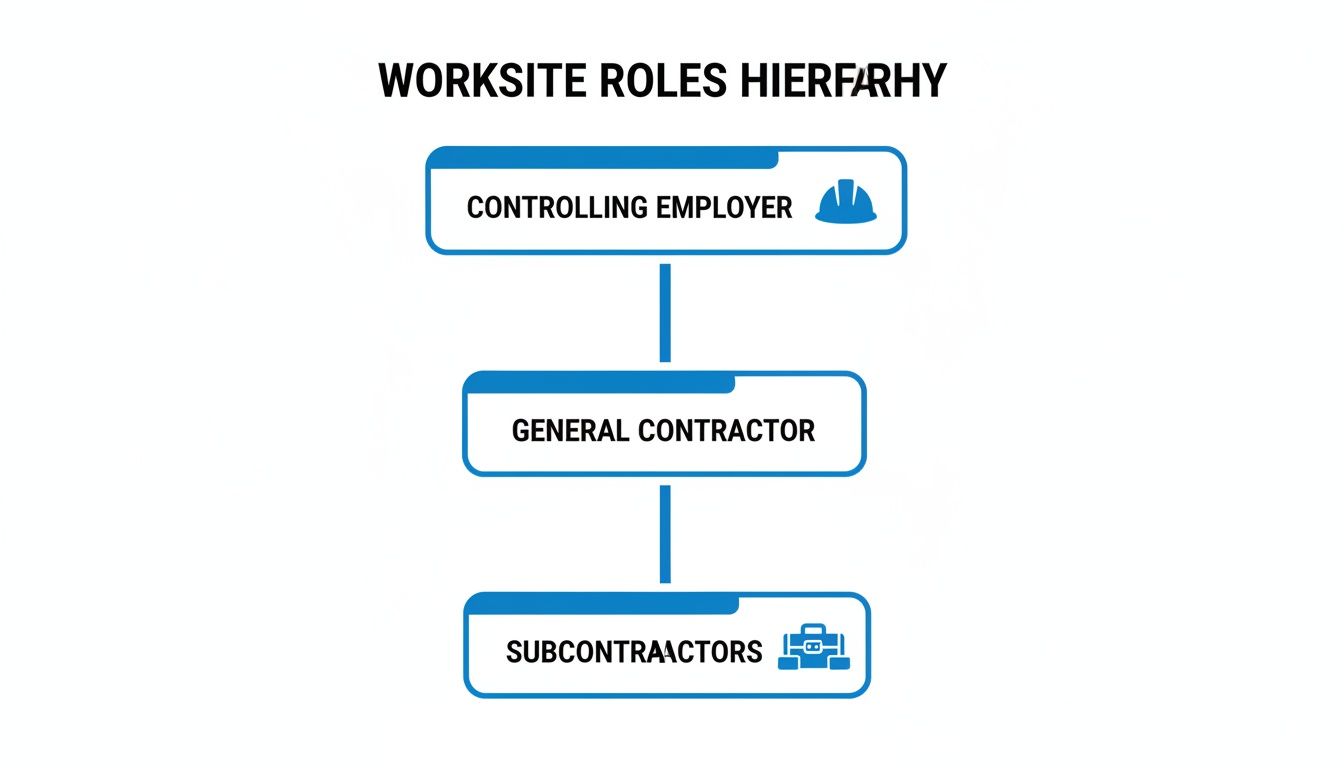
As you can see, while subcontractors manage their own crews, the controlling employer holds the ultimate responsibility for site-wide safety.
Understanding Your Specific Employer Category
To drill down even further, OSHA defines four distinct employer categories on a multi-employer site. Figuring out where you fit is the key to understanding your specific duties and potential liabilities. It’s not about your company's size; it’s about your actions and awareness concerning a particular hazard.
- Creating Employer: This is the company that actually created the hazard. If an electrical contractor leaves live wiring exposed, they are the creating employer.
- Exposing Employer: This is any company whose own employees are exposed to the hazard, no matter who created it. A painting crew working near that same exposed wiring is an exposing employer.
- Correcting Employer: This is the employer responsible for fixing the hazard. It might be the controlling employer or a specialist brought in for that specific task, like a dedicated safety contractor.
- Controlling Employer: This is the company with general supervisory authority over the worksite—the one with the power to order hazards to be corrected. The general contractor almost always fills this role.
It's important to remember that a single company can wear multiple hats. That electrical contractor who created the hazard (creating) is also responsible for their own team members working near it (exposing).
Key Takeaway: OSHA's policy makes safety a shared responsibility, but with clearly defined lines. You can't just ignore a hazard because you didn't create it, especially if your people are exposed or you have the authority to get it fixed. This proactive mindset is crucial for preventing incidents, particularly on complex jobs that involve coordinating temporary services like mobile natural gas units.
Core OSHA Standards Every Contractor Must Follow
If you try to read through the entire library of OSHA regulations, your head will spin. The good news is you don't have to. For most construction projects, a handful of core standards cover the biggest dangers your crew will face day in and day out.
Think of these as the non-negotiables. They directly address the hazards behind OSHA's "Fatal Four"—falls, struck-by objects, electrocutions, and caught-in/between incidents. These four dangers are responsible for more than half of all construction worker deaths every year, so getting these right is job one.
Let's break down the standards that show up again and again on citations and, more importantly, in accident reports.
The Top Cited OSHA Construction Standards and Key Requirements
Year after year, OSHA's list of most-cited violations in construction looks remarkably similar. This table highlights the usual suspects—the standards that are most frequently missed on job sites. Mastering these is a huge step toward a safer project and avoiding hefty fines.
| Standard (29 CFR 1926) | Standard Name | Core Compliance Requirement |
|---|---|---|
| .501 | Fall Protection | Must provide fall protection (guardrails, nets, or personal fall arrest systems) at 6 feet or higher on unprotected sides. |
| .1053 | Ladders | Use ladders correctly; ensure they are inspected, can support the load, and are set up at the proper angle. |
| .503 | Fall Protection – Training | Train every worker who might be exposed to fall hazards to recognize and minimize the risks. |
| .451 | Scaffolding | Ensure scaffolds are designed, erected, and inspected by a competent person before and during use. |
| .102 | Eye and Face Protection | Provide and require appropriate eye or face protection when workers are exposed to hazards from flying particles, molten metal, etc. |
| .652 | Excavations – Protective Systems | Use protective systems (sloping, shoring, or shielding) in trenches 5 feet or deeper to prevent cave-ins. |
| .21 | Safety Training and Education | Instruct each employee in recognizing and avoiding unsafe conditions applicable to their work environment. |
As you can see, fall protection isn't just one item—it dominates the top of the list. That's why it deserves a closer look.
Fall Protection: The Top Priority
If there’s one area to be absolutely militant about, it’s fall protection. Falls are, without a doubt, the number one killer in construction. It’s also the most frequently cited OSHA violation, which tells you that plenty of sites are still getting it wrong.
The key rule here is 29 CFR 1926.501. This standard is crystal clear: if you have workers on a surface with an unprotected edge that is six feet or more above a lower level, you must provide fall protection. This isn’t a suggestion; it’s a direct order with specific, approved methods.
- Guardrail Systems: The best option when possible. A physical barrier is always better than relying on a harness because it prevents the fall from ever happening.
- Safety Net Systems: When guardrails aren't practical, nets can be installed below the work area to catch a falling worker.
- Personal Fall Arrest Systems (PFAS): This is your classic setup of a full-body harness, a lanyard, and a solid anchor point. It doesn't prevent the fall, but it stops it from becoming fatal.
The right system depends entirely on the task at hand, but the one thing that's not an option is doing nothing.
Personal Protective Equipment (PPE)
Next up is the gear that acts as a worker’s last line of defense against injury: Personal Protective Equipment, or PPE. The governing standard, 29 CFR 1926.95, puts the responsibility squarely on the employer to assess the job site for hazards and give employees the right gear to protect themselves—at no cost to them.
Think of PPE as armor tailored for the job. A hard hat can turn a potentially lethal blow from a dropped tool into a minor incident. Safety glasses are the only thing standing between a flying piece of rebar and permanent blindness.
Crucial Insight: PPE is the last resort. Before you hand out hard hats and gloves, you are required to first try and engineer the hazard away (like installing machine guards) or use administrative controls (like creating a "no-go" zone). PPE is for the risk that's left over.
Trenching and Excavation Safety
Working below ground level introduces one of the most terrifying and deadly risks on any site: cave-ins. A trench wall can collapse in an instant, and the weight of the soil is immense—a single cubic yard can weigh as much as a car.
This is why OSHA's standard 29 CFR 1926.652 is so strict. It requires a protective system in any trench five feet deep or greater, unless you are digging in solid, stable rock.
There are three primary ways to keep your crew safe:
- Sloping: Cutting the trench walls back at a safe angle.
- Shoring: Using supports like hydraulic jacks to hold the trench walls in place.
- Shielding: Placing workers inside a "trench box" that can withstand a collapse.
A designated "competent person" must inspect the trench every day before work starts and any time conditions change (like after a heavy rain). It's a life-or-death inspection. Digging into specific industry rules, like the OSHA trucking rules, shows just how tailored these safety standards can be to different work environments.
Electrical Safety Standards
Electrocution is another member of the Fatal Four, and it’s an ever-present danger on sites with temporary power. The cornerstone of electrical safety during maintenance and service work is 29 CFR 1910.147, the standard for Lockout/Tagout (LOTO).
LOTO is a set of procedures to ensure that machinery or equipment is completely shut off and can't be started up again while someone is working on it. This is absolutely critical for any system that could unexpectedly energize, including the temporary natural gas lines we deal with.
Before anyone puts a wrench on that equipment, the energy source must be isolated, locked out with a physical lock, and tagged with the name of the person working on it. That machine stays off until that person, and only that person, removes their lock. It’s a simple process that has saved countless lives.
Managing High-Risk Tasks and Specialized Operations
The basics like hard hats and safety glasses handle the day-to-day stuff, but many jobs involve operations that are in a whole different league of danger. These high-risk tasks demand more than just standard gear. They require meticulous, step-by-step procedures, formal permits, and sharp oversight to prevent a catastrophe.
Think of it like this: a regular driver's license is fine for your daily commute. But if you’re hauling hazardous materials, you need a special endorsement, extra training, and a carefully planned route. High-risk construction tasks work the same way. You need a specialized "license to operate"—in the form of permits and rigid safety protocols—before you can even think about starting.
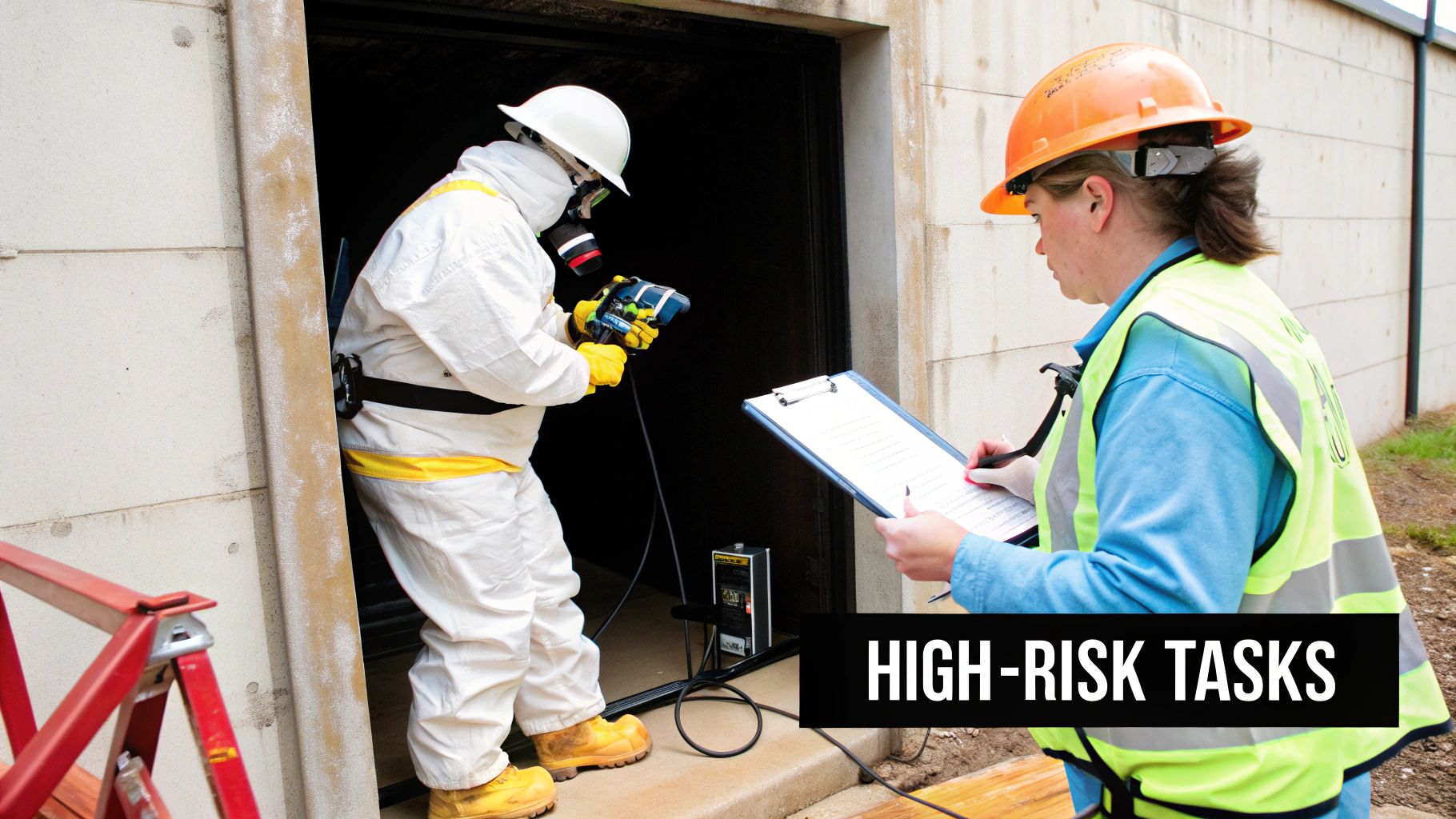
This is no time for winging it. Let’s dive into three of the most common and critical high-risk scenarios you'll encounter: confined space entry, hot work, and advanced electrical safety.
Protocols for Confined Space Entry
A confined space is any spot big enough for a person to get into, but with limited ways in or out, and it's definitely not designed for someone to hang out in all day. We're talking about tanks, vaults, pits, and large-diameter pipes. The real danger is what you can't see—toxic gases, a sudden drop in oxygen, or the risk of being engulfed by materials.
Because of these invisible killers, OSHA's standard 29 CFR 1910.146 requires a strict permit system for any "permit-required confined space." This isn't just paperwork; it’s a non-negotiable safety checklist that has to be nailed down before anyone sets foot inside.
The permit process is all about verification:
- Atmospheric Testing: Before anyone goes in, a qualified person has to test the air for oxygen levels, flammable gases, and any toxic junk that might be lingering. This isn't a one-and-done check; the air needs to be monitored periodically as long as people are inside.
- Isolation: You have to cut the space off from all hazards. Any pipes, electrical lines, or other energy sources must be completely disconnected, blocked off, or locked out.
- Rescue Plan: You must have a detailed, practical rescue plan ready to go. This means trained rescue personnel and the right equipment are on standby. And let's be clear: simply planning to call 911 is not an acceptable rescue plan in OSHA's eyes.
Real-World Scenario: A crew needs to inspect an underground vault tied into a temporary natural gas system. Before entry, they test the air for gas and oxygen. They verify the gas line feeding the vault is shut off and locked. A trained attendant stays topside, keeping an eye on the workers and ready to kickstart the pre-planned rescue if something goes wrong.
Procedures for Managing Hot Work
Hot work is anything that makes sparks, flames, or intense heat—welding, grinding, and torch cutting are the usual suspects. All it takes is one stray spark to find flammable material, and you’ve got a disaster on your hands. That's why the OSHA standard 29 CFR 1910.252 demands a formal hot work permit system to keep things under control.
The whole point is to create a safe "bubble" around the work area. The permit acts as a final check to make sure every precaution has been taken before the sparks start flying.
Key parts of a safe hot work procedure include:
- Fire Watch: You must have a designated and trained "fire watch" whose only job is to look for fires. They need to be there during the work and stick around for at least 30 minutes after it’s done to catch any smoldering embers.
- Clearing Ignition Sources: The area must be swept clean of all flammable and combustible materials within a 35-foot radius. If something can't be moved, it has to be covered with fire-resistant blankets.
- Fire Extinguishers: The right type of fire extinguisher needs to be right there, ready to go. Not in the truck, not in the gangbox—at the location of the work.
Advanced Electrical Safety and Lockout/Tagout (LOTO)
We've mentioned Lockout/Tagout (LOTO) before, but it's impossible to overstate its importance in high-risk work. When you're servicing equipment—especially complex setups like temporary natural gas systems—an accidental startup isn't just an inconvenience; it can be deadly. LOTO is the formal procedure that prevents that from ever happening.
The process is deliberately methodical and personal. An authorized employee puts their own lock on the energy-isolating device, making it physically impossible for the machine to be turned on. Their tag says who is working on it. Here's the most important part: only the person who placed the lock can remove it. This personal control is the heart and soul of the LOTO system. It guarantees that no one can re-energize a machine without the person whose life is on the line giving the all-clear.
Building a Compliant Safety Program with Training and Documentation
Meeting OSHA's safety requirements for contractors is about more than just having the right gear on-site. It's about proving your team knows how to use it safely and having the paperwork to back it all up. A solid safety program really boils down to two key pillars: effective, ongoing training and meticulous, organized documentation.
Think of your records as the project’s safety ledger. It’s the indisputable proof of your due diligence. Without it, from an inspector's point of view, that safety meeting or equipment check might as well have never happened.
Mandatory Training for a Safer Worksite
OSHA is crystal clear on this: employers must train workers on the specific hazards they'll face on the job. This isn't a one-and-done deal during onboarding; it’s a continuous process. Anytime a new hazard pops up—like bringing in a specialized piece of equipment or setting up a temporary natural gas system—you need to provide specific training.
A good training program will always hit these core areas:
- Hazard Communication: Your crew needs to know how to read Safety Data Sheets (SDS) and understand chemical labels. This ensures they know the risks of every material they handle.
- Equipment Operation: Anyone operating machinery, whether it’s a forklift or an aerial lift, has to be formally trained and certified on that specific piece of equipment.
- Fall Protection: Anyone working at heights of six feet or more must be trained to spot fall hazards and use their fall protection systems the right way. No exceptions.
- Emergency Procedures: Every single person on site needs to know the plan for emergencies—evacuation routes, where the fire extinguishers are, and who to call when things go wrong.
This isn't just a friendly suggestion; it’s a legal mandate. An untrained worker exposed to a hazard is a huge liability and a direct violation of OSHA standards.
A well-trained team is your first and best line of defense against accidents. Training transforms safety rules from abstract concepts into practical, life-saving actions that workers can apply every single day on the jobsite.
The Critical Role of Recordkeeping
If training is the action, documentation is the proof. When an accident happens or an OSHA inspector shows up, your records are the very first thing they’ll ask to see. Being able to produce clear, organized documents shows you’re serious about safety.
Here's a rundown of the key documents every contractor needs to maintain. Think of it as your compliance checklist—having these organized and ready will save you major headaches down the road.
| Essential OSHA Recordkeeping Checklist for Contractors |
| :— | :— | :— |
| Document/Record | Required Retention Period | Key Purpose |
| Training Logs | Duration of employment + 3 years | Proves each worker received specific safety training on relevant hazards. |
| Equipment Inspection Checklists | Varies (e.g., 3 months for cranes) | Demonstrates equipment was inspected and deemed safe for operation. |
| OSHA Forms 300, 300A, 301 | 5 years | Records all work-related injuries and illnesses, as required by law. |
| Safety Data Sheets (SDS) | Duration of chemical use + 30 years | Provides workers with access to information about hazardous chemicals. |
| Exposure Monitoring Records | Duration of employment + 30 years | Documents employee exposure to harmful substances like asbestos or lead. |
This table isn't just a list; it's a roadmap to proving your commitment. Keeping these records straight is non-negotiable for staying compliant and, more importantly, keeping your people safe. For a deeper dive into this, resources like this guide on Mastering OSHA Recordkeeping Compliance can be incredibly helpful.
Ultimately, having these documents on hand shows that your safety program is more than just words on paper—it’s a living, breathing part of your daily operations.
Mastering Jobsite Communication and Coordination
On any jobsite, but especially one with multiple crews, communication isn't just a good idea—it's the glue that holds your safety plan together. When you have different contractors working in the same space, wires get crossed, warnings go unheard, and a simple task can quickly become a dangerous situation. The real goal isn't just for crews to work near each other, but to work with each other to keep everyone safe.
This is a huge piece of the puzzle for OSHA compliance. The agency needs to see a clear, structured way for information to flow so that every single person on site knows the risks they're facing, no matter who signs their paycheck.
I like to think of a complex project like an orchestra. The general contractor is the conductor, setting the pace and making sure the entire performance comes together. Each subcontractor is a master of their own instrument. If the conductor is waving their arms wildly without clear direction, or the trumpet player isn’t paying attention to the violins, you get noise instead of music. On a construction site, that noise is a serious incident waiting to happen.
The Power of Pre-Construction Safety Meetings
You start building a safe job long before you break ground. A solid pre-construction safety meeting is where you lay the foundation, bringing all the subcontracting leads into one room to hash out the safety ground rules for the entire project.
This isn't just a quick handshake and a cup of coffee. It's a real-deal planning session that needs to get into the weeds on things like:
- Site-Specific Hazards: What are we walking into? Let’s talk about those overhead power lines, the buried utilities we know about, and any specific headaches that come with setting up temporary natural gas services on this particular site.
- Emergency Action Plan: When things go wrong, who does what? We need to walk through evacuation routes, agree on rally points, and make sure everyone has the right phone numbers for emergency responders and key site contacts programmed into their phones.
- Chain of Command: Who's the ultimate authority on safety for this job? We need to make it crystal clear who to go to with a hazard report and what the exact process is for reporting an incident.
- Permitting Procedures: Everyone needs to be on the same page for high-stakes work. Let’s review the exact process for getting permits for hot work or confined space entry so there’s zero confusion.
Getting everyone aligned in this first meeting means every team steps onto the site already speaking the same safety language.
Daily Toolbox Talks: The Safety Heartbeat
The pre-con meeting sets the strategy, but daily toolbox talks are where the rubber meets the road. These quick, informal huddles at the start of every shift are absolutely essential for keeping safety front and center.
Think of the toolbox talk as your daily safety briefing. It’s the perfect time to cover the day's game plan, point out any new hazards that popped up overnight, and do a quick refresher on a critical safety rule. It keeps safety from becoming background noise and gives the crew a chance to speak up before a small concern turns into a big problem.
These talks should be short and sweet—usually just 5 to 15 minutes—and focused on what's happening today. For a crew getting ready to hook up a temporary natural gas line, the talk should hit on lock-out/tag-out procedures and the importance of sweeping the area for ignition sources. This daily rhythm is what truly builds a strong safety culture that can withstand the pressures of a multi-employer worksite.
What to Do When an OSHA Inspector Shows Up
Let's be honest, seeing an OSHA inspector walk onto your jobsite can make your heart skip a beat. It feels like a pop quiz you didn't study for, and the stress level can shoot through the roof. But it doesn’t have to be that way.
If you’re prepared, an inspection is just a professional review of the safety program you already have in place. Knowing what to expect and understanding your rights can turn a potentially nerve-wracking event into a manageable process.
The Inspection Process: Step-by-Step
An OSHA inspection isn’t a random ambush; it follows a predictable script. It almost always kicks off with an opening conference. The inspector, officially called a Compliance Safety and Health Officer (CSHO), will introduce themselves, show their credentials, and explain why they’re there. It could be a routine check, a follow-up, or a visit triggered by a complaint.
This initial meeting is your chance to set a cooperative tone and understand the exact scope of their visit. Are they looking at the entire site, or just one specific operation?
After the conference, the CSHO begins the walkaround inspection. You have the right to walk with them every step of the way, and you absolutely should. This lets you see what they see, answer questions in real-time, and offer context for anything they might flag.
The inspector will also conduct private employee interviews. These conversations are confidential, and they can speak with anyone they choose. While you can't be in the room, you can (and should) let your crew know beforehand that they should answer truthfully and stick to the facts about their own work.
Pro Tip: Your attitude during an inspection matters. A calm, organized, and cooperative approach tells the inspector you have a strong safety culture. This can genuinely influence their final report and demonstrates you're serious about protecting your team.
Understanding OSHA Citations and Penalties
If the inspector finds violations, OSHA will issue citations. These aren't just slaps on the wrist; they come with hefty fines designed to be a serious deterrent. For a smaller contractor, these penalties can be devastating.
OSHA groups violations into different tiers based on severity and the employer’s awareness.
Willful Violation: This is the big one. It means an employer knew about a hazard and deliberately ignored it or was plainly indifferent to the law. Fines here can soar past $161,000 for a single violation.
Serious Violation: This applies when a hazard could likely cause death or serious injury, and the employer knew (or should have known) about it. This is one of the most common citations on construction sites.
Other-Than-Serious Violation: This is for a hazard directly related to safety but not likely to cause death or serious physical harm.
The process wraps up with a closing conference, where the inspector will go over their findings and any proposed citations and penalties. This is your opportunity to ask for clarification and make sure you understand the deadlines for fixing any issues. Handling this final step professionally reinforces your commitment to meeting all contractor safety requirements OSHA sets out.
Frequently Asked Questions About Contractor Safety
Walking onto a busy, multi-employer jobsite can feel like navigating a maze of safety rules. It's natural to have questions about who's responsible for what. Let's clear up some of the most common ones contractors ask about OSHA safety requirements.
Who Is Responsible for Providing PPE?
This is a classic question, and the answer is simple: the responsibility follows the payroll.
Under OSHA's rules (29 CFR 1910.132), every employer is on the hook for providing the right personal protective equipment (PPE) for their own employees. While the general contractor might set a site-wide policy for hard hats, it's the subcontractor who must supply their crew with specific gear like fall harnesses, respirators, or arc-flash suits.
Can a General Contractor Be Cited for a Subcontractor's Violation?
Absolutely. This is a common scenario under OSHA’s Multi-Employer Worksite Policy, and it catches many general contractors by surprise.
If you're the "controlling employer" (usually the GC), you can be cited for a hazard created by a subcontractor. This happens if you either knew about the hazard or should have known about it with reasonable diligence and didn't take steps to get it fixed.
Key Insight: This shared liability is precisely why proactive oversight is non-negotiable. As the controlling employer, you have a duty to actively look for and correct safety violations on your site, making safety everyone's job.
What Is the Difference Between an OSHA Standard and an ANSI Standard?
It's easy to get these two confused, but the distinction is critical.
- OSHA Standard: Think of this as the law. These are legally binding federal regulations. Ignoring them can lead to citations, fines, and work stoppages.
- ANSI Standard: These are consensus-based best practices developed by industry experts through the American National Standards Institute. They represent the industry's "gold standard" for how to do things safely.
Here's where it gets interesting, though. OSHA often incorporates ANSI standards directly into its own regulations, which gives them the full force of law. Even when they aren't legally mandatory, following the latest ANSI standards is a fantastic way to show you're making a good-faith effort and building a safety program that goes beyond the bare minimum.
At Blue Gas Express, we know that keeping your project on schedule and keeping your crew safe are your top priorities. When delays from permanent natural gas line installations threaten your timeline, our temporary CNG and LNG solutions bridge the gap. We ensure your project keeps moving forward without ever cutting corners on safety.
Keep your operations running without a hitch. Visit our website at https://bluegasexpress.com to see how our reliable, on-demand natural gas services can help.