

California is a leader in natural gas vehicle adoption for a reason. With a solid network of over 200 public compressed natural gas (CNG) fueling stations and counting, the infrastructure is already in place. This guide is designed to be your go-to resource for tapping into that network, whether you're a fleet manager planning a major transition or an operator just looking for your next fill-up.
Your Guide to CNG Fueling Across California
As California continues its aggressive push toward ambitious clean air goals, CNG has proven itself as a practical, reliable choice for transportation. It’s not just another "alternative fuel" — it's a core part of the state's strategy to clean up our air, offering a real-world path to slash emissions and get a handle on unpredictable fuel costs. For anyone managing a fleet, understanding this landscape isn't just helpful; it's essential for staying competitive.
Think of this guide as your roadmap to California's entire CNG ecosystem. We'll go way beyond just showing you where the stations are. My goal is to give you the practical, on-the-ground knowledge you need to make smart decisions that work for your bottom line and help meet the state's sustainability targets.
What This Guide Covers
We’ll start with the basics and build from there, so you have a solid foundation for everything that follows. You'll walk away knowing exactly how to navigate the world of CNG fueling stations in California.
Here's what we'll dig into:
- How a CNG Station Actually Works: I'll break down the mechanics in simple terms—from how a station connects to the main gas supply to the compression process that gets high-pressure fuel safely into your vehicles.
- Finding Your Next Fill-Up: We'll cover the best tools and data sources for locating both public stations and private-access fueling sites anywhere in the state.
- Regulations, Permits, and Money on the Table: A straightforward look at California's rules, the permitting maze, and the powerful financial incentives available to help you pay for it all.
- Planning for Your Fleet: We'll get into the brass tacks of vehicle compatibility, figuring out your return on investment, and planning a smooth, headache-free switch to CNG.
The move to cleaner fuels isn't just about checking a compliance box; it's a strategic business decision. California’s strong incentive programs and mature CNG infrastructure make a powerful argument for fleets that want stable fuel costs and serious emissions cuts.
Innovative Solutions for Today's Challenges
Of course, a permanent fueling station doesn't work for everyone. What about industries like construction, disaster recovery, or agriculture, where the work is temporary or in a remote location? You can't exactly build a permanent station for a job site that's only active for six months.
That’s where mobile CNG fueling solutions come in. We’ll explore how these "virtual pipeline" services bring the fuel directly to you, bridging the gap when you're off the grid or too far from a public station. This kind of flexibility is a game-changer, making CNG a workable option for almost any operation, anywhere in the state. It ensures you can keep projects on track while still reaping the benefits of a cleaner, more affordable fuel.
How CNG Fueling Infrastructure Actually Works
To really get a handle on the CNG fueling stations in California, it’s helpful to see them as more than just gas pumps. Each station is essentially a small-scale, self-contained gas processing facility. It taps into the same standard utility pipeline that feeds natural gas to homes and businesses, then transforms that gas into a high-pressure fuel ready for your vehicle.
The whole process, from pipeline to tank, unfolds in a few key steps. First, the station draws natural gas from an underground utility line. This gas arrives at a very low pressure, often less than 60 psi (pounds per square inch), which isn't nearly enough to power a vehicle for any real distance.
Next comes the real workhorse of the station: a powerful, multi-stage compressor. This machine is the heart of the operation, squeezing the natural gas and cranking its pressure way up to between 3,600 and 4,500 psi. This compression is what packs the energy into the fuel, allowing a vehicle’s tank to hold enough CNG for a practical driving range.
This simple infographic breaks down the process from the driver's point of view—from finding a station to getting back on the road with cleaner fuel.
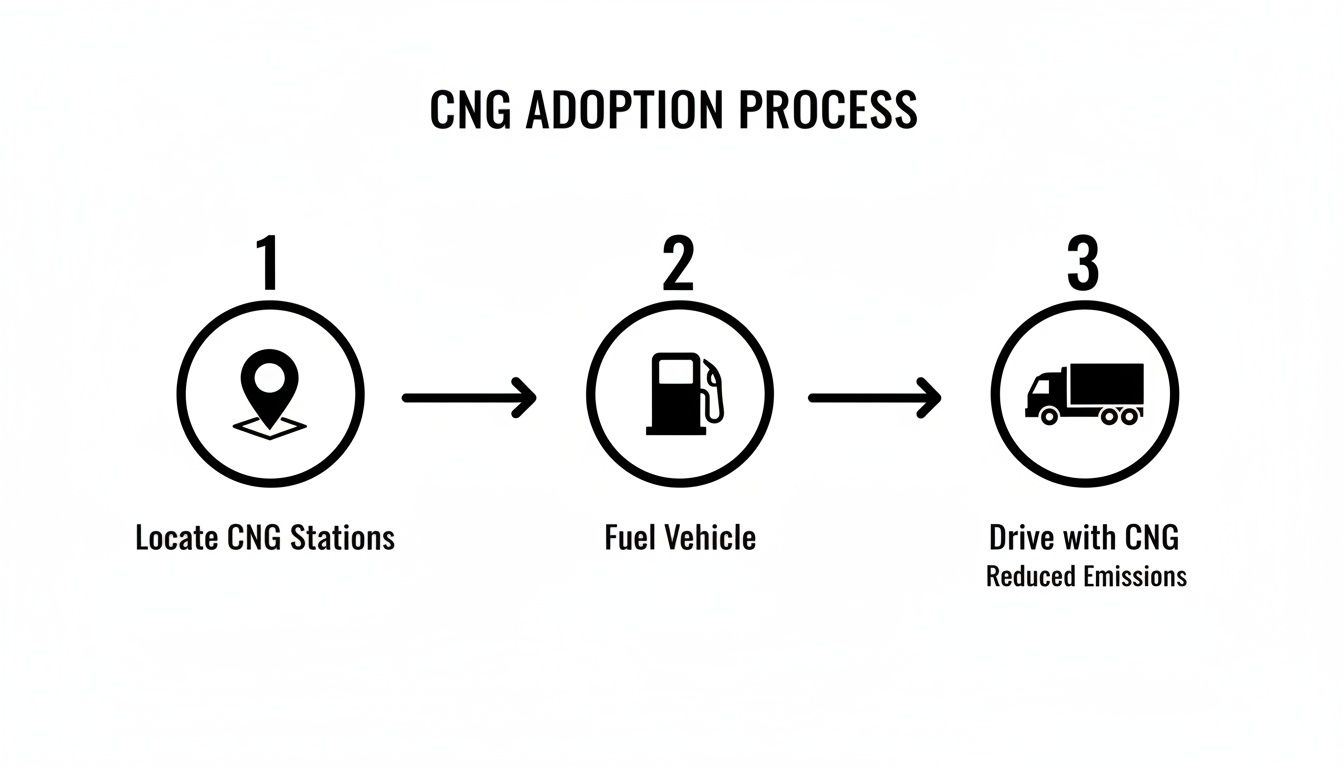
The image really shows how user-friendly the experience is designed to be, closely mirroring a trip to a regular gas station but powered by some impressive tech behind the scenes.
Fast-Fill Stations for Quick Turnaround
Most public CNG stations you'll come across are what we call "fast-fill" stations. You can think of them as the CNG version of your typical corner gas station. Once the gas is compressed, it’s funneled into a series of heavy-duty storage cylinders, collectively known as a "cascade."
This cascade system acts like a reservoir, holding the high-pressure gas ready for a quick fill-up. When you pull up, the dispenser draws directly from these tanks. The result? A light-duty vehicle can be refueled in just 3-5 minutes, while a heavy-duty truck takes about 10-15 minutes. That kind of speed is crucial for public stations that serve everyone from individual drivers to commercial fleets on tight schedules.
Fast-fill stations are built for speed and convenience, making them the backbone of California's public CNG network. Their ability to refuel vehicles quickly ensures that switching to CNG doesn't mean sacrificing valuable time on the road.
Time-Fill Stations for Fleet Efficiency
On the flip side, you have "time-fill" systems, which are built for a completely different job: refueling entire fleets overnight. You’ll typically find these at private depots for organizations like school districts or waste management companies. Instead of a massive cascade, a time-fill station uses a smaller compressor that sends gas directly to multiple parked vehicles at once over several hours.
This approach offers some big perks for fleet managers:
- Lower Upfront Costs: Time-fill setups need smaller compressors and less storage capacity, which brings down the initial investment.
- Better Energy Efficiency: Compressing gas slowly and steadily uses less electricity, saving money on utility bills over the long haul.
- Dead-Simple Operation: Drivers just park, hook up the fuel hose at the end of their shift, and come back to a full tank the next morning. It’s that easy.
While you’d never want this slow a process at a public station, it’s a brilliant, cost-effective solution for any fleet that returns to a central yard each night.
Even with this growing infrastructure, natural gas for vehicles is still a specific niche in California’s broader energy landscape. The entire transportation sector uses only about 1% of the state's total natural gas consumption. But with California’s underground storage capacity sitting at roughly 604 billion cubic feet, the supply is more than ready to support a much larger fleet of clean-running CNG vehicles. You can dive deeper into the numbers on California's natural gas profile over at the U.S. Energy Information Administration.
Finding Public and Private CNG Stations in California
Knowing where to find your next fill-up is the most practical skill for any driver or fleet manager running CNG vehicles. California has a pretty solid network, but not all stations are created equal. Some are open to the public 24/7, while others are private, "behind-the-fence" facilities reserved for specific fleets.
The key is knowing how to tell them apart and where to look. Luckily, a few great digital tools make locating cng fueling stations in California a breeze. These resources do more than just drop a pin on a map—they give you the critical details you need before you even get there.
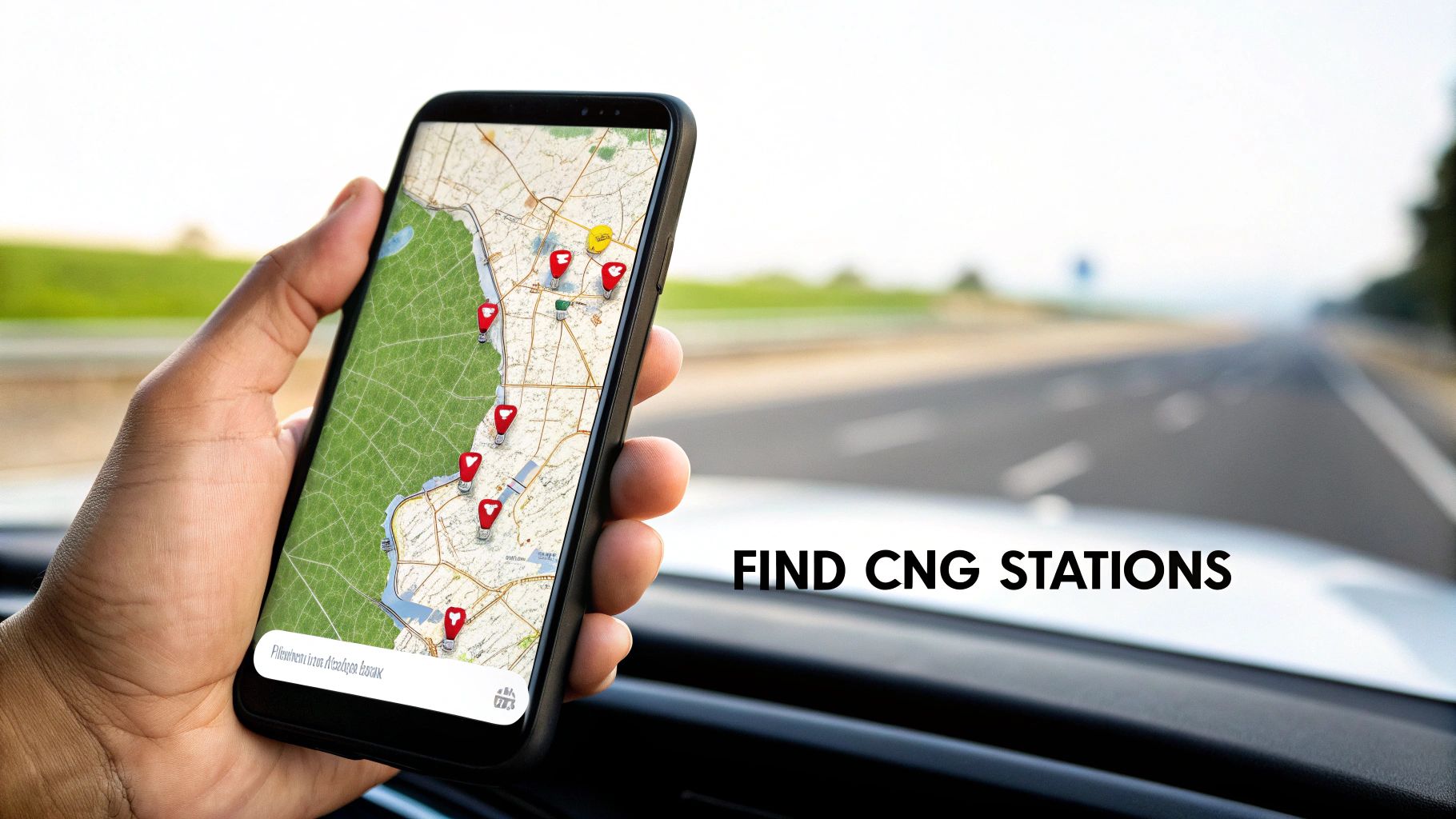
Your Go-To Digital Tools for Station Hunting
If there's one resource you should bookmark, it's the U.S. Department of Energy’s Alternative Fuels Data Center (AFDC) Station Locator. This free tool is the gold standard, period. It's kept up-to-date with information straight from station owners, so you can filter for CNG, see where stations are clustered, and plan your routes with confidence.
You can see how stations are strategically placed along major arteries like I-5 and within big metro areas. It’s clear the network was designed to support both long-haul and regional routes.
For those times when you're already on the road, mobile apps like GasBuddy are a good backup. While it's famous for gasoline prices, you can filter for CNG. Its crowd-sourced data can be handy for finding a station in a pinch or even checking on prices that other drivers have recently reported.
Reading the Station Details: What Really Matters
Finding a station is half the battle; knowing if it's the right station for you is the other half. When you click on a station in a locator tool, you’ll see a bunch of information. Learning to read these details is what separates the pros from the rookies.
Always look for these key data points:
- Public vs. Private Access: This is the big one. "Public" means you're good to go. "Private" or "Fleet-Only" means it’s off-limits unless you're part of that specific fleet (like a city's sanitation department or a school district). Don't waste a trip.
- Dispenser Pressure (PSI): Most modern CNG vehicles need 3,600 psi for a complete fill. Some older or specialized stations might offer lower pressures, so double-checking this detail ensures you can actually fill up your tank properly.
- Payment Methods: There’s nothing worse than pulling up to a pump and not having the right card. The AFDC locator clearly lists what they take—Visa, MasterCard, fleet cards like Voyager, or sometimes their own proprietary card.
- Hours of Operation: While many public stations are 24/7, some aren't. Always check the hours before planning a late-night or early-morning stop.
Understanding the difference between a public fast-fill station on a highway and a private time-fill station at a municipal yard is fundamental. Using locator tools to filter by access type saves you from routing to a station you can't even use.
By getting comfortable with these tools and knowing what to look for, you can navigate California’s CNG network like a seasoned pro. It turns the map from a simple collection of dots into a powerful, practical resource that keeps your vehicles fueled and on schedule.
Making Sense of California's CNG Rules and Incentives
Knowing where to find CNG fueling stations in California is just the start. The real story behind the state’s massive push into natural gas vehicles lies in the powerful combination of ambitious regulations and serious money on the table. California isn’t just encouraging fleets to go clean; it’s actively writing the rules and cutting the checks to make it happen.
Two key state agencies are running the show: the California Air Resources Board (CARB) and the California Energy Commission (CEC). CARB is the architect of the state’s strict emissions standards, creating the regulatory pressure that pushes fleets toward cleaner fuels like CNG. The CEC, on the other hand, provides the financial muscle through grants and incentives, making the switch an attractive business move.
Think of it like this: CARB sets the high jump bar for air quality, and the CEC provides a powerful springboard to help fleets clear it. It's a one-two punch that makes adopting CNG both an environmental win and a smart financial decision.
Tapping into Key Financial Incentive Programs
California has rolled out a whole suite of programs designed to take the sting out of switching to CNG. We're not talking about small rebates here. These are major funding opportunities that can slash the cost of new vehicles, engine conversions, and even help you build your own fueling station.
The biggest player is the Clean Transportation Program, run by the CEC. This is the state's main funding pipeline for alternative fuel projects, channeling millions of dollars to get more clean vehicles on the road and build the infrastructure to support them.
These programs offer help in a few key ways:
- Vehicle Purchase Vouchers: The Hybrid and Zero-Emission Truck and Bus Voucher Incentive Project (HVIP) is a huge one. It gives you a point-of-sale discount on new, clean vehicles, including CNG models. This can make the upfront cost of a new CNG truck look a lot more like its diesel counterpart.
- Infrastructure Grants: If you're thinking about building your own private CNG fueling stations in California, there are grants available that can cover a huge chunk of the design, permitting, and construction costs.
- Scrappage Programs: Some programs sweeten the deal even more. They offer extra cash if you trade in an old, polluting diesel truck for a new CNG one, essentially paying you to get the dirtiest vehicles off the road for good.
The whole point of these incentives is to take the risk out of investing in clean transportation. California gets that the upfront cost can be a dealbreaker, so they’ve built these programs to bridge that financial gap. This makes the long-term savings of CNG feel real from day one, not years down the road.
Key California CNG Incentive Programs Overview
To help you get a clearer picture, here’s a quick rundown of some of the most impactful programs available for fleets and infrastructure developers in the state.
| Program Name | Administering Agency | Who It's For | What It Covers |
|---|---|---|---|
| Clean Transportation Program | CEC | Fleet owners, vehicle manufacturers, infrastructure developers, public agencies | Funding for a wide range of projects, including new vehicle deployment, infrastructure construction, and workforce training. |
| Hybrid and Zero-Emission Truck and Bus Voucher Incentive Project (HVIP) | CARB | California-based purchasers and lessees of new medium- and heavy-duty commercial vehicles | Point-of-sale vouchers (discounts) that significantly reduce the upfront cost of purchasing eligible clean vehicles, including CNG trucks and buses. |
| Carl Moyer Memorial Air Quality Standards Attainment Program | CARB / Local Air Districts | Owners of heavy-duty on-road and off-road diesel equipment | Grants for replacing, repowering, or retrofitting older, high-polluting engines with cleaner models, including new CNG vehicles. |
| Low Carbon Fuel Standard (LCFS) Credit Generation | CARB | Fleets using low-carbon fuels (especially Renewable Natural Gas) and infrastructure providers | Generates marketable credits based on the carbon intensity of the fuel used, creating an ongoing revenue stream that lowers fuel costs. |
This table is just a starting point, as programs and funding levels can change. It's always best to check with the specific agency for the latest guidelines and application deadlines before making any big decisions.
The Secret Weapon: The Low Carbon Fuel Standard
Beyond direct grants, California's Low Carbon Fuel Standard (LCFS) is a total game-changer. It’s a market-based system that creates a powerful, ongoing financial reason to use cleaner fuels. The program requires fuel suppliers to lower the "carbon intensity" (CI) of their products over time. If their fuel is cleaner than the state’s target, they earn credits. If it’s dirtier, they have to buy credits to make up the difference.
This is where Renewable Natural Gas (RNG) shines. Because it's made from organic waste like landfills, dairies, and wastewater, RNG has an incredibly low—or even negative—carbon score. When your fleet runs on RNG, you’re generating valuable LCFS credits. These credits can then be sold to companies producing high-carbon fuels like gasoline and diesel.
This creates a steady stream of revenue that gets passed down to you, the end-user, often in the form of much lower prices at the pump. It’s the main reason why RNG now accounts for the vast majority of all natural gas used in California vehicles.
It's not just a small difference, either. In a huge milestone, California's RNG vehicle fuel portfolio recently became the first ever to hit a carbon-negative status under the LCFS program. The official score reached -0.85 gCO2e/MJ, proving just how powerful this fuel is for decarbonization. This is especially impressive when you consider that RNG made up nearly 90% of all on-road natural gas fuel used in the state. You can read more about this incredible achievement and what it means for the state's clean fuel strategy.
Calculating Costs and Planning Your Fleet's Transition to CNG
Making the jump to compressed natural gas is a major business decision, and like any big move, it needs a solid financial game plan. For fleet managers, it all comes down to weighing the initial investment against the powerful, long-term savings on the other side. This financial blueprint is key to justifying the switch and charting a clear course to a cleaner, more affordable fleet.
The biggest upfront costs are, of course, the vehicles themselves—either buying new CNG trucks or converting existing ones. Yes, a new CNG truck often costs more off the lot than its diesel equivalent, but California's fantastic incentive programs can shrink that price gap considerably. You absolutely have to factor in those vouchers and grants from day one to get a true picture of the costs.
Understanding Upfront Investments
Beyond the vehicles, the other big-ticket item can be fueling infrastructure. If you're thinking about building a private station, that’s a serious capital investment. You have to budget for everything from design and permitting to buying the compressors and storage cascades, not to mention the actual construction.
But here’s the good news: many fleets can sidestep that massive expense entirely by using California's huge public network of cng fueling stations. This strategy lets you dip your toes in the water without diving headfirst into a huge infrastructure project. You can start with just a few CNG vehicles, use existing stations, and see the benefits for yourself.
Calculating Your Return on Investment
The real magic of CNG happens over the long haul, where the operational savings start to pile up and quickly eat away at those initial costs. The foundation of this math is the price difference between CNG and diesel.
CNG is priced in Gasoline Gallon Equivalents (GGE), which makes for a clean, apples-to-apples comparison. And historically, CNG has been consistently cheaper and way more stable than diesel, which can feel like a rollercoaster at the pump.
To figure out your potential ROI, you’ll want to look at a few key things:
- Fuel Cost Savings: Take your fleet's total annual fuel use and multiply it by the average price difference between CNG and diesel.
- Maintenance Reductions: CNG burns much cleaner. That often means less engine wear, more time between oil changes, and longer-lasting spark plugs.
- Incentive Value: Tally up all the state grants, vouchers, and tax credits you qualify for and subtract that total from your upfront costs.
The financial case for CNG isn't just about one thing; it's the combined power of cheaper fuel, lower maintenance bills, and hefty state incentives. When you map this out over a truck's entire lifespan, the savings create a powerful ROI that often pays back the initial investment in just a few years.
State funding can also dramatically change the math for station operators, which means better prices for you. For instance, in one project, California Clean Fuels upgraded a public station with a new dispenser. A $83,000 grant from the CEC—covering about 35 percent of the total cost—helped the station offer a competitive price of $2.35 per GGE and drastically cut down fueling times for big rigs. You can learn more about how state funding improves fueling infrastructure and lowers costs.
Building a Phased Transition Plan
A smart transition doesn't happen all at once. Taking a phased approach lets your team learn the ropes, get trained, and fine-tune operations without causing a major headache.
A great way to start is by identifying a few routes that are already well-covered by public cng fueling stations in California.
Then, as your older, maintenance-heavy diesel trucks reach retirement, start replacing them with new CNG models. This one-by-one replacement strategy spreads out the cost and lets your crew get comfortable with the new technology. As you plan for the future, it's always helpful to review 10 essential fleet management best practices for 2025. This kind of methodical, step-by-step approach minimizes risk while you steadily stack up the financial and environmental wins.
Solving Fueling Gaps With Mobile CNG Solutions
The network of permanent CNG fueling stations in California is the foundation of our clean transportation system. But let's be realistic—what happens when your work takes you miles from the nearest station? For fleets in construction, agriculture, or emergency services, operations don't always stick to the main highways. This is precisely where mobile CNG fueling comes in, offering a flexible and essential solution.
Think about a construction crew breaking ground on a new development, long before any utility lines are in place. Or picture a farm harvesting crops in a remote valley. In situations like these, building a permanent station just isn't feasible. Mobile fueling closes that gap by bringing the CNG directly to your fleet, keeping your vehicles running wherever the job takes you.
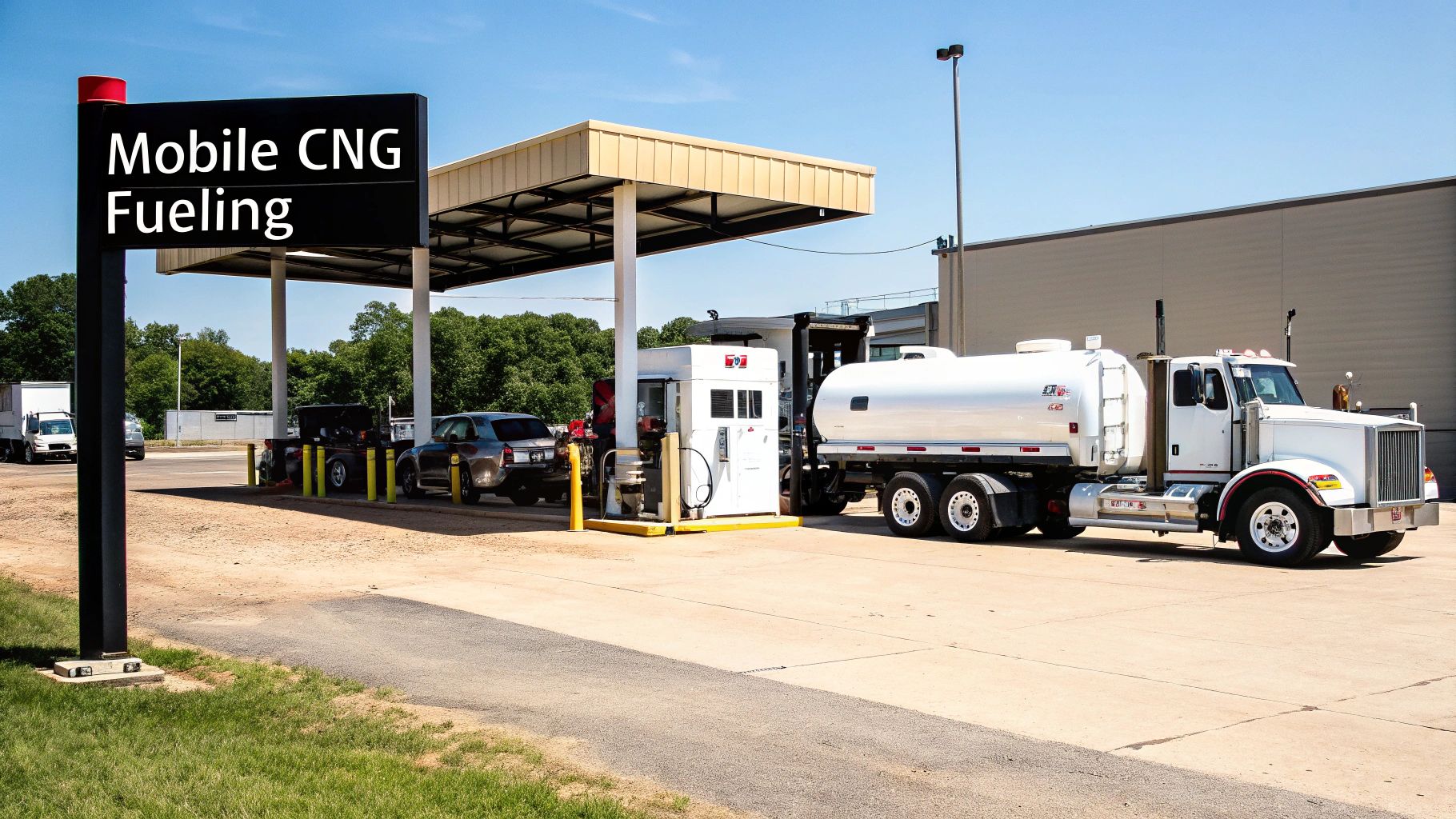
How the Virtual Pipeline Works
The technology that makes this possible is often called a "virtual pipeline." It’s a simple but brilliant idea: instead of moving gas through a fixed pipe in the ground, you transport it by truck. The key piece of equipment is the tube trailer, a semi-trailer specifically designed to carry several large, high-pressure cylinders filled with CNG.
These trailers get filled up at a permanent compression station and then drive right to your location. Once on-site, they connect to a portable dispenser, instantly creating a temporary fueling station. This setup lets you refuel your trucks and equipment just as you would at a regular station, so you can keep work moving without spending a dime on permanent construction.
This "fuel-on-demand" model is a game-changer for project-based work. It gives businesses the flexibility to bid on remote jobs or respond to emergencies, knowing their CNG fleet has a reliable fuel source no matter the location.
Mobile fueling isn't just for off-grid sites, either. It’s a vital tool for energy resilience. If a permanent station has to shut down for maintenance or a local utility experiences a service interruption, a mobile unit can be brought in to keep critical fleets—like city buses or waste collection trucks—on the road.
Common Scenarios for Mobile Fueling
The uses for temporary CNG fueling are incredibly varied, solving real-world logistical headaches for all kinds of California industries. Once you see how others are using it, you can start to imagine how it could fit into your own operations.
Here are a few key situations where mobile CNG is the perfect fit:
- Remote Construction and Industrial Sites: For projects that are far from established infrastructure, mobile units deliver the fuel needed to power heavy-duty vehicles for the entire job.
- Emergency Response and Disaster Recovery: After an earthquake or wildfire disrupts utility lines, mobile CNG can be deployed quickly to fuel emergency vehicles or power temporary command posts.
- Infrastructure Downtime: When a permanent station is down for upgrades or repairs, a virtual pipeline service acts as a stopgap, preventing service disruptions for public transit and private fleets.
- Pilot Programs and Fleet Transitions: If you're thinking about switching to CNG, mobile fueling offers a low-commitment way to test the vehicles in your real-world routes before investing in a permanent station.
Ultimately, mobile solutions make CNG a practical choice for almost any operation in California, breaking the dependence on a fixed station map. This adaptability ensures the cost savings and environmental benefits of natural gas are within reach, even in the most challenging or temporary locations.
Common Questions About California CNG Stations
Thinking about making the switch to compressed natural gas? You've probably got a few questions. That's completely normal. This section tackles some of the most common things people ask about using CNG in California, giving you straight answers from an expert's perspective.
We'll cover the practical, day-to-day stuff so you can feel confident about what to expect.
How Long Does It Take to Refuel a CNG Vehicle?
This really comes down to the type of station you’re using. For most drivers, the experience at a public station is going to feel very familiar—a lot like filling up with gasoline.
The majority of public cng fueling stations in California are “fast-fill” stations. At one of these, you can fill up a light-duty car or truck in about 3-5 minutes. Even for the big rigs, the process is surprisingly quick, usually taking just 10-15 minutes. It’s designed for getting drivers back on the road with minimal downtime.
The other type, called a “time-fill” station, is a different beast altogether. You typically see these in private fleet yards. They're designed to refuel an entire fleet of vehicles at once, usually overnight while they're parked. As the name suggests, it's a much slower process that takes several hours.
Is CNG a Safe Vehicle Fuel?
Absolutely. In fact, CNG has an incredible safety record, often proving to be safer than gasoline or diesel. The entire system, from the station to the vehicle, is built with multiple safety layers and is regulated by strict federal standards.
For starters, CNG is stored in tanks that are built like fortresses—they are incredibly tough and puncture-resistant, far more so than a standard metal gas tank. But the real standout safety feature is a simple matter of physics. Natural gas is lighter than air. In the unlikely event of a leak, the gas just rises and dissipates into the atmosphere. It doesn't pool on the ground like gasoline, which dramatically lowers the fire risk.
What Is Renewable Natural Gas (RNG)?
Renewable Natural Gas, or RNG, is the real game-changer here in California. Chemically, it's the exact same stuff as conventional natural gas, but its origin is what makes it so special. RNG is produced by capturing methane from organic waste.
Where does this waste methane come from? Think about major sources of emissions:
- Dairy farms (cow manure)
- Landfills
- Wastewater treatment plants
Instead of letting that potent greenhouse gas escape into the atmosphere, we capture it, clean it up to meet pipeline standards, and use it as fuel. This turns a major pollution problem into a clean energy solution. The result is a fuel that’s not just low-carbon but often carbon-negative. A huge portion of the CNG sold in California is actually RNG, which is why so many fleets are using it to crush their emissions goals.
Can I Convert My Current Vehicle to Run on CNG?
Yes, you can. Converting an existing gasoline or diesel vehicle to run on CNG is a popular route, especially for commercial fleets looking to manage costs. The process involves having an EPA-certified conversion kit installed by a professional, which adds the high-pressure tank, new fuel lines, and injectors needed to run on natural gas.
This approach makes a lot of sense for fleet managers. The long-term savings on fuel are often significant enough to more than cover the upfront cost of the conversion, delivering a solid return on investment.
The key is to work with a qualified, certified technician. This ensures the conversion is done right and meets all safety and emissions standards set by the state and federal government. It's a fantastic way to start using cleaner fuel without having to buy a whole new set of vehicles.
Ready to solve your fueling gaps with a reliable, mobile CNG solution? Blue Gas Express brings the fuel directly to you, ensuring your operations never stop. Learn how our temporary fueling services can support your project today.