

California boasts one of the largest and most well-developed CNG fueling station networks in the entire country, cementing its role as a leader in the move toward cleaner transportation. This isn't just a collection of stations; it's the critical infrastructure that allows thousands of commercial fleets to slash emissions and bring down their fuel costs.
This guide will walk you through everything you need to know to tap into the vast network of cng fueling stations california has built.
Why California Is Leading the Charge in CNG Fueling
California's leadership in alternative fuels is no accident. It’s the direct result of a focused, decades-long push shaped by aggressive environmental goals, powerful financial incentives, and a progressive energy strategy. The state has long been committed to cutting greenhouse gas emissions and cleaning up its air, creating the perfect environment for technologies like Compressed Natural Gas (CNG) to take root and grow.
This effort is most apparent in the transportation sector, historically one of the biggest sources of air pollution. State and local agencies have consistently championed CNG as a viable, cleaner-burning alternative to diesel and gasoline. Because of this sustained support, California now has a mature, thriving market for natural gas vehicles and the fueling infrastructure they depend on.
The Twin Drivers of Adoption
For commercial fleets across the state, the shift to CNG is really being pushed by two powerful forces: strict environmental rules and clear economic advantages.
Regulations from agencies like the California Air Resources Board (CARB) impose tough emissions standards that older diesel trucks often struggle to meet. Switching to CNG gives fleet operators a straightforward path to stay compliant.
At the same time, the numbers just make sense. CNG consistently costs less than diesel on a gallon-equivalent basis. Over the life of a vehicle, this translates into major savings on operational expenses. This one-two punch makes moving to CNG a smart business decision, not just a green one.
For many fleet managers, the decision comes down to a simple reality: CNG helps meet California's stringent regulations while positively impacting the bottom line. It aligns environmental responsibility with financial prudence.
Mobile Fueling: The Critical Link
While the network of permanent cng fueling stations in California is robust, it doesn't cover every single square mile. What do you do when a construction site is too remote for a pipeline, or a fleet needs to refuel far from an established station? That's where mobile CNG fueling solutions come into play.
Companies like Blue Gas Express offer what is essentially a "virtual pipeline," delivering CNG directly to where it's needed on specialized trailers. It’s an incredibly flexible solution for a whole range of situations.
- Construction Sites: Powering heaters and equipment before permanent utility lines are even installed.
- Industrial Facilities: Keeping the lights on and machinery running during planned pipeline maintenance or unexpected outages.
- Utility Support: Bridging the gap in service while permanent infrastructure is being repaired or built out.
This kind of on-demand energy keeps projects moving and businesses running, making it a vital tool for navigating the real-world logistics of a statewide energy transition.
How a CNG Fueling Station Actually Works
Ever pulled up to a CNG fueling station and wondered how it all works? It’s a pretty neat process that takes the same natural gas that might heat your home and turns it into a high-powered vehicle fuel. Think of the massive natural gas grid running beneath California as a giant reservoir. A CNG station acts as a specialized processing plant, tapping into that reservoir to pressurize and dispense the gas.
It all starts by connecting to a local utility pipeline. The gas flowing through that line is at a very low pressure, which is great for a furnace but not nearly enough for a truck. This is where the heart of the station comes in: a powerful compressor.
This machine is the real workhorse. It sucks in that low-pressure gas and squeezes it down, boosting the pressure to an incredible 3,600 to 4,500 pounds per square inch (psi). For a little context, your car tires are probably sitting at around 35 psi. This massive compression is what packs enough energy into the vehicle’s tank to make it a viable fuel.
From Compression to Storage
Once the gas is compressed, it doesn’t go straight into a vehicle. It first gets routed into a series of heavy-duty, reinforced storage vessels right there on site. This setup is often called a "cascade" storage system, and its job is to safely hold the highly pressurized gas until a vehicle is ready to fuel up.
Having this on-site storage is key to making the fueling process quick and efficient, especially at busy public CNG fueling stations in California. It acts as a ready-to-go buffer, ensuring there's always a full supply of high-pressure gas on tap for the next driver.
This system is becoming more common as fleets across the state make the switch for a variety of reasons, from mandates to pure economics.
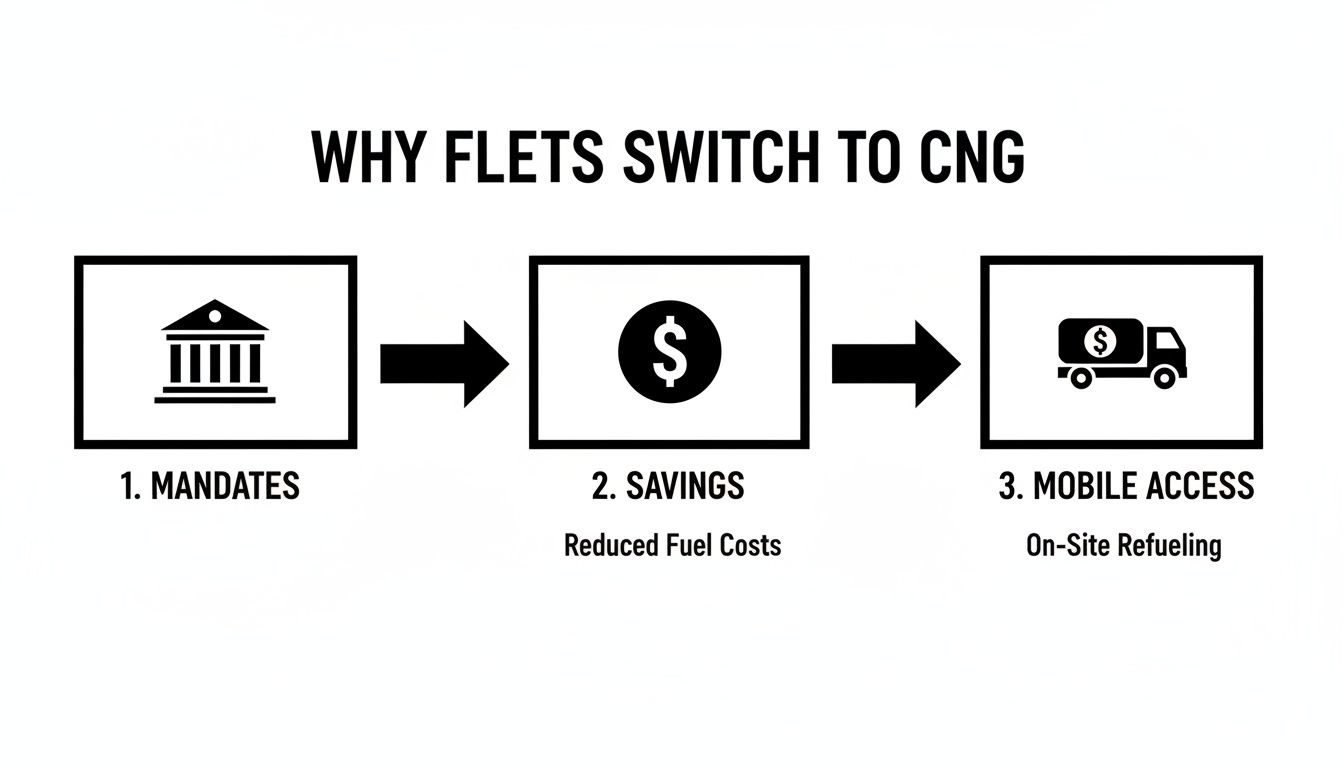
As you can see, the decision to adopt CNG is often a mix of regulatory necessity, bottom-line savings, and the logistical advantages of on-site fueling.
Two Types of Fueling Systems
Not all CNG stations are built the same. The design really comes down to who is using it and how quickly they need to fuel. This leads to two distinct approaches:
Fast-Fill Stations: This is the system most people are familiar with. You’ll find them at public retail stations designed to get you in and out in just a few minutes, much like a regular gas station. They rely on that cascade storage system to rapidly push large volumes of compressed gas into a vehicle’s tank.
Time-Fill Stations: This is the go-to for private fleets, like transit buses or refuse trucks that come back to the same yard every night. Vehicles are simply hooked up to dispensers and left to fill slowly over several hours. Because there’s no rush, this method uses a smaller compressor and requires less on-site storage, making it a more economical choice for depot-based operations.
The choice between fast-fill and time-fill is a strategic one. Fast-fill prioritizes speed and public access, while time-fill prioritizes cost-efficiency and overnight fleet readiness.
This growing infrastructure is a vital piece of the state's energy puzzle. Right now, about 1% of California’s total natural gas consumption is used as CNG vehicle fuel. While that might sound small, it’s a significant slice of the energy pie in the second-largest natural gas-consuming state in the U.S. (right behind Texas). You can dive deeper into these numbers by exploring California’s energy profile from the U.S. Energy Information Administration.
Where to Find CNG Fueling Stations Across California
Knowing where you can reliably fuel up is the bedrock of any fleet operation. It’s no different with compressed natural gas. The good news is that California has a huge network, but you still need the right tools to navigate it. A few excellent, easy-to-use resources make finding CNG fueling stations in California dead simple.
The best place to start is the Alternative Fuels Data Center (AFDC) Station Locator, run by the U.S. Department of Energy. Just think of it as the Google Maps for every alternative fuel out there. It gives you a live, interactive map of every public and private CNG station in the state, loaded with all the details a driver could need.
This isn’t just for finding a station on the fly; it’s a critical tool for planning routes and making sure your fleet can get across the state without any fuel anxiety.
Using the AFDC Station Locator
The AFDC map is much more than a bunch of pins on a screen—it's a smart database built for fleet managers. You can filter your search to find the exact type of station you need, ensuring every planned stop actually works for your vehicles and your payment methods.
Take a look at the filtering options available. This is where you can really dial in the map to match your fleet's specific needs.
As the screenshot shows, you can get incredibly specific. You can narrow down the CNG fueling stations across California by whether they’re public or private, what payment cards they take, and even the type of connector they have. This kind of detail takes the guesswork out of fueling and prevents a driver from showing up at an incompatible station.
A few key filters you’ll use all the time:
- Public vs. Private Access: This is the big one. Public stations are open to anyone, but private ones are often restricted to a specific fleet, like a city bus depot or a company's own yard.
- Payment Options: You can filter for stations that take your company’s credit cards or fleet cards, like Visa, MasterCard, or Wright Express.
- Connector Types: Make sure the station has the NGV1 or NGV2 connectors that your vehicles use.
Using these filters turns a generic map into a custom-built route plan that fits your fleet's operation like a glove.
Understanding Station Distribution and Key Corridors
California’s CNG infrastructure wasn’t built randomly. It's strategically concentrated along the state's biggest freight corridors and inside major economic hubs. You'll see the highest density of stations along the I-5 corridor, which is really the backbone of logistics in the state. This means long-haul trucks can run from the Mexico border all the way up to Oregon with confidence.
Beyond that, big metro areas like the Los Angeles basin, the Inland Empire, and the San Francisco Bay Area have a ton of CNG fueling stations. This makes sense, as they support the thousands of local delivery trucks, garbage trucks, and transit buses running through those dense areas every single day.
California has truly cemented itself as the national leader in natural gas infrastructure. The state is home to 318 CNG fueling stations, which is more than 23% of the entire U.S. total.
That dominant footprint means fleets operating in the Golden State have incredible access to cleaner, cheaper fuel. If you want to dig deeper into the numbers, you can find a great analysis of CNG station expansion across the country. This robust network is a direct result of California's long-standing commitment to cutting emissions and supporting alternative fuels.
To give you a quick snapshot for route planning, here are some of the top cities where you'll find easy public access to CNG.
Top California Cities for Public CNG Fueling Access
This table highlights the major metro areas with a high concentration of public CNG stations, making them reliable hubs for both local and long-haul fleets.
| City/Metro Area | Approximate Number of Public Stations | Key Corridors Served |
|---|---|---|
| Los Angeles | 30+ | I-5, I-10, I-405, Port of LA/Long Beach |
| Sacramento | 15+ | I-5, I-80, SR-99 |
| San Diego | 20+ | I-5, I-8, I-15, Border Crossings |
| San Francisco Bay Area | 25+ | I-80, I-580, US-101, Port of Oakland |
| Fresno / Central Valley | 15+ | SR-99, I-5 |
As you can see, the infrastructure is already in place to support a large-scale shift to CNG. By planning your routes around these fueling hotspots, you can maximize your fleet's efficiency and really start to see the cost savings add up.
How California's Clean Fuel Rules Drive CNG Adoption
California’s vast network of CNG fueling stations is no accident. It’s the product of a decades-long push by the state to slash air pollution and greenhouse gas emissions. These regulations create both the pressure and the opportunity for fleets to embrace cleaner fuels like Compressed Natural Gas (CNG).
The main architect behind this strategy is the California Air Resources Board (CARB). CARB sets the nation's toughest emissions standards for vehicles and fuels, which in turn creates a powerful market for alternatives to traditional diesel. For any fleet operating in California, aligning with CARB rules isn't just a good idea—it's essential for long-term viability. Switching to CNG is one of the most reliable ways to stay ahead of the curve.
But this isn't just about avoiding penalties. California has masterfully built a web of financial incentives into its environmental policies, creating a powerful business case for fleets to invest in natural gas.
The Low Carbon Fuel Standard: Turning Emissions Into Revenue
One of the most powerful tools in California’s arsenal is the Low Carbon Fuel Standard (LCFS). The idea is simple: it forces fuel producers to lower the "carbon intensity" (CI) of the products they sell. Diesel and gasoline have high CI scores. CNG, and especially Renewable Natural Gas (RNG), have much, much lower scores.
Here's where it gets interesting for fleet managers. When your fleet uses a low-carbon fuel like RNG, you generate LCFS credits. These credits are like cash on an open market. Producers of high-carbon fuels (like oil refineries) are required to buy them to meet their own state-mandated targets.
This means the LCFS creates a brand-new revenue stream for your fleet. You're not just saving on fuel; you're generating valuable credits that can be sold, dramatically improving the ROI on your CNG vehicles.
This brilliant system transforms a regulatory requirement into a direct financial benefit. It's a huge reason why more and more CNG fueling stations in California are making the switch to dispensing RNG.
Getting Paid to Go Clean: Grants and Vouchers
Beyond the LCFS market, California provides a whole host of direct financial incentives to help fleets cover the upfront cost of new CNG vehicles and fueling infrastructure. These programs can slash the initial investment, making the transition far more manageable.
Here are the heavy hitters you should know about:
- Voucher Incentive Programs (VIP): These are often the easiest to access. Programs like the Hybrid and Zero-Emission Truck and Bus Voucher Incentive Project (HVIP) offer a straightforward discount right at the point of sale. No complex rebate process—the price of the new, cleaner vehicle is simply lower from the start.
- Grant Funding: CARB and local air districts regularly offer competitive grants for projects that promise significant emissions reductions. This funding can be used for new CNG trucks, engine retrofits, or even to help build your own private fueling station.
- Tax Credits: Don't forget about federal and state tax incentives. These can provide another layer of savings, applying to both the cost of the vehicles and the fueling equipment.
Of course, building a new station means navigating a maze of local permits and applications. Getting ahead of common permit rejection issues can save you from months of headaches and costly delays.
Together, these overlapping programs create an incredibly supportive environment for CNG in California. The state doesn't just demand clean air; it provides the financial tools and market frameworks to help businesses make it a reality. By understanding how to tap into these resources, fleet managers can turn an environmental upgrade into a smart financial move.
Planning Your Fleet's Transition to CNG
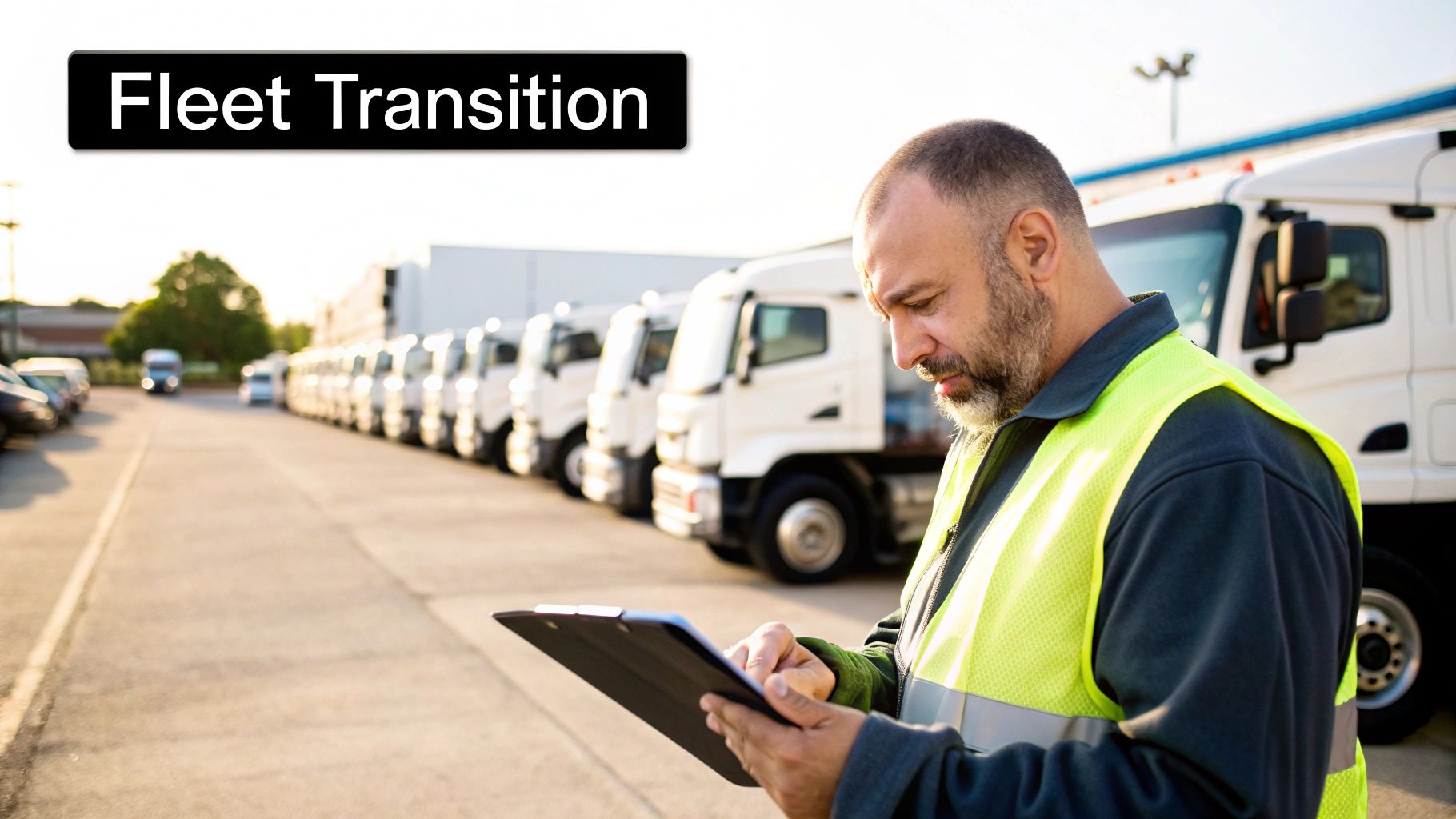
Making the switch to Compressed Natural Gas (CNG) for a commercial fleet is a whole lot more than just picking a different fuel. It's a major operational shift that demands a close look at your budget, your trucks, and how you get work done every day. For any fleet manager in California, jumping in without a solid, numbers-based plan is a recipe for headaches. You need to make sure the move is smart for your bottom line and doesn't disrupt your routes.
The first step is always to look at the big picture: the Total Cost of Ownership (TCO). Yes, the sticker price for a new CNG truck might be higher than its diesel equivalent, but that’s only the beginning of the story. The real win comes from the fuel itself.
CNG has a long history of being cheaper than diesel and gasoline. We measure it in a gasoline gallon equivalent (GGE)—basically, the amount of CNG that gives you the same punch as a gallon of gas. Here in California, the cost per GGE is often dramatically lower than diesel, which means you start saving money with every single mile. Those savings are what build the foundation for a strong return on your investment.
Assessing Vehicle Options and Compatibility
Once the numbers start looking good, it's time to think about the trucks themselves. The great news is the CNG market has grown up. You can find a wide variety of trucks ready to go, especially in the medium- and heavy-duty classes that do most of the heavy lifting.
You generally have two ways to get CNG vehicles into your fleet:
- Factory-Direct OEM Vehicles: Big names like Freightliner, Kenworth, and Peterbilt build popular models with dedicated CNG engines right on the assembly line. This is usually the best way to go. The truck is engineered from the ground up for natural gas and is backed by a full manufacturer's warranty.
- Certified Conversions: The other option is to retrofit your existing diesel or gasoline trucks with EPA-certified conversion kits. This can be a smart way to get started without buying all-new equipment, as long as your current trucks are a good fit and have plenty of life left in them to make the investment worthwhile.
There's no single right answer between buying new and converting old. It really comes down to your fleet's replacement schedule, your budget, and what your routes demand. Many fleets find a hybrid approach—a few new trucks mixed with some conversions—is the most practical way to get started.
Creating Your Fleet Transition Checklist
A smooth rollout doesn't happen by accident; it happens because of a good plan. A simple checklist can help you make sure nothing gets missed, from buying the first truck to training your team for the new routine.
Here are the key things to put on your planning list:
- Vehicle Acquisition Costs: Run the numbers. What’s the upfront cost of a new CNG truck compared to converting one of your existing assets?
- ROI Calculation: Map out your projected fuel savings over the next few years. Don’t forget to factor in California’s valuable incentives, like LCFS credits and HVIP vouchers, to see how quickly you'll break even.
- Maintenance and Training: CNG engines aren't the same as diesel. Your mechanics will need specialized training to safely handle the fuel systems and other new components.
- Driver Training: Your drivers are on the front lines. They need to be comfortable with the new fueling procedures at CNG fueling stations in California, from connecting the nozzle to understanding fill times.
- Fueling Strategy: Will you rely on public stations along your routes? Or does it make more sense for your operation to build a private, on-site station for convenient overnight fueling?
Thinking through these points step-by-step helps you build a transition plan that actually works. It minimizes the chaos and sets you up to get the most out of the financial and environmental perks of moving your fleet to CNG.
Solving Fueling Gaps with Mobile CNG Solutions
California’s network of permanent CNG fueling stations is solid, but it can’t be everywhere at once. So, what do you do when a major construction project is miles from the nearest pipeline? Or when a factory has to shut down its gas line for a planned upgrade? This is where mobile CNG solutions step in, creating what’s often called a "virtual pipeline" to bring fuel directly to where it's needed, right when it's needed.
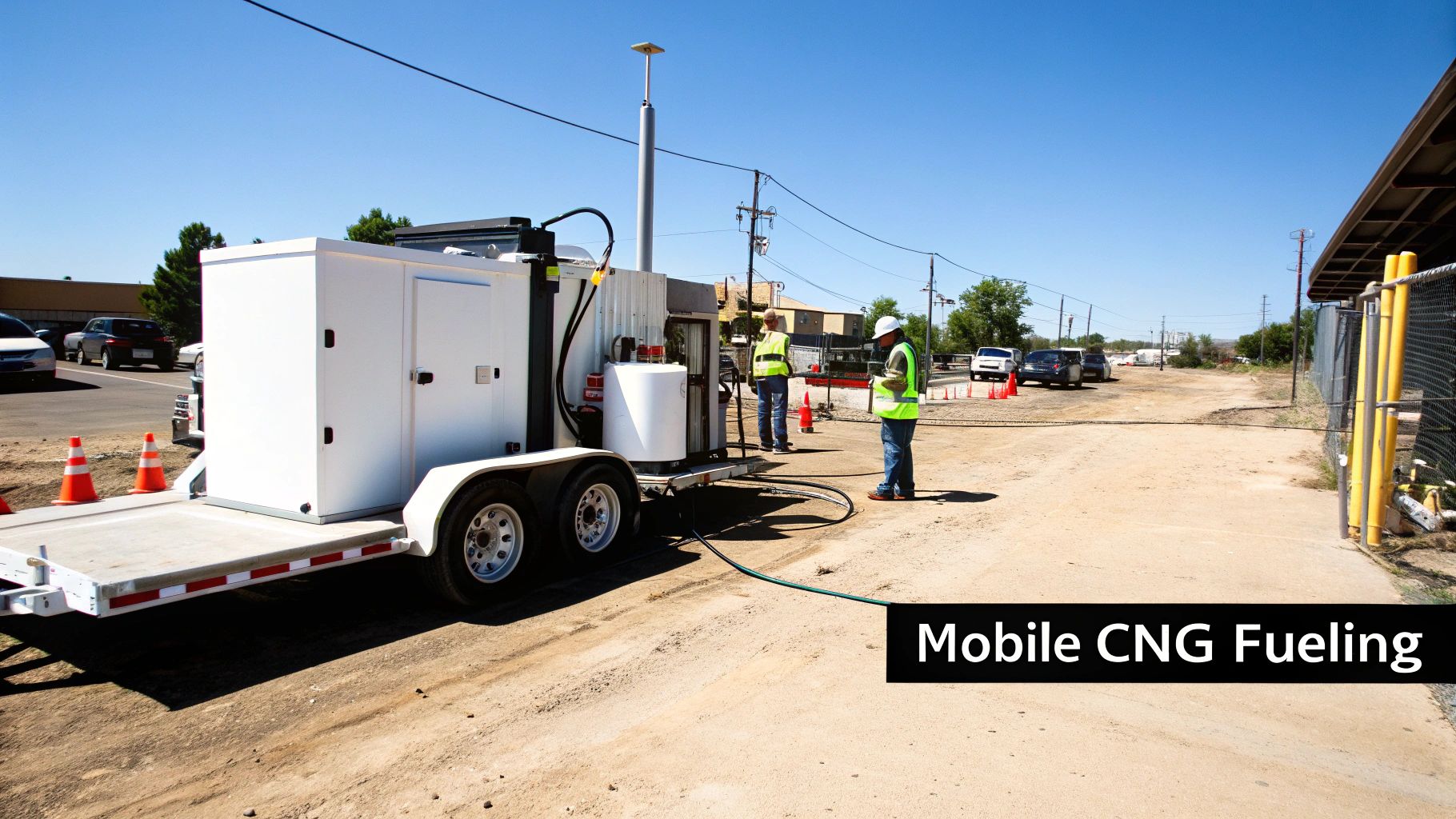
Think of mobile CNG as energy on demand. Specialized trailers, packed with pressurized natural gas, are hauled directly to your site. Once there, they connect to your equipment through a pressure reduction system, providing a steady, reliable flow of gas just like you'd get from a permanent utility connection. It’s an incredibly flexible and fast way to solve all sorts of temporary energy problems.
Common Scenarios for Mobile Fueling
The uses for this technology are as practical as they are essential for keeping California's economy running. Instead of getting stuck waiting months for new infrastructure to be built, project managers can get the energy they need in a matter of hours or days.
Here are a few situations where it really shines:
- Remote Construction Sites: Big projects, like housing developments or industrial parks, often need power for generators and heaters long before permanent gas lines are installed. Mobile CNG lets them get to work immediately, keeping tight schedules from slipping.
- Industrial Plant Maintenance: When a manufacturing facility has to shut down its main gas line for maintenance, it doesn't mean production has to grind to a halt. A mobile CNG unit can be brought in to power critical systems, avoiding a costly shutdown.
- Utility Pipeline Support: Even the gas utilities lean on mobile CNG. If a section of pipeline needs repairs, a mobile unit can be hooked up to serve the homes and businesses downstream. For them, it means no one ever loses service.
Mobile CNG is a logistical game-changer. It decouples project timelines from the constraints of fixed infrastructure, providing energy security and operational continuity that would otherwise be impossible. This flexibility is critical for both emergency response and strategic project planning.
How a Virtual Pipeline Works
The process itself is straightforward, but it’s all highly engineered for safety and efficiency. It’s a complete, self-contained energy solution designed for rapid deployment anywhere in California.
A typical mobile fueling operation has three main parts:
- High-Pressure Transport: CNG is loaded onto specialized tube trailers—basically a bundle of super-strong cylinders holding gas at pressures up to 3,600 psi.
- On-Site Pressure Regulation: At the site, the trailer is connected to a pressure reduction skid. This piece of equipment is the brains of the operation, carefully dropping the gas pressure down to exactly what the on-site machinery needs, whether that’s a small heater or a massive industrial boiler.
- Continuous Monitoring: The whole setup is monitored 24/7 to ensure a safe, steady flow. When one trailer starts getting low, a full one is swapped in seamlessly, so there’s never an interruption in supply.
This innovative approach is much more than just a temporary patch; it's a strategic tool. Companies like Blue Gas Express are experts in deploying these mobile solutions, helping project managers and utility partners navigate logistical challenges and keep the power on. By filling these crucial energy gaps, mobile CNG plays a vital role in supporting the broader network of cng fueling stations in California.
Questions We Hear All the Time About CNG in California
Jumping into alternative fuels always brings up a lot of practical questions. If you're a fleet manager, a builder, or a business owner looking at your options, you need straight answers. This FAQ section is designed to tackle the most common things people ask about using CNG in California.
We've rounded up the questions that pop up again and again to get you the information you need, fast. From how the costs stack up to what kind of fuel you should be using, these answers will give you a clearer picture of what bringing compressed natural gas into your operation really looks like.
Is CNG Actually Cheaper Than Diesel in California?
Yes, it almost always is. When you compare them on an apples-to-apples basis—what we call a gasoline gallon equivalent (GGE)—CNG consistently comes out cheaper than diesel. Fuel markets are always in flux, of course, but fleet operators who make the switch routinely see significant savings year after year.
This cost advantage is one of the biggest reasons fleets across the state are moving to natural gas. The money saved on fuel helps pay back the initial cost of the CNG vehicles, often making it a financially smart move over the life of the truck.
The Bottom Line: The steady price difference between CNG and diesel is a powerful incentive. It's what turns a decision driven by regulations and environmental goals into one that also makes perfect sense for your budget.
What's the Real Difference Between CNG and RNG?
This is a huge deal here in California, and it's something you really need to understand. Both work in the same natural gas vehicles, but where they come from is totally different—and that has a massive impact on your emissions profile and the financial incentives you can get.
- CNG (Compressed Natural Gas) is what most people think of: conventional natural gas pulled from the ground. It's a fossil fuel, just compressed to be used in vehicles.
- RNG (Renewable Natural Gas) is biogas captured from organic waste sources like dairy farms, landfills, and wastewater treatment plants. It's chemically the same as CNG, but because it captures methane that would otherwise pollute the atmosphere, it's often considered a carbon-negative fuel.
In California, using RNG can generate valuable credits under the state's Low Carbon Fuel Standard (LCFS), which can make it an even better choice for both the planet and your wallet.
Can I Just Convert My Existing Trucks to Run on CNG?
The short answer is: maybe. Not every truck is a great candidate for a CNG conversion, but many popular medium- and heavy-duty models can be retrofitted using EPA-certified conversion kits. It makes the most sense for vehicles that still have plenty of working years left in them to make the investment worthwhile.
That said, for anyone buying new vehicles, the easier path is usually to buy a truck built for CNG right from the factory. Major manufacturers like Freightliner and Kenworth offer dedicated CNG models. This is typically the most seamless and reliable way to add CNG to your fleet.
Ready to bridge your own energy gaps without waiting for permanent infrastructure? Blue Gas Express provides on-demand mobile CNG solutions to keep your projects powered and on schedule. Learn how our virtual pipeline can serve your construction site or industrial facility by visiting https://bluegasexpress.com.