

Picture this: a personal fuel pump right in your own garage, connected to the very same natural gas line that powers your furnace or stove. That’s exactly what a CNG home refueling station is. It lets you fill up your natural gas vehicle overnight, using fuel that costs a whole lot less than gasoline.
Your Personal Fuel Pump in the Garage
The easiest way to think about a home CNG station is to compare it to an EV charger. Instead of plugging in your car to charge its battery, you connect it to a special unit that fills its tank with compressed natural gas. This completely erases those last-minute, inconvenient trips to the gas station.
The whole process is pretty straightforward. The appliance takes the low-pressure natural gas already flowing into your home and slowly compresses it to a high pressure suitable for your vehicle. It’s a slow, deliberate process designed for safety and efficiency, typically running overnight. When you wake up, your vehicle is ready to hit the road with a full tank of clean, affordable fuel.
The Appeal of Home Refueling
So, why would someone install one of these? It really boils down to two huge advantages: convenience and serious cost savings. Natural gas is almost always significantly cheaper than gasoline. For someone who drives a lot, those savings can easily climb into the thousands of dollars each year, making the initial investment pay for itself.
But it's not just about the money. There are other solid reasons this technology is catching on:
- Ultimate Convenience: Imagine never having to stop for gas again. You wake up every single day with a full tank, ready to go.
- A Greener Footprint: Natural gas is a cleaner-burning fuel than gasoline. It produces far fewer harmful emissions, which is a big win for local air quality and your own environmental impact.
- Energy Security: You’re tapping into a domestic energy source. This means you're less exposed to the wild price swings and supply issues that can plague the global oil market.
A home refueling unit transforms a daily chore into a seamless, automated process. It’s not just about saving money on fuel; it's about reclaiming your time and making a smarter energy choice for your household or small business.
Who Benefits Most from a Home Station?
While the idea sounds great to almost anyone, a home station is a real game-changer for specific types of drivers. If you're a high-mileage commuter, the math works out beautifully—you can see a return on your investment in just a few years.
It’s also an incredible solution for small businesses. Think of a local plumbing company or a delivery service running a few CNG-powered vans. A home or shop-based station can slash their operational costs and make refueling a simple, end-of-day task. This guide will walk you through everything you need to know to figure out if a home CNG station is the right call for you.
How Your Home CNG Station Actually Works
A home CNG refueling station might sound intimidating, but the concept is actually pretty simple. It’s less like a miniature power plant and more like a super-powered air compressor you’d find in a high-end workshop. The key difference? Instead of air, it uses the natural gas that already flows into your home.
The entire system is built to do one thing really well: take the low-pressure gas from your utility line, crank up the pressure significantly, and store it in your vehicle's tank. The whole process is designed to be safe, quiet, and fully automated, usually running overnight while you sleep.
The Three Key Components
Every home CNG station, regardless of the brand, relies on three core parts working together. Each one plays a critical role in making sure the natural gas is clean, dry, and pressurized perfectly before it ever gets near your vehicle.
- The Dryer: The natural gas coming into your house contains a bit of water vapor. Before you can compress the gas, that moisture has to go. The dryer removes it, preventing rust and ice from forming inside the high-pressure parts of the station or your vehicle’s fuel system.
- The Compressor: This is the muscle of the operation. It’s essentially a multi-stage pump that takes the purified, low-pressure gas and squeezes it in steps, boosting the pressure until it hits roughly 3,600 pounds per square inch (psi).
- The Dispensing Hose and Nozzle: This is where you connect to your car. The hose is specially designed to handle that immense pressure safely, and the nozzle clicks on to create a tight, leak-proof seal with your vehicle's fuel port.
This diagram helps visualize how this straightforward process leads to some major perks.
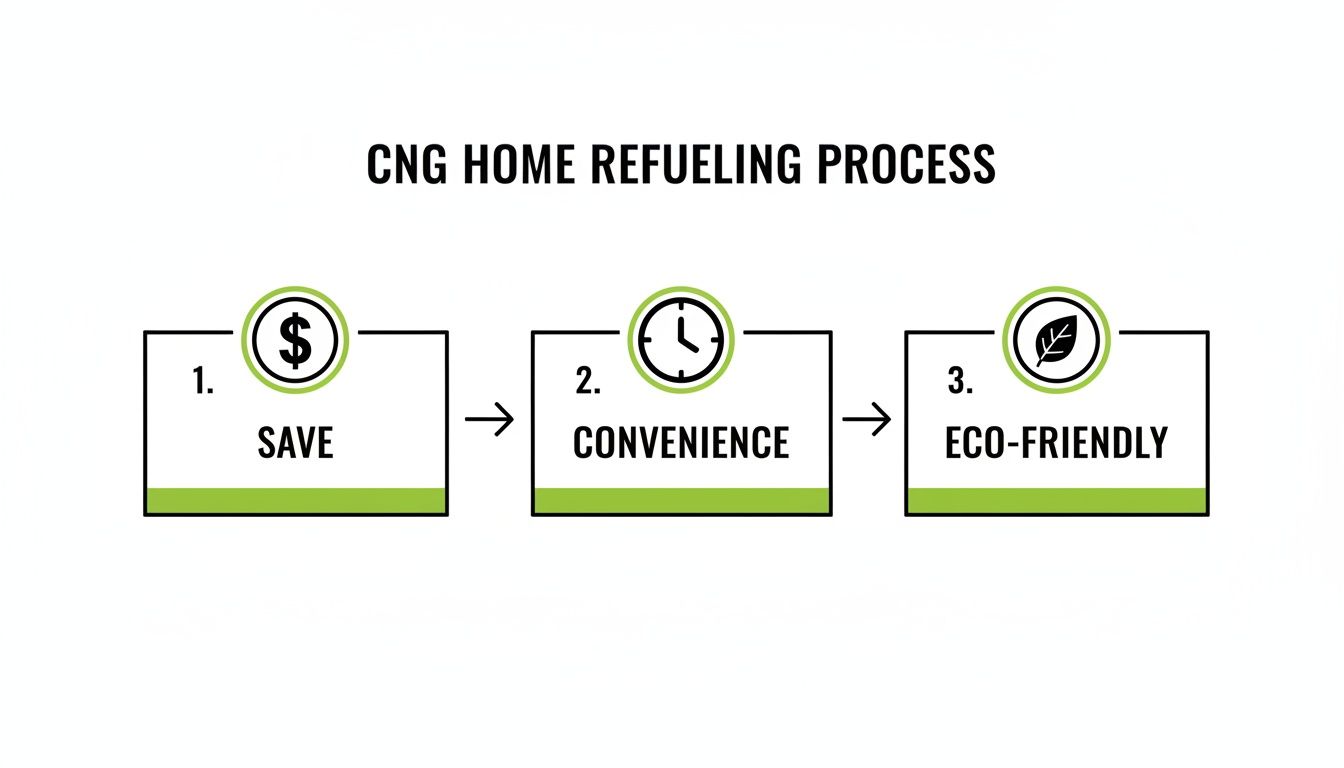
You can see how the system's simple function translates directly into real-world benefits like saving money, enjoying incredible convenience, and shrinking your carbon footprint.
From Utility Line to Vehicle Tank
So what does an overnight fill-up actually look like? It’s a smooth, hands-off sequence that turns your garage into a private fueling station.
It all starts when you connect the hose to your vehicle and turn the unit on. The station immediately starts to pull a small, steady amount of natural gas from your home's supply line—the very same one that feeds your furnace or stove, which is typically at a very low pressure of less than 0.5 psi.
From there, the gas flows through the dryer. Think of it as a specialized dehumidifier for natural gas, pulling out all the water vapor. This purification step is absolutely essential for protecting the equipment and your vehicle’s engine from long-term damage.
The real magic happens in the compressor. It takes that dry gas and runs it through multiple compression cycles, kind of like filling a scuba tank. The pressure builds and builds with each stage until it hits that sweet spot of 3,600 psi, which is the industry standard for CNG vehicles.
Finally, the highly compressed gas travels through the heavy-duty hose to fill your vehicle's tank. Because home units are built for a "slow-fill" approach, a complete top-off usually takes about 8-12 hours. This gentle method is easier on the equipment and ensures you get a full, safe tank every single time, so your car is ready to hit the road when you are.
Bringing It Home: Installation and Permitting
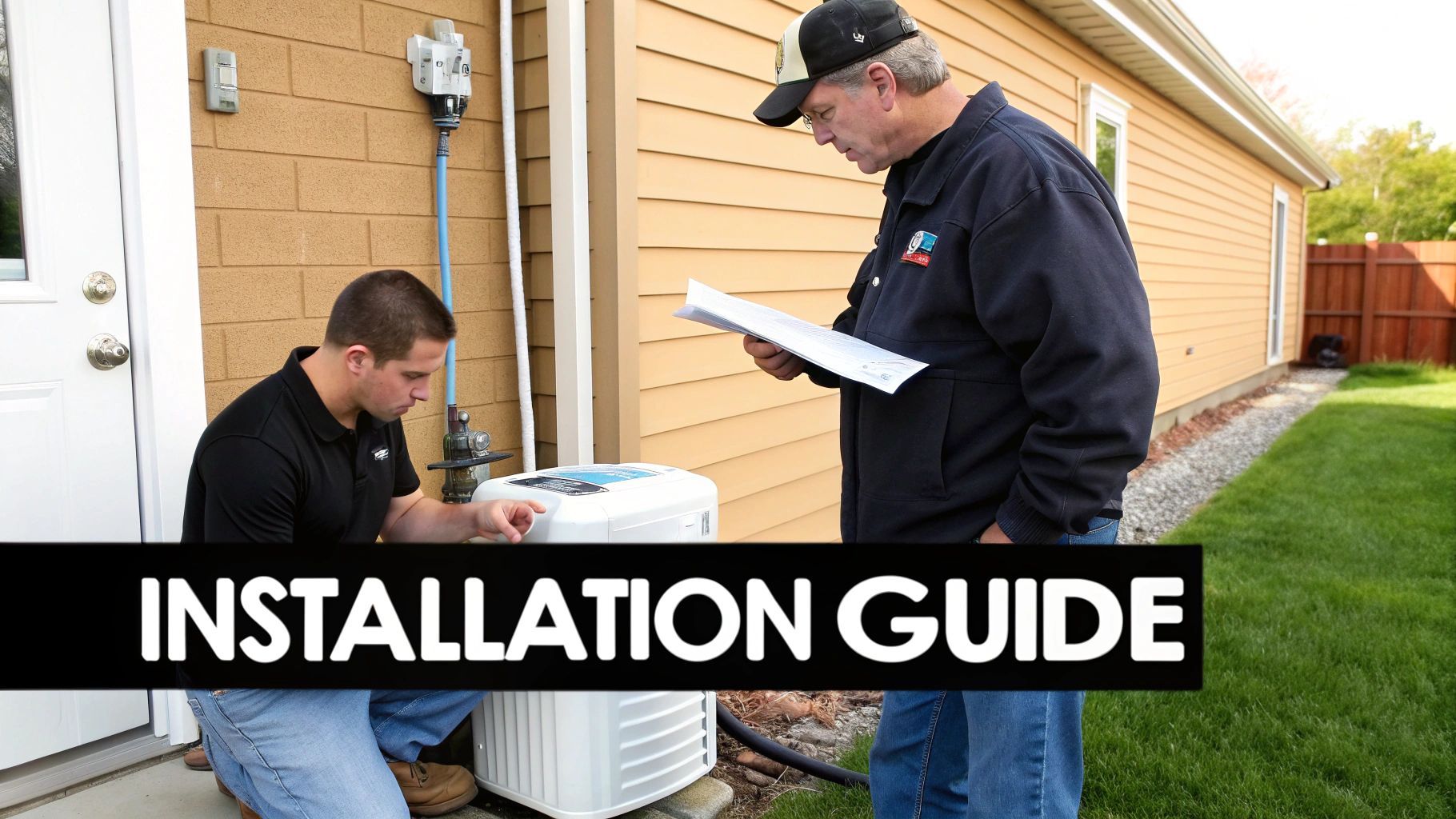
So, what does it actually take to get a cng home refueling station up and running? The good news is it's less like a major construction project and more like installing a high-end appliance, say a backup generator or a new central AC unit.
When you break it down, the path from an empty spot in your garage to your first overnight fill-up is straightforward. The absolute key, though, is working with certified professionals who know the equipment and, just as importantly, the local rules.
The whole process kicks off with a professional site assessment. A qualified installer will come out to your property to make sure it's a good fit for a safe and efficient setup. This isn't just a quick look-see; they'll be doing a detailed review of your existing utilities and the spot you've picked out for the unit. They're checking for two deal-breakers: a suitable natural gas supply and an adequate electrical system. Once those get the green light, you can move on to the real work.
Laying the Groundwork: Your Pre-Installation Checklist
Before a single tool comes out, there's some important prep work to do. Think of this as the planning phase, where you confirm your home is truly ready to support the new gear. Getting this stage right is the best way to avoid expensive surprises and frustrating delays later on.
First up, your installer will check the pressure and volume of your home's natural gas line. Most of these units work just fine with a standard residential gas supply, but the technician needs to confirm your line can handle the consistent flow without affecting your furnace or water heater.
Next, they’ll take a hard look at your electrical panel. The compressor is the heart of the station, and it needs a dedicated 240-volt circuit—the same kind of power an electric dryer or oven needs. If you don't already have one handy in the garage or wherever the unit is going, an electrician will have to run a new line.
These are the essential milestones before the real work begins:
- Professional Site Assessment: A certified tech will evaluate your garage or outdoor space, making sure there's proper ventilation, clearance from other objects, and easy access to your utility lines.
- Gas Line Verification: The installer confirms that your natural gas line meets the specific pressure and flow rate specs required by the station's manufacturer.
- Electrical System Upgrade: An electrician inspects your panel and installs that dedicated 240-volt circuit to power the compressor safely and reliably.
The pre-installation phase is where a successful project is made. Ensuring your home’s utilities are up to the task is the single most important step in guaranteeing a smooth, safe, and code-compliant installation process.
Securing Approvals: The Permitting Process
With the technical boxes checked, it's time to deal with the paperwork. Just like any other significant upgrade to your home, a CNG station has to comply with local building, fire, and safety codes. Any reputable installer will handle this whole process for you, but it’s still good to know what’s happening behind the scenes.
Your installer will submit a permit application to your local municipality, complete with detailed plans for both the gas and electrical work. This document shows the city inspectors exactly how the system will be installed, proving it meets all safety standards.
Navigating the permitting journey can feel complex, but it's all about following established rules. While not specific to CNG stations, resources about things like the Tennessee Residential Building Codes highlight just how important professional guidance is for meeting all legal requirements.
Once the permit is approved, the physical installation can finally start. After the unit is in place and all the connections are made, a city official will come out for one final inspection. They’ll sign off on the work, confirming it matches the approved plans and follows all safety protocols. That final signature is your official green light to start refueling at home.
Breaking Down the Costs and Calculating Your Return

Putting in a cng home refueling station is a serious investment, no doubt about it. But it's one of those investments where the financial upside is both significant and surprisingly easy to map out. The first step is getting a handle on what you'll actually spend upfront.
Your biggest line item is the refueling appliance itself. Think of it as a specialized, heavy-duty piece of equipment built to work safely and reliably for years. It's the heart of the system, and its cost reflects that.
Of course, the hardware is only half the story. Professional installation isn't optional—it's essential for safety and code compliance. You'll need a certified technician to handle the natural gas plumbing and the electrical hookups. Depending on your home's layout, this might also mean running a new 240-volt circuit to your garage or wherever the unit will live.
Upfront Investment Breakdown
So, what kind of numbers are we talking about? While the final price tag can shift based on the brand you choose and how complex your installation is, most homeowners will see their total investment fall into a fairly predictable range.
The cng home refueling station unit is a fascinating piece of tech. These appliances are designed to pull from standard residential gas lines and deliver four to six Gasoline Gallon Equivalents (GGE) overnight. For that capability, you can expect the unit itself to cost between $4,000 and $10,000.
This performance is what drives the payback, creating $0.50 to $1.00 per GGE savings compared to what you'd pay for gasoline. With that kind of savings, many users see a return on their investment in just two to three years. You can find more details about the broader trends in the natural gas refueling market.
Here’s a clearer look at where the money goes:
- Refueling Unit: The core appliance, ranging from $4,000 to $10,000.
- Professional Installation: This covers the skilled labor for gas and electrical work, typically costing $1,500 to $3,000.
- Permitting Fees: This depends on your local municipality but usually falls between $200 and $500.
- Potential Electrical Upgrades: If you need a new 240V circuit, budget an extra $500 to $1,500.
When you add it all up, a complete, professionally installed system will generally land somewhere between $6,200 and $15,000.
Calculating Your Return on Investment
Once you have a solid idea of the initial cost, you can start figuring out your payback period. The entire ROI calculation boils down to a simple comparison: the price you pay for natural gas versus the price you pay for gasoline at the pump.
To make it a fair fight, we convert the cost of natural gas into a "Gasoline Gallon Equivalent," or GGE. This gives you a true apples-to-apples number. The beauty is that the cost of a GGE from your home's utility line is drastically lower than a gallon of gas. For instance, if gasoline is $3.50 a gallon and your natural gas works out to $1.50 per GGE, you're pocketing $2.00 in savings on every "gallon" you use.
The core of your ROI calculation is fuel cost displacement. Every mile you drive using home-compressed natural gas is a mile you aren't paying gasoline prices for, and that price difference is what pays back your initial investment.
To run the numbers for your specific situation, just follow these simple steps:
- Calculate Your Annual Mileage: How many miles do you typically drive in a year?
- Find Your Vehicle's Fuel Economy: Check your car's miles per gallon (MPG) on both CNG and gasoline (they're usually very close).
- Determine Your Annual Fuel Consumption: Divide your annual mileage by your MPG to see how many gallons or GGEs you use each year.
- Calculate Annual Savings: Multiply your annual fuel use by the price difference between a gallon of gas and a GGE of natural gas.
- Find Your Payback Period: Divide your total upfront cost by your annual savings.
This table gives a simplified example of how the annual costs might shake out for an average driver.
Cost and Savings Comparison: Home CNG vs. Gasoline
| Metric | Home CNG Refueling | Gasoline Refueling |
|---|---|---|
| Annual Miles Driven | 15,000 miles | 15,000 miles |
| Vehicle MPG/GGE | 25 | 25 |
| Annual Fuel Consumed | 600 GGEs | 600 Gallons |
| Cost per GGE/Gallon | $1.50 | $3.50 |
| Annual Fuel Cost | $900 | $2,100 |
| Annual Savings | $1,200 | N/A |
As you can see, the savings add up quickly.
For anyone who puts a lot of miles on their vehicle, the payback period is often just 2-4 years. On top of that, don't forget to look into federal and state tax credits for clean energy infrastructure. These incentives can shorten your payback period even further, making the financial case for a cng home refueling station incredibly strong.
Choosing Your Refueling Method: Home vs. Public Stations
So, you're sold on driving a CNG vehicle. That's the easy part. The next big question you need to tackle is, "Where do I fill this thing up?" Unlike gasoline, where you can find a station on practically every corner, a solid CNG refueling strategy takes a bit more thought.
You’re essentially looking at three main paths, each with its own set of pros and cons when it comes to convenience, cost, and availability. You can install your own cng home refueling station, rely on the growing network of public stations, or even use a specialized mobile refueling service. The right answer for you really hinges on your daily driving habits, your budget, and what you want to get out of it long-term.
Thinking about a home CNG station means weighing its benefits against sticking with public options. It's a very similar dilemma to what electric vehicle owners face with the decision between a home setup and public networks. Each approach serves a different need, so let's break down what makes each one tick.
The Ultimate Convenience: A Home Station
For sheer daily convenience and long-term savings, nothing beats a home refueling station. Imagine having your own private, incredibly cheap "gas" station right in your garage. You just plug your vehicle in when you get home, and it’s full by the next morning. Every single time.
This setup completely erases refueling stops from your daily routine. Better yet, the cost per Gallon of Gasoline Equivalent (GGE) is as low as it gets because you’re paying your standard residential natural gas rates—which are almost always cheaper than the retail price at a public pump.
Of course, this convenience comes with a hefty upfront investment for the unit and its installation. A home station makes the most sense for:
- Daily Commuters: If you put a lot of miles on your car, you'll maximize fuel savings and see a much faster return on your investment.
- Small Residential Fleets: Perfect for businesses with a few CNG vehicles that return to a central base every night.
- Drivers with Predictable Routes: Ideal if you operate within a known range and rarely need to refuel in the middle of a trip.
Relying on Public CNG Stations
If you’re someone who travels long distances or has a less predictable schedule, the public refueling network will be your go-to. These stations are much, much faster than a home unit, capable of filling a tank in just a few minutes—pretty much the same experience as a traditional gasoline pump.
The public network has come a long way, making CNG a far more practical choice than it used to be. By the end of 2025, the U.S. had expanded its CNG infrastructure to 1,385 operational stations. What's really important is that 53% of these stations (around 734) are open to the public, making CNG a genuinely workable option for everyone from individual drivers to commercial fleets. You can dig into the data on this growth in this 2025 natural gas station report.
While public stations give you speed and the freedom to take road trips, they come with a higher cost per GGE. You also have to plan your routes around their locations. The convenience here is in the fill-up speed, not in everyday access.
This option is the best fit for:
- Long-Haul Drivers: Anyone, from individuals to fleets, who travels beyond the range of a single overnight fill.
- Occasional CNG Users: Drivers who might not use their CNG vehicle enough to make the cost of a home installation worthwhile.
- Renters or Apartment Dwellers: Folks who simply can't install a permanent refueling appliance where they live.
The Mobile Refueling Alternative
There's a third, more specialized option on the table: mobile CNG refueling. Companies like Blue Gas Express bring the fuel directly to your location, filling up a temporary storage unit on-site. This isn't really a permanent solution for a daily driver, but it’s an absolute lifesaver in certain commercial or temporary situations.
Mobile services are perfect for bridging gaps where natural gas infrastructure doesn't exist yet. Think of construction sites that need temporary power or fleets operating in a new area before a permanent station gets built. It offers incredible flexibility but is really geared toward industrial or large-scale needs rather than individual vehicle owners.
Is a Home CNG Station Your Best Move?
Deciding whether to install a CNG home refueling station is a big deal. It's more than just a financial investment; it’s a commitment that changes how you fuel up and plan your days. Before you dive in, you need to honestly look at your driving habits and daily routines to see if this technology really fits your life. The right person for a home station isn't just chasing cheaper fuel—they have a lifestyle that makes the most of what these systems offer.
So, how do you know if you're a good fit? It really starts with your daily mileage. Do you have a long commute? Do you run a small business with a few vans or trucks that come back to the same spot every night? If so, you're exactly who these systems are designed for. Consistent, high mileage is what makes the math work, turning what you save at the pump into a real payback on your investment.
Your Personal Decision Checklist
Let's treat this as a final gut-check before you commit. If you find yourself nodding "yes" to most of these questions, then a home CNG station is probably a fantastic move for you.
- High Annual Mileage: Are you putting more than 15,000 miles on your vehicle each year? The more you drive, the faster those fuel savings will cover the upfront cost of the system.
- NGV Compatibility: Do you already own a natural gas vehicle (NGV), or are you planning to buy one soon? It sounds obvious, but the station is only as good as the compatible vehicle you have to fill.
- Homeownership and Space: Are you a homeowner with a good spot for the unit? You'll need a well-ventilated space, like a garage or a secure spot outside.
- Natural Gas Access: Is your home already hooked up to a natural gas line? This is the absolute deal-breaker; without it, there’s no way to install a station.
- Long-Term Outlook: Do you see yourself staying in your current home for at least the next 3-5 years? That’s usually the time it takes to really start seeing the financial benefits pay off.
This isn't just a niche idea anymore; it's a growing part of the energy landscape. The global market for CNG filling stations was valued at around $15 billion in 2025 and is only expected to grow. Just like we've seen with home EV chargers, these personal refueling units are poised to become more common, offering the convenience of overnight fills for both homeowners and small businesses. If you're interested in the data, you can dig deeper into these trends in this CNG filling stations market report.
Ultimately, a home CNG station is for the practical planner—the high-mileage commuter, the small fleet owner, or the environmentally-conscious driver who values long-term savings and energy independence over a low initial cost.
By running through this checklist and thinking about your own situation, you can make a clear-headed decision and feel confident about whether you're making a smart investment in your energy future.
Frequently Asked Questions
Even after weighing the costs and benefits, you probably still have a few practical questions about what it's really like to live with a cng home refueling station. Let's tackle some of the most common ones head-on so you can feel completely confident in your decision.
How Safe Is a CNG Home Refueling Station?
This is usually the first question people ask, and for good reason. The short answer is: they are incredibly safe. Home CNG units are built from the ground up with safety as the main design principle. They come loaded with features like automatic shut-off valves and pressure relief devices to prevent any chance of overfilling or leaks.
Plus, every installation has to be done by a certified pro and must pass a tough inspection to make sure it meets strict national safety codes. It's also helpful to remember that natural gas itself is lighter than air. Unlike gasoline vapor that can pool dangerously on the ground, natural gas simply rises and dissipates into the air if a leak ever occurs, dramatically lowering any fire risk.
What Kind of Maintenance Does a Home CNG Unit Require?
You'll be pleasantly surprised. Maintaining a home CNG unit is a lot like taking care of any other major appliance, like your furnace or water heater. It's mostly a "set it and forget it" system.
- Annual Filter Change: About once a year, you’ll need to swap out a dryer filter. It's a simple task that keeps the natural gas pure and the system running smoothly.
- Periodic Inspections: It’s a good idea to have a certified technician give it a professional once-over every few years, just to check the seals and make sure everything is in top shape.
The main compressor is a sealed unit, built to give you years of trouble-free service without you ever having to touch it.
Can I Install a Station if I Have Low Gas Pressure?
That's a key question we figure out during the initial site assessment. Most home refueling appliances are designed to work perfectly with the standard natural gas pressure supplied to residential neighborhoods. Your installer will take precise measurements to make sure your home's gas line can deliver what the unit needs.
If it turns out your pressure is a little low, it's not necessarily a deal-breaker. It might mean your local gas company needs to make a small upgrade to your service line. While this can add to the project's cost and timeline, it's something we identify right at the beginning so there are no surprises.
How Long Does It Take to Refuel My Vehicle?
Home units are designed for "slow-fill" refueling, which is a gentle process that's better for the equipment and ensures you get a completely full tank. The exact time depends on the size of your vehicle’s tank and the station’s output, which is usually between 0.5 to 1.5 GGE (gasoline gallon equivalents) per hour.
What does that look like in practice? For a typical passenger car or light-duty truck, an overnight fill is perfect. It generally takes about 8 to 12 hours to go from empty to full, meaning you can just plug it in when you get home and wake up to a full tank every single morning.
For commercial projects or temporary job sites where a permanent station doesn't make sense, Blue Gas Express provides specialized mobile CNG solutions. Find out more about our flexible, on-demand natural gas delivery at the Blue Gas Express website.