

When you're dealing with natural gas, having immediate access to safety information isn't just about checking a compliance box—it's an absolute necessity. The MSDS, now officially known as a Safety Data Sheet (SDS), is your go-to guide for handling emergencies safely and effectively. This section is built for the crews in the field who need that critical info right now.
Actionable Safety Data For Field Operations
In the middle of an incident, nobody has time to sift through pages of technical jargon. Your team needs the most important safety facts, boiled down into simple, clear instructions. A good quick-reference guide makes the difference, turning complex chemical data into actions anyone on site can follow, from the seasoned foreman to the new hire. That’s how you manage risk when every second counts.

To make this happen, we've put together two indispensable tools: a quick-glance table with the most critical data from the natural gas SDS and a downloadable emergency checklist. Think of them as the bridge between what the regulations require and what you actually need to do on the job.
Natural Gas (Methane) Key Safety Data At-A-Glance
This table pulls the most vital safety and identification info from the natural gas SDS. It's designed for quick reference in the field, helping your team instantly grasp the material's properties and potential hazards.
| Data Point | Value/Information | Significance |
|---|---|---|
| UN Number | UN1971 (Liquefied) / UN1972 (Compressed) | This is the universal identifier for shipping and emergency response. It immediately tells first responders exactly what they're up against. |
| Primary Hazards | Extreme Flammability, Gas Under Pressure, Simple Asphyxiant | These are the big three dangers. Natural gas ignites easily, can explode from pressure buildup, and will displace oxygen in enclosed areas, leading to suffocation. |
| LEL / UEL | Approx. 5% / 15% in air | This is the "fire triangle" danger zone. Any gas concentration between the 5% Lower Explosive Limit and the 15% Upper Explosive Limit can ignite. It's why leak detection is so crucial. |
| Signal Word | DANGER | This single word, mandated by the GHS, signals the highest level of hazard. It's the most urgent warning on an SDS, designed for immediate risk awareness. |
Knowing these four points can make all the difference when you're making decisions under pressure.
Downloadable Emergency Action Checklist
To give your team an extra edge, we've developed a straightforward, step-by-step emergency checklist. It lays out the initial actions for a suspected leak, proper evacuation procedures, and who to contact. This tool is built specifically for construction crews and facility managers to ensure everyone responds as a coordinated, effective team.
Field Tip: Don't just save this on a computer. Print out multiple copies and keep them in your site safety binder and inside every company vehicle. When things get chaotic, having a physical guide to follow keeps everyone calm and ensures no critical steps are missed.
Reading the 16 Sections of a Natural Gas SDS
A Safety Data Sheet (SDS) for natural gas isn’t just a formality to keep regulators happy—it’s your operational safety manual. The old Material Safety Data Sheets (MSDS) were replaced by the global 16-section SDS format for a good reason: it created a consistent, easy-to-follow structure so anyone, anywhere, can find life-saving information in seconds.
If you work with natural gas, knowing how to find and apply the details in each section is non-negotiable. Let's break down the technical jargon and turn this document into a practical tool you can actually use.
The Essentials: Sections 1 to 5 for Quick Action
The first five sections are your go-to for immediate identification and emergency response. Think of them as the "who, what, and how" when things go wrong.
Section 1: Identification: This is the most basic, yet critical, part. It tells you exactly what you’re dealing with—the product name (like Natural Gas, Compressed or Methane), UN numbers, and the supplier's contact info (such as Blue Gas Express). In a crisis, this is the first thing responders will ask for.
Section 2: Hazard Identification: Here's your at-a-glance summary of the dangers. It uses universal GHS pictograms (like the flame symbol), a signal word (DANGER), and straightforward hazard statements like, "Extremely flammable gas."
Section 3: Composition and Information on Ingredients: For natural gas, this section is pretty simple. It lists methane as the main component, often over 85%, along with other hydrocarbons. It’s the chemical breakdown of what’s inside the container.
Section 4: First-Aid Measures: This is your script for a medical emergency. It gives you clear, step-by-step instructions for different exposures, whether it’s inhalation (asphyxiation) or skin contact with LNG (frostbite). Follow these directions while waiting for professional help.
Section 5: Fire-Fighting Measures: This part tells you exactly how to tackle a fire. It covers which extinguishing agents to use, what specific hazards to expect (like a vapor cloud explosion), and what protective gear firefighters absolutely must wear.
The Playbook: Sections 6 to 10 for Safe Operations
Once you move past the immediate emergency info, the next sections get into the nitty-gritty of preventing incidents in the first place. This part of the MSDS for natural gas is your playbook for daily handling, storage, and control.
For site managers, this is where you'll find the hard data needed to build out your site-specific safety plans. These sections turn chemical properties into real-world rules for your team.
For instance, Section 7’s rule to keep storage areas well-ventilated and away from ignition sources comes directly from the flammability data found in Section 9. It all connects.
Section 6: Accidental Release Measures: This lays out the plan for containing a leak or spill. It covers personal precautions (evacuate!), environmental protection, and the right methods for cleanup.
Section 7: Handling and Storage: Here you'll find the official best practices for moving and storing natural gas, including critical details on grounding procedures and temperature limits.
Section 8: Exposure Controls and Personal Protection: Safety managers live by this section. It spells out the required Personal Protective Equipment (PPE) and defines exposure limits to keep your crew safe.
Section 9: Physical and Chemical Properties: This is the technical spec sheet: what it looks like (colorless gas), what it smells like (thanks to the added odorant), and its flammability limits.
Section 10: Stability and Reactivity: This tells you what not to do. It lists incompatible materials, like strong oxidizers, that could trigger a dangerous reaction if they come into contact with the gas.
The Fine Print: Sections 11 to 16 for Compliance and Logistics
The final block of the SDS is filled with specialized information for toxicology, transport, and regulatory compliance. Field crews might not use these sections daily, but they are absolutely essential for your logistics managers, EHS professionals, and legal teams.
These last sections tie the SDS to the wider world of regulations. For example, standards in major markets require specific numeric data like flammability limits (LEL 5.0% / UEL 15.0%) and the official UN shipping number (UN1972 for compressed methane). These numbers aren't just for show—they dictate vehicle placarding, cargo limits, and driver training for mobile gas fleets. For a deeper dive into these regulatory drivers, you can explore comprehensive gas market reports.
The remaining sections round out the full safety profile:
- Section 11: Toxicological Information
- Section 12: Ecological Information
- Section 13: Disposal Considerations
- Section 14: Transport Information
- Section 15: Regulatory Information
- Section 16: Other Information (like the date it was last updated)
Hazard Identification and First-Aid Protocols
When you're out in the field, knowing the immediate dangers of natural gas is the absolute first step in keeping everyone safe. That's why I always tell new team members to focus on Section 2 (Hazard Identification) and Section 4 (First-Aid Measures) of the natural gas SDS. These two sections are your go-to playbook in an emergency, giving you the critical warnings and life-saving steps you need at a glance.
Section 2 cuts through the complex chemistry to give you straightforward, universal warnings. It's where you'll find the signal word DANGER, which immediately tells you you're dealing with a high-level hazard. It also includes the GHS pictograms—those simple symbols that instantly convey the main risks without you having to read a single word.
Decoding GHS Hazard Pictograms
For natural gas, you’ll consistently see a few key pictograms, and each one tells a critical part of the story. Recognizing them on sight is fundamental to understanding what you're up against.
- Flammability (Flame Symbol): This is the one everyone knows. It’s a clear warning that natural gas can ignite with frightening ease from a spark, an open flame, or even static discharge.
- Gas Under Pressure (Gas Cylinder Symbol): This symbol signals that the gas is contained under high pressure. A compromised or heated container doesn’t just leak; it can rupture with explosive force.
- Simple Asphyxiant: While not technically toxic, natural gas is an asphyxiant because it pushes oxygen out of the air. In a confined space like a trench or vault, a leak can quickly drop oxygen levels, leading to dizziness, collapse, and ultimately, suffocation.
This chart illustrates how these crucial pieces of information fit into the larger SDS framework.
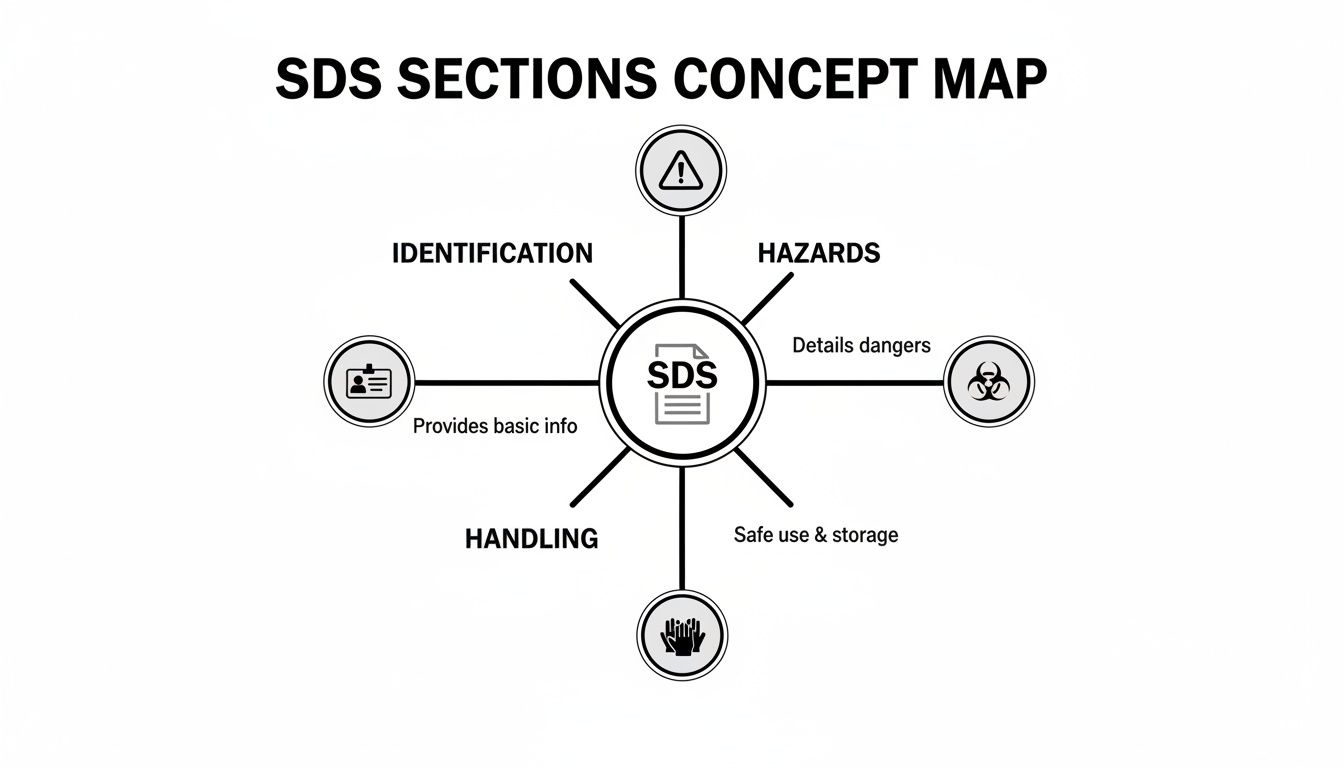
As you can see, hazard identification is the foundation that informs everything else, from how we handle the material to how we respond when things go wrong.
Administering Critical First Aid
If an exposure happens, Section 4 is your script for what to do right now. Every second counts, and following these steps while waiting for paramedics can make all the difference. The instructions are logically broken down by how the person was exposed.
Crucial Reminder: Before you do anything, get the victim to fresh air in a safe, uncontaminated area. Your safety is paramount. You can't help anyone if you become a casualty yourself.
Key First-Aid Actions for Natural Gas Exposure:
- Inhalation (Asphyxiation): This is the most common and immediate danger. Your first move is to get the person into fresh air. If they're not breathing, and you're trained, begin rescue breathing or CPR. Call for medical help immediately, as even a brief period of oxygen deprivation can cause serious internal harm.
- Skin Contact (LNG Frostbite): Liquefied Natural Gas (LNG) is a cryogenic, meaning it's incredibly cold and can cause instant, severe frostbite. Do not rub the skin. Instead, gently rewarm the affected area with lukewarm water—never hot. Cover it loosely with a sterile dressing and seek immediate medical attention.
Firefighting and Accidental Release Measures
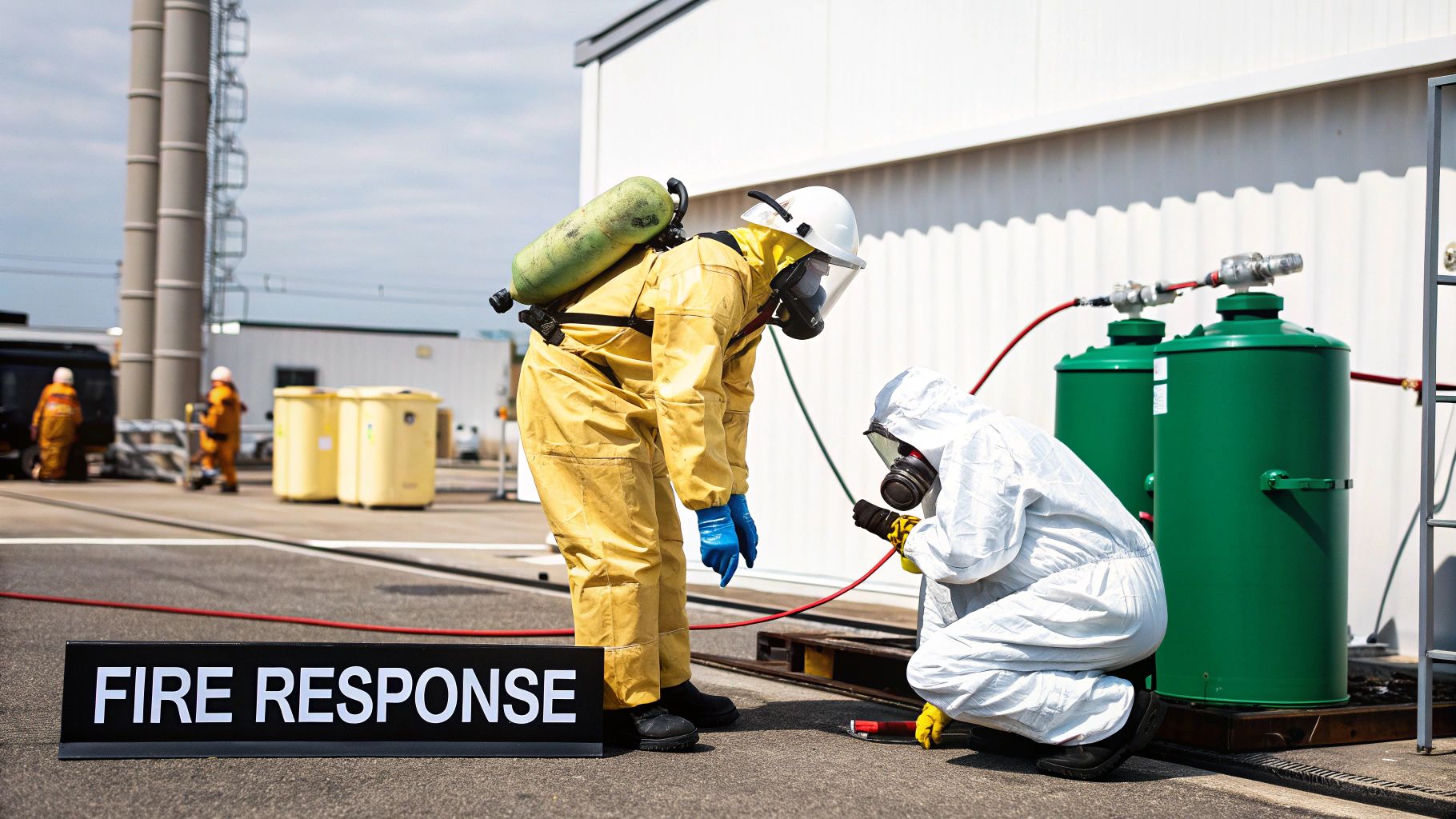
When a situation goes from routine to emergency, the msds for natural gas becomes your playbook. Beyond just listing hazards, Section 5 (Fire-Fighting Measures) and Section 6 (Accidental Release Measures) are where the document provides clear, actionable steps for getting a major incident under control. For first responders and field crews, this information is the key to preventing a manageable situation from spiraling into a catastrophe.
It’s all about knowing what to do—and just as importantly, what not to do. A great example is using water. While it's a firefighter's go-to tool, the SDS will tell you it's a huge hazard with LNG pool fires. Hitting it with water can actually speed up vaporization, creating a much larger and more dangerous vapor cloud.
Proper Firefighting Media and Techniques
Section 5 lays out the exact tools and tactics for tackling a natural gas fire. The number one rule? Stop the fuel flow. If you put out the flame without shutting off the gas, you’re just creating an invisible, explosive gas cloud that could reignite with catastrophic force.
Suitable Extinguishing Agents:
- Dry Chemical Powder: This is your best bet for most natural gas fires. It gets right in there and breaks the chemical chain reaction of the fire itself.
- Carbon Dioxide (CO2): Great for smaller fires, especially in confined spaces. CO2 works by displacing oxygen and smothering the flames.
- Water Spray/Fog: Think of this as a cooling tool, not an extinguisher. Responders use a fog pattern to cool down surrounding tanks and equipment to keep them from overheating and rupturing. A solid stream of water is a huge no—never direct it at the fire source or an LNG pool.
While knowing how to react is critical, being proactive is even better. Digging into effective fire prevention strategies is a smart move that helps ensure you never have to use these emergency measures.
Managing Accidental Gas Releases
What if you have a leak but no fire? That's where Section 6 comes in. Your immediate priority shifts to preventing ignition at all costs. It's a methodical process of securing the area and protecting everyone until the leak is stopped.
Field Crew Action Plan: If you're dealing with a significant leak, kill every potential ignition source immediately. That means shutting down engines, no smoking, and turning off all electronics that aren't intrinsically safe, including cell phones. Your next step is to isolate the area and set up a secure perimeter.
The SDS provides the specific, step-by-step instructions needed to contain the release and minimize the risk to people and property.
Steps for Containing a Natural Gas Leak:
- Isolate the Leak: If you can do it safely, shut off the gas flow at the source. This is always the first goal.
- Ensure Ventilation: If the leak is indoors, get doors and windows open right away. You need to disperse the gas to keep it from concentrating and hitting its Lower Explosive Limit (LEL).
- Monitor the Area: Break out the calibrated gas detectors. Monitor the gas concentration levels continuously to confirm when the area is actually safe for re-entry.
- Protect Personnel: Evacuate everyone who isn't essential to the response. Make sure the teams going in are geared up with the right Personal Protective Equipment (PPE).
Safe Handling, Storage, and Exposure Controls
Knowing how to read a natural gas MSDS is one thing; turning that technical data into real-world, on-the-job safety is another. Sections 7 (Handling and Storage) and 8 (Exposure Controls/Personal Protection) are where the rubber meets the road. They give you the playbook for creating a safe work environment, from where you chain up your cylinders to the gear your team needs to wear. These aren't just recommendations—they're the standards that keep your people and your operation safe.
First and foremost, you have to respect the material. Natural gas is highly flammable and stored under immense pressure. That’s why every container, whether it's a compressed natural gas (CNG) cylinder or a liquefied natural gas (LNG) tank, must be properly grounded. A stray spark from static electricity is a well-known ignition source, so grounding is a non-negotiable step during any setup or transfer.
Best Practices for Handling and Storage
Once you've handled the grounding, your storage area is the next critical link in the safety chain. The SDS is clear: store natural gas in a well-ventilated space, well away from direct sunlight, heat sources, and anything it might react with, especially strong oxidizers like chlorine.
Here are a few core rules to live by:
- Secure Your Cylinders: Always keep cylinders upright and firmly secured to a wall, rack, or other fixed object. A falling cylinder can easily snap a valve, leading to a dangerous, uncontrolled release.
- Establish Clear Zones: Your storage and handling areas must be strictly enforced "no ignition source" zones. That means no smoking, no welding, and no electronics that aren't intrinsically safe.
- Watch the Temperature: Store containers where they won’t be exposed to temperatures over 125°F (52°C). Excessive heat causes the pressure inside to climb to dangerous levels.
The real value of a Safety Data Sheet comes from the hard numbers it provides. An SDS for methane, the primary component of natural gas, will tell you its lower explosive limit (LEL) is 5.0%. It will also list occupational exposure limits, such as a time-weighted average of 1,000 ppm. Safety managers use these exact figures to calibrate gas detectors, set ventilation rates, and ensure alarms are triggered long before a dangerous situation develops. You can get a broader perspective on how these metrics influence safety on a global scale by checking out insights from the International Gas Union.
Required Personal Protective Equipment
Section 8 of the SDS spells out the Personal Protective Equipment (PPE) your team needs to wear. The right gear really depends on the state of the gas—are you working with compressed gas (CNG) or the super-chilled cryogenic liquid (LNG)?
A Note From the Field: Remember, PPE is your last line of defense. Your first and best tools for safety are always engineering controls like proper ventilation and solid, safe work procedures.
The table below breaks down the essential gear for handling both CNG and LNG. While some protection is universal, the extreme cold of LNG introduces the very serious risk of cryogenic burns (frostbite), requiring specialized equipment.
Recommended PPE for Natural Gas Handling (CNG & LNG)
| Protection Type | CNG (Compressed Gas) | LNG (Cryogenic Liquid) | Notes |
|---|---|---|---|
| Eye Protection | Safety glasses with side shields (minimum) | Chemical splash goggles and a full face shield | Full-face protection is critical to prevent splashes from reaching the eyes or face. |
| Hand Protection | Standard work gloves (leather or similar) | Insulated, loose-fitting cryogenic gloves | Cryogenic gloves protect against extreme cold but must be loose enough to be removed quickly if liquid gets inside. |
| Foot Protection | Steel-toed boots | Steel-toed boots with no cuffs | Cuffs or pant legs tucked into boots can trap spilled LNG, causing severe cold burns. |
| Body Protection | Flame-resistant (FR) long-sleeved shirt and pants | Flame-resistant (FR) coveralls or apron | Provides a barrier against both flammability and accidental splashes. |
Always conduct a job-specific hazard analysis to confirm your PPE selection. The SDS provides the minimum requirements, but your site-specific conditions might call for additional or more robust protection.
Making Sense of Transport and Regulatory Information
The MSDS for natural gas isn't just for on-site crews. For the logistics managers and compliance officers who move this product across the country, Sections 14 (Transport Information) and 15 (Regulatory Information) are the most critical parts of the document. This is where safety protocols meet the real world of federal and international law.
Think of this information as a universal safety language. When a tanker or truck carrying natural gas is on the road, its placards and shipping papers instantly communicate its hazards to everyone from highway patrol to first responders in an emergency. It’s not just about ticking boxes; it’s about making sure every shipment is legal, documented, and safe from start to finish.
Shipping Classifications: What the Codes Mean
Section 14 lays out all the essential data for shipping natural gas according to Department of Transportation (DOT) rules and international standards. Getting this right prevents dangerous mix-ups and ensures a quick, informed response if something goes wrong in transit.
Here’s what you’ll find and what it means:
- UN Number: This is a four-digit code that uniquely identifies a hazardous substance. For natural gas, you’ll most often see UN1971 (Refrigerated Liquid Natural Gas, or LNG) and UN1972 (Compressed Natural Gas, or CNG).
- Proper Shipping Name: This is the official name that must be used on all documents, like "Natural gas, compressed." No slang or abbreviations allowed.
- Hazard Class: Natural gas is designated as Class 2.1, which simply means it’s a flammable gas.
- Packing Group: This field defines the level of danger. Given its extreme flammability and high-pressure hazards, natural gas has very strict requirements for how it’s contained and transported.
Staying on the Right Side of the Law
Section 15 is where the SDS connects directly to the agencies that create and enforce workplace safety laws, chiefly the Occupational Safety and Health Administration (OSHA). It lists the specific federal, state, and local regulations that apply to natural gas, essentially confirming that your safety procedures are legally sound. This section is your best friend during an audit.
The precise guidelines in an SDS are fundamental to operational safety. U.S. natural gas utilities invest around $37 billion each year in safety and system upgrades, which has helped cut emissions by an incredible 70% since 1990. Those investments are guided by the very controls and limits found in an SDS.
With global demand for natural gas growing by 78 billion cubic meters in 2024 alone, our reliance on accurate SDS documents for safe transport and handling has never been more important. To see the incident data that drives these regulations, you can explore pipeline safety statistics from PHMSA.
Frequently Asked Questions About Natural Gas SDS
Working with hazardous materials documentation always seems to stir up a few questions. When it comes to the msds for natural gas, getting straight answers is non-negotiable for a safe and compliant worksite. Let's tackle some of the most common questions we hear from project managers, safety officers, and the crews out in the field.
Making sure everyone is on the same page with this stuff ensures your team is working from a single, accurate playbook.
What Is the Difference Between MSDS and SDS?
You've probably heard people use "MSDS" and "SDS" as if they're the same thing, but there's a crucial difference rooted in safety and consistency. For a long time, the MSDS (Material Safety Data Sheet) was the standard, but there was a big problem: its format wasn't standardized. One manufacturer's MSDS could look completely different from another's, making it tough to find critical information in an emergency.
That all changed in 2012 when OSHA got on board with the Globally Harmonized System (GHS). This brought us the SDS (Safety Data Sheet), a new standard with a mandatory 16-section format. Now, whether you're looking for first-aid measures or firefighting instructions, you know exactly where to find it on any SDS. Today, the SDS is the only legally accepted format.
How Often Should a Natural Gas SDS Be Updated?
There’s no hard-and-fast expiration date on a natural gas SDS. Instead, the rule is that it must be updated whenever new, significant information about its hazards comes to light. Federal regulations give manufacturers or importers a three-month window to revise and distribute a new SDS after they learn of any new hazard data.
As a practical matter on your end, it’s just good safety practice to check for the latest version from your supplier at least once a year or before starting any new major project. This simple step guarantees your safety plans are built on the most current information.
Where Can I Find the Most Current SDS?
Your direct supplier is always the definitive source for an up-to-date Safety Data Sheet. A generic SDS you find online can be a decent starting point for general knowledge, but it won't be specific to the gas being delivered to your particular site.
For every job, make it a standard operating procedure to formally request the latest SDS from your provider. That’s the only way to get a site-specific document that’s fully compliant and accurately reflects what your team is handling. For businesses, being aware of programs like the Enbridge Gas Direct Install Program can also be part of a bigger picture of safety and regulatory diligence.
Is the SDS for CNG the Same as for LNG?
No, they are absolutely not the same, and mixing them up can be dangerous. While Compressed Natural Gas (CNG) and Liquefied Natural Gas (LNG) are both methane, their physical states introduce completely different sets of hazards. That means they require separate, specific Safety Data Sheets.
The SDS for LNG has to address the extreme cryogenic hazard. LNG is kept at a chilling -260°F (-162°C) and can cause severe, instant frostbite on contact. The PPE required for LNG is highly specialized for cryogenic work, something you wouldn't find mentioned in a standard CNG document.
The SDS for each will be dramatically different in several key areas:
- Hazards: The LNG sheet will put a heavy emphasis on cryogenic burns and the risk of rapid vapor expansion.
- First Aid: You'll find specific instructions for treating frostbite in the LNG document.
- Firefighting: It contains critical warnings about not using water on LNG pools, as it can dangerously accelerate vaporization.
- Handling/Storage: LNG requires specialized insulated containers and handling protocols that simply don't apply to CNG.
Always double-check that you have the correct msds for natural gas that matches the state—compressed or liquefied—you’re actually working with.
When utility hookup delays threaten your project timeline, a temporary gas solution is the answer. Blue Gas Express delivers mobile CNG and LNG units to keep your operations online and on schedule. Get the site-specific SDS you need and a reliable gas supply by visiting https://bluegasexpress.com to schedule your delivery.