

Ever wondered how a new branch is added to a major, active pipeline without shutting the whole thing down? The answer is a sophisticated technique known as hot tapping.
Think of it as performing keyhole surgery on a pipeline. It’s the process of drilling into a live, pressurized pipeline to create a new connection, all while the product inside—whether it’s natural gas, oil, or water—continues to flow completely uninterrupted. It’s a highly specialized job, one that’s crucial for maintenance, repairs, and expansion projects that can’t afford a shutdown.
Why Hot Tapping Is a Game-Changer for Modern Pipelines
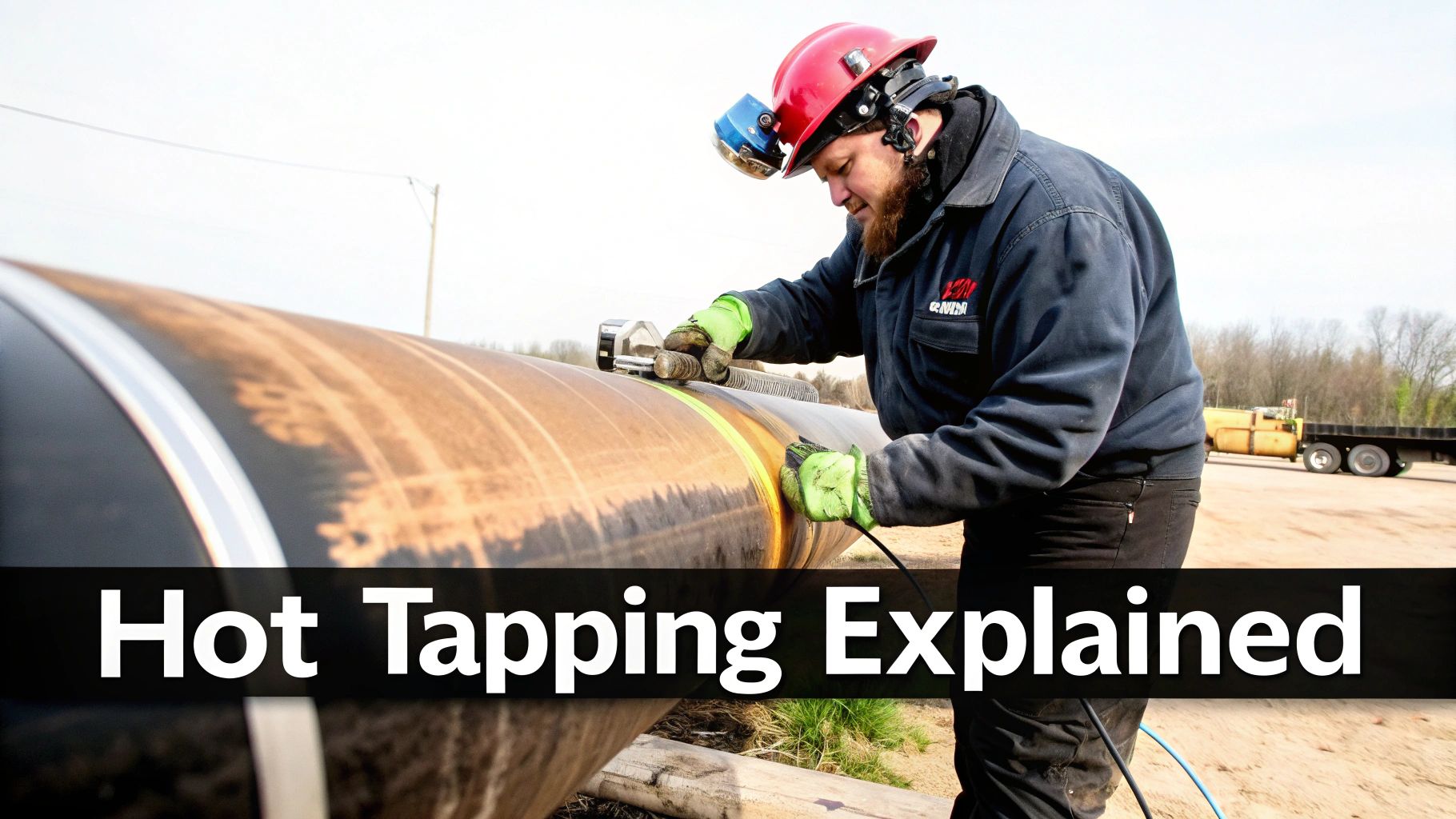
Imagine trying to build a new exit ramp on a busy highway. The old way would mean closing multiple lanes for weeks, creating gridlock and costing everyone time and money. Hot tapping is the modern equivalent of building that new ramp while every car keeps moving at full speed.
This method allows trained technicians to safely cut into a live pipe and install a new branch. For industries that depend on a constant flow of product, this isn't just a minor convenience—it's a massive financial and logistical advantage, saving them from the enormous costs and disruptions of a full system shutdown.
Core Purpose and Key Applications
The whole point of a hot tapping pipeline operation is to keep the system running and the service continuous. A traditional shutdown is a huge ordeal. You have to drain the pipeline, purge it completely, do the work, and then go through the lengthy process of refilling and re-pressurizing. It’s expensive, it takes a ton of time, and it means lost revenue for every minute the system is offline.
Hot tapping sidesteps all of that, which is why it's the go-to solution in several key situations:
- System Expansion: Need to add a new line for a factory, a new housing development, or a commercial park? Hot tapping lets you do it without interrupting service for current customers.
- Installing Instruments: You can place new sensors, meters, or probes directly into the flow to get real-time data on pressure, temperature, or product quality.
- Creating New Access Points: It's perfect for adding new entry points for inspection gear, maintenance tools, or to set up a temporary bypass line for other repair work.
At its core, hot tapping is a proactive maintenance and expansion strategy. It transforms what would be a major operational halt into a precisely managed, non-disruptive procedure, ensuring that businesses and communities receive an uninterrupted supply.
Choosing between a hot tap and a full shutdown is a major decision for any project manager. Here’s a quick rundown to help clarify when each approach makes the most sense.
When to Use Hot Tapping vs a Full Shutdown
| Scenario | Hot Tapping (Recommended) | Traditional Shutdown (Consider) |
|---|---|---|
| Continuity is Critical | The pipeline supplies essential services (e.g., hospitals, critical manufacturing) and any downtime is unacceptable. | The pipeline serves non-critical loads, and a planned outage is manageable and can be communicated in advance. |
| Cost & Revenue Impact | A shutdown would cause significant revenue loss, easily justifying the higher upfront cost of a hot tap. | The cost of the shutdown (lost revenue, labor) is less than the cost and complexity of a hot tapping operation. |
| Project Timeline | The project is on a tight schedule, and the lengthy process of shutdown, purge, and restart is not feasible. | The project timeline is flexible and can accommodate a multi-day shutdown and recommissioning process. |
| Pipeline Conditions | The pipe material, wall thickness, and operating conditions are confirmed to be safe and suitable for hot tapping. | The pipeline’s integrity is uncertain, or it contains materials (like cast iron or certain plastics) that are unsafe to hot tap. |
| Scope of Work | The goal is to add a simple branch, install an instrument, or create a bypass connection. | The work involves major modifications, like replacing a large section of the mainline or repairing severe structural damage. |
Ultimately, while hot tapping is a powerful tool for maintaining continuity, a shutdown is sometimes the safer and more practical choice for extensive repairs or when pipe conditions are questionable.
Keeping New Projects on Track
While the hot tapping itself keeps the main pipeline flowing, the new branch connection might not be immediately ready to serve a new facility. For example, a new factory might be built and ready to go, but the final tie-in from the hot tap is still a few days or weeks away. This is where smart project support comes in.
This is where Blue Gas Express can bridge the gap. We deploy temporary mobile gas solutions, like CNG or LNG units, to supply natural gas directly to a site. This allows new facilities to commission equipment, run tests, and even start operations on schedule. Even while the complex hot tapping pipeline work is being finalized, we ensure the downstream project keeps moving forward without a single delay.
The Strategic Advantages of Live Pipeline Tapping
Deciding to use hot tapping is much more than just a technical call—it's a strategic move with major financial, operational, and even environmental upsides. The whole game is built around one powerful concept: continuity. By tapping into a pipeline while it’s still live, you sidestep a full system shutdown. This keeps products flowing, services running, and revenue coming in, effectively turning a potential crisis into a well-managed, routine task.
That continuity translates directly into serious cost savings. Think about a traditional shutdown for a moment. It’s a waterfall of expenses: lost production value for every minute the system is down, the hefty labor costs of draining and purging miles of pipeline, and the potential for steep penalties if you can't meet your service contracts. Hot tapping just wipes those costs off the board.
Quantifying the Financial and Environmental Gains
The business case for hot tapping is incredibly compelling, especially in the natural gas industry where every puff of vented gas is money and emissions floating away. These savings aren't just theoretical; they are real, measurable, and often massive.
For instance, an EPA analysis drives home just how beneficial this technique is. They found that performing an average of 320 hot taps a year on natural gas pipelines could save about 24,440 Mcf of gas. At current prices, that's worth over $171,000. On top of that, you avoid using inert purge gases like nitrogen, saving another $13,680. That brings the total annual benefit to more than $184,760. You can read the full analysis of these savings on the EPA's website to see how the numbers stack up.
But it’s not all about the bottom line. The environmental benefits are a huge part of the story.
By preventing the need to vent large volumes of product into the atmosphere, hot tapping significantly reduces the emission of methane and other greenhouse gases. This makes it an environmentally responsible choice that aligns with modern corporate sustainability goals.
Unlocking Operational Flexibility
The advantages of live pipeline tapping go well beyond just avoiding shutdowns. The procedure gives you a degree of operational agility that's simply out of reach with older methods. It allows companies to adapt their infrastructure on the fly to meet new demands without ever disrupting a single existing customer.
Think about these common situations where that kind of flexibility is a game-changer:
- Rapid System Expansion: A utility needs to serve a new housing development or industrial park. With hot tapping, they can add new branch lines seamlessly, getting new customers connected and generating revenue much faster—all without impacting their current users.
- On-the-Fly Modifications: A manufacturing plant might need to reroute a line or add a new monitoring sensor to make their process more efficient. Hot tapping lets them make these changes during normal operating hours, avoiding a costly plant shutdown.
- Proactive Maintenance: Instead of putting off critical work until a scheduled outage, teams can install new valves or inspection points proactively. This boosts the system’s reliability and safety without ever bringing operations to a halt.
This ability to modify and expand a live system is really the foundation of modern infrastructure management. It helps businesses stay nimble and competitive, ensuring their pipeline network can grow and change right alongside their needs. In short, hot tapping transforms a static pipeline into a dynamic asset, ready to adapt to new challenges and opportunities without missing a beat.
A Step-by-Step Look at the Hot Tapping Process
A hot tap isn't just a single action; it's a carefully orchestrated sequence of events where engineering, safety, and hands-on skill come together. Think of it less like drilling a hole and more like performing surgery on a live pipeline. For anyone managing a project that involves a hot tap, understanding the flow of work is crucial for a smooth and safe operation.
Each step logically builds on the last, from the initial survey to the moment the tapping machine is removed. Let's walk through the main phases of a typical hot tapping job.
Phase 1: Initial Site Assessment and Engineering
The most important work happens long before any heavy equipment shows up. This is the planning stage, where all the critical thinking and calculations take place. Technicians need to know every single detail about the pipe they’re about to tap. What's it made of? How thick are its walls? What's the pressure and temperature inside?
This initial phase always covers a few key areas:
- Material Verification: Engineers use methods like ultrasonic testing to confirm the pipe’s exact metallurgy and structural health. This tells them if the pipe can actually handle the stress of having a new fitting welded onto it while under pressure.
- Weldability Analysis: Not every pipe is a good candidate for hot tapping. This analysis determines whether a strong, safe weld can be made without weakening the existing pipe.
- Engineering Calculations: This is where the specifics get nailed down. Specialists calculate the precise dimensions for the fitting, the valve, and the cutter. There's no room for guesswork here.
Before anything else, a thorough risk assessment is mandatory. You need to know exactly what hazards you're dealing with. For a good overview, check out this practical guide on how to do a risk assessment.
Phase 2: Fitting Installation and Pressure Testing
With the engineering signed off, the hands-on work begins. A custom-fabricated fitting—usually a split-tee or weld-on saddle—is carefully positioned over the spot where the new connection will be. Following a very strict, pre-approved welding procedure, certified welders attach the fitting directly to the live pipeline. That weld is the foundation for everything that follows, so it has to be perfect.
Once the weld has cooled, it's time for a critical safety check: the pressure test. The space between the new fitting and the old pipe is filled with water or an inert gas and pressurized to a level well above the pipe's normal operating pressure. If the pressure holds steady, the weld is sound. Any drop in pressure means there's a leak that must be found and fixed before moving on.
Phase 3: Machine Mounting and the Tapping Operation
After a successful pressure test, the main hardware is brought in. A permanent valve is bolted to the new fitting, and then the hot tapping machine itself is attached to the valve. This powerful machine holds a pilot drill and a circular cutter, both designed to cleanly penetrate the pipe wall.
The actual tap is a slow, methodical process:
- The operator carefully advances the drill until it just makes contact with the pipe's surface.
- With incredible precision, the machine begins drilling through the pipe wall. The whole assembly is completely sealed, so nothing inside the pipe can escape.
- After the pilot drill breaks through, the larger cutter takes over, carving out a round piece of the pipe wall called a coupon.
This infographic breaks down the core benefits that make this complex process so valuable.
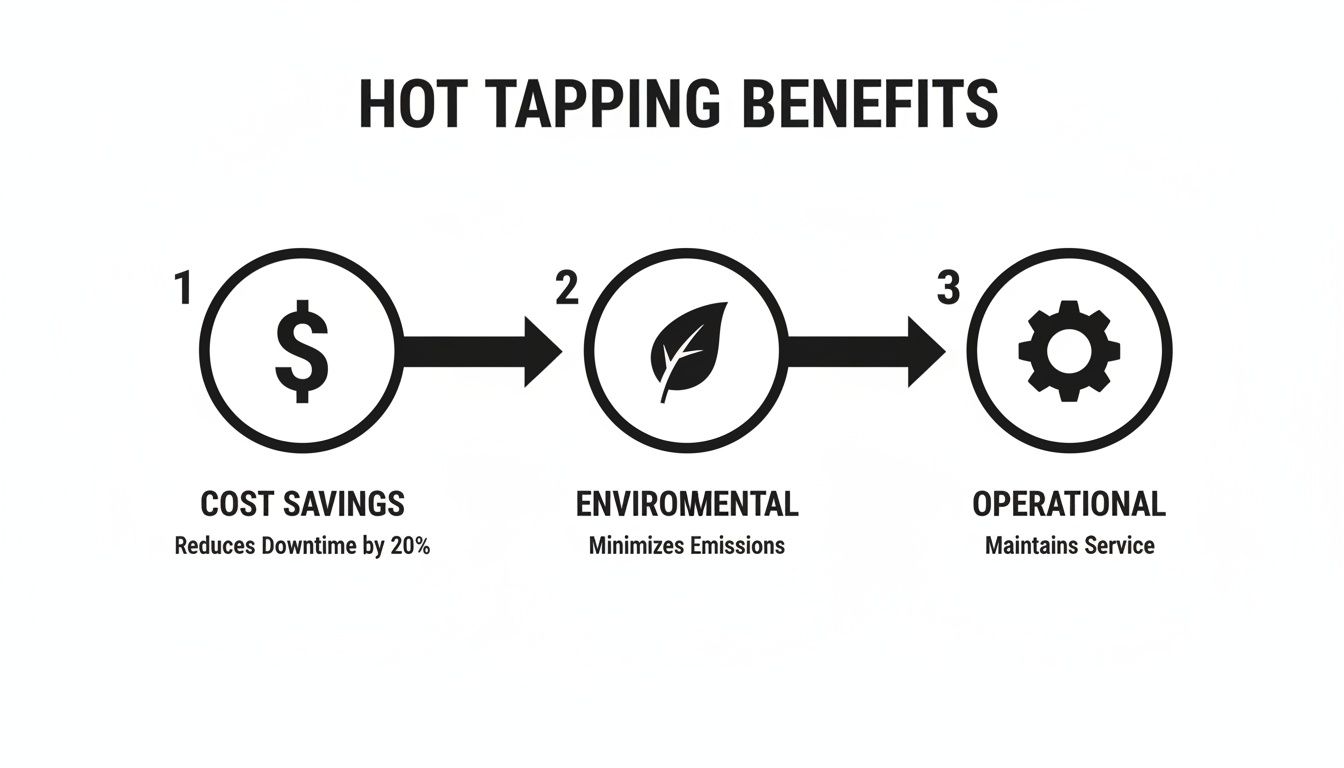
As you can see, the ability to avoid a full system shutdown delivers major wins in cost, environmental safety, and operational uptime.
Phase 4: Coupon Retrieval and Final Closure
Here’s where the design of the hot tapping machine really shines. The pilot drill is specially designed for coupon retention, meaning it securely grabs the piece of pipe it just cut out. As the operator retracts the cutter, it pulls the coupon back with it, up through the brand-new valve.
Retrieving the coupon is absolute proof of a successful tap. It confirms that a full-bore opening has been created and that no metal fragments were left to obstruct flow or damage downstream equipment.
Once the cutter and coupon are safely clear of the valve, the operator closes it tight. This action permanently isolates the hot tapping machine from the live pipeline. Now, the machine can be depressurized and removed safely. The new branch connection is officially live and ready for its final tie-in—all without interrupting service on the main line for even a second.
Critical Safety Standards and Regulatory Compliance
Think of a hot tapping pipeline operation as the industrial equivalent of open-heart surgery. It’s a high-stakes procedure where a single mistake can have catastrophic consequences. Because of this, every step is wrapped in strict safety standards and federal regulations built to protect workers, the environment, and the integrity of our critical infrastructure.
This is absolutely not a job for a general contractor or your local welding shop. A successful hot tap hinges on a deep understanding of industry best practices, a fierce commitment to meticulous planning, and an unwavering focus on safety protocols. These aren't just suggestions—they are non-negotiable rules that form the foundation of any legitimate operation.
Key Standards and Regulatory Bodies
To make sure every hot tap is done safely and correctly, several key organizations have laid out comprehensive standards. These documents are the official playbook, providing a detailed roadmap for planning, engineering, and executing the work, leaving nothing to chance.
In the United States, two of the most important standards are:
- API RP 2201 (Safe Hot Tapping Practices in the Petroleum & Petrochemical Industries): This is the bible for the industry. It covers everything from initial planning and equipment selection to specific welding procedures and operator qualifications, ensuring a standardized, safe approach across the board.
- PHMSA Regulations (49 CFR Parts 192 and 195): The Pipeline and Hazardous Materials Safety Administration (PHMSA) sets the federal laws for natural gas and hazardous liquid pipelines. These regulations dictate specific safety procedures, material standards, and operational controls that are legally required.
Many companies also align their internal safety management systems with international standards. For anyone navigating the complexities of setting up these systems, especially in high-risk fields, a practical guide to ISO 45001 certification can be an invaluable resource.
Mitigating Common Risks in Hot Tapping
Even with rock-solid standards, hot tapping has inherent risks. The key to a safe job is identifying these potential hazards long before the work starts and putting robust mitigation strategies in place. It’s all about being proactive and preventing problems, not just reacting to them.
The most critical phase for managing risk is the pre-job planning. Rigorous analysis, non-destructive testing (NDT) of the parent pipe, and precise engineering calculations are your best defense against equipment failure and human error.
Here are some common risks and how professionals handle them:
- Equipment Failure: This is addressed by using only certified, pressure-tested equipment and conducting thorough inspections before it ever touches the pipe.
- Leaks During Operation: Precise welding procedures are a must, followed by hydrostatic pressure tests on the fitting before any drilling begins.
- Operator Error: The entire crew must be highly trained, certified, and have proven experience with similar hot tapping jobs. There's no room for on-the-job training here.
- Incorrect Pipe Assessment: Ultrasonic testing (UT) is used to verify the pipe's wall thickness and metallurgy, confirming it can handle the stress of the procedure.
The Dangers of Illegal Pipeline Tapping
The meticulous, controlled world of professional hot tapping pipeline operations is the complete opposite of illegal tapping. This criminal activity, usually done to steal product, involves crude, uncontrolled methods that create a massive risk of explosions, leaks, and catastrophic environmental damage. It's a reckless act that compromises the entire pipeline system.
In the U.S., equipment failure and defective materials are already major threats. In 2021, PHMSA data showed these issues were behind 43.6% of the damage to our nation's natural gas pipelines. While malicious attacks like illegal tapping are a smaller category, they add a dangerous and unpredictable layer of risk—a risk that regulated, professional hot tapping is specifically designed to avoid. If you're interested in pipeline integrity threats, you can learn more about research into pipeline security and theft detection.
Choosing the Right Partner for Your Hot Tapping Project
A hot tapping operation is a precision-driven task. There is absolutely zero room for error. Success hinges less on the equipment and more on the expertise, experience, and proven safety record of the crew doing the work. Picking the right contractor is the single most critical decision you'll make—one that directly affects your people's safety, your pipeline's integrity, and your operational continuity.
This is not the kind of job you award to the lowest bidder without some serious vetting. The stakes are simply too high. A qualified partner becomes an extension of your own team, bringing specialized knowledge and a deep-seated safety culture to ensure the project runs flawlessly, from the first engineering assessment to the final turn of the valve.
Essential Qualifications for a Hot Tapping Contractor
When you’re evaluating potential partners, you need a checklist of non-negotiables. Think of these as the absolute minimum requirements just to get in the door for a job this critical. Any professional outfit worth its salt will not only meet these criteria but will have the paperwork ready to prove it.
Your review should zero in on four key areas:
- Verifiable Experience: The contractor needs a long, documented history of projects just like yours. That means working with the same pipe materials (steel, HDPE), diameters, and operating conditions like pressure, temperature, and product.
- A Documented Safety Record: Ask for hard numbers. You want to see their Experience Modification Rate (EMR) and Total Recordable Incident Rate (TRIR). A low EMR (under 1.0) and a consistently low TRIR are solid signs of a company that takes safety seriously.
- Adherence to Industry Standards: They must prove strict compliance with key industry standards, especially API RP 2201 and the relevant ASME codes. Their entire operational procedure should be built on the foundation of these documents.
- Certified Technicians and Welders: Every single person on that job site must be certified for the work they're doing. Welders, in particular, need current certifications for the exact types of welds needed to install the fitting.
Choosing a contractor is a risk management decision. A partner with a sterling safety record and deep, relevant experience isn't an expense—it's an investment in a successful, incident-free project outcome.
The Bigger Picture Supporting the Core Operation
While the hot tapping contractor is busy creating the new connection, the overall success of your project often relies on other support services that keep things moving for everyone else. The physical tap is just one piece of a much larger puzzle, especially when you're trying to get a new facility or development up and running without any hold-ups.
This is where the project support ecosystem becomes so important. Imagine a new residential development or a factory is completely ready to go, but the final tie-in from the hot tap is still a few days out. The hot tapping contractor did their job perfectly, but the end-user is still sitting there waiting for gas.
This is exactly the gap Blue Gas Express was designed to fill. While your specialized contractor focuses on modifying the pipeline, our team makes sure your downstream customers get an uninterrupted gas supply. We can deploy temporary CNG or LNG units right to the site, providing the fuel needed to commission HVAC systems, test equipment, or fire up production lines. This kind of strategic partnership prevents expensive project delays and keeps everything on schedule, making sure that "no-shutdown" promise extends all the way to the final customer.
Keeping Your Project Moving with Temporary Gas Solutions
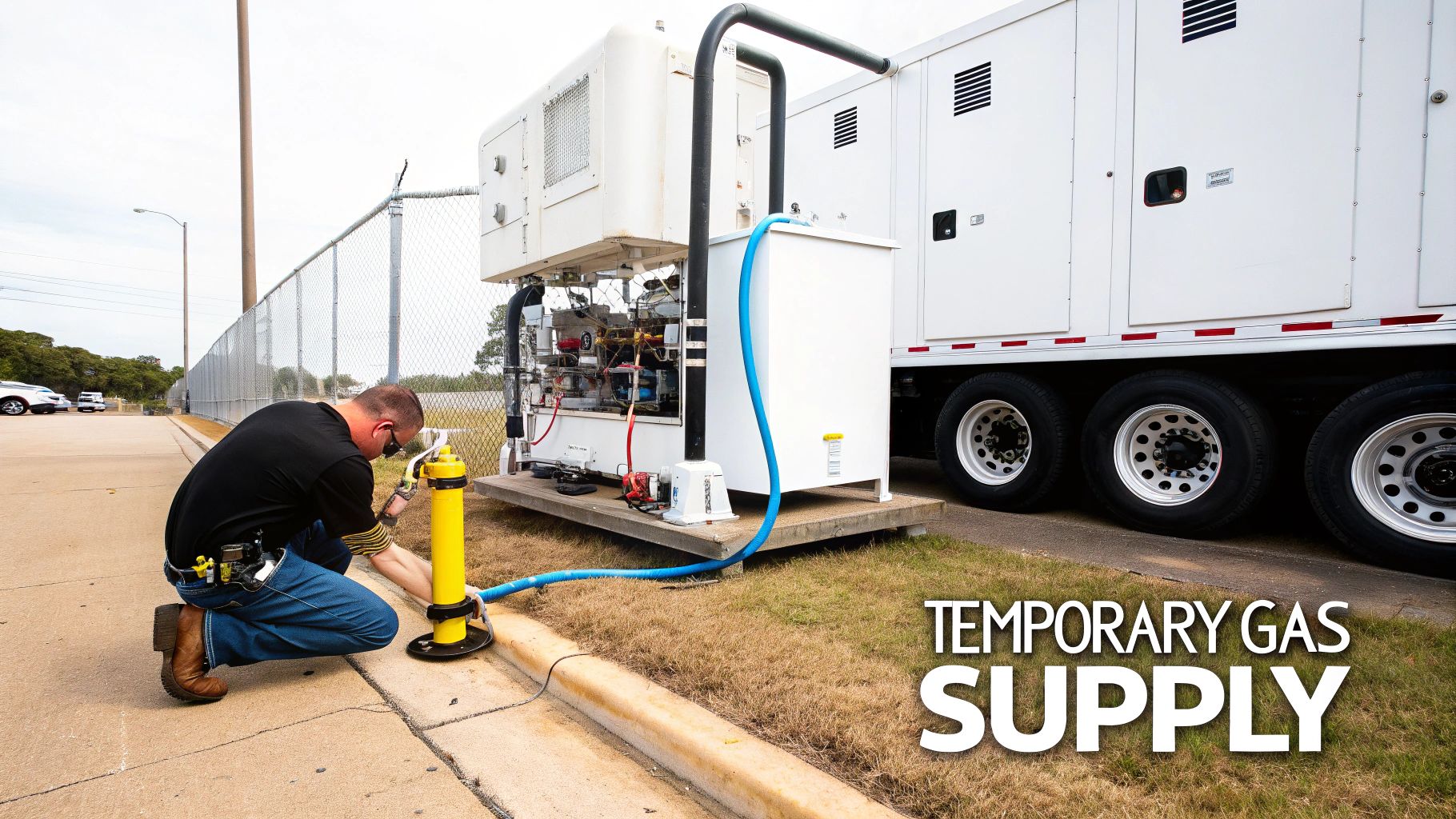
A successful hot tap is a major milestone. It means you’ve managed to create a new connection without shutting down the main pipeline—a huge win. But for the construction company building a subdivision or the factory expanding its facility, the job's not done until their new lines are actually live.
This is where projects often hit a "last mile" snag. The hot tap is finished, but the final tie-in and commissioning of the new branch takes time. This gap can lead to expensive delays, stopping builders from getting occupancy permits or forcing a plant to idle a new production line. Every single day of waiting costs money and kills momentum.
This is exactly why temporary, mobile gas solutions are so important. They can turn a potential bottleneck into a smooth, seamless transition.
Bridging the Gap From Tap to Tie-In
Picture a new housing development where the homes are finished and just waiting for final inspection. The utility has already performed the hot tapping pipeline operation on the main line, but the new neighborhood distribution system isn't pressurized yet. Without gas, the builders can't test the HVAC systems, a crucial step for getting an occupancy permit.
Instead of just waiting, a temporary gas supply can bridge that gap. A mobile Compressed Natural Gas (CNG) unit can be brought directly to the site to provide an immediate flow of gas. This lets the builders:
- Commission HVAC systems and other gas appliances right on schedule.
- Secure necessary occupancy permits without delay, so home sales can move forward.
- Keep the project timeline from slipping, ensuring subcontractors and workflows stay on track.
This simple step effectively disconnects the construction schedule from the final utility hookup, making sure the project never loses steam.
By providing an on-demand gas supply, mobile solutions act as a project accelerator. They ensure that downstream operations can continue uninterrupted, maximizing efficiency and minimizing the financial impact of waiting for the final connection to go live.
Maintaining Operations During Complex Modifications
This need for temporary gas is just as critical in industrial environments. Imagine a manufacturing plant that has to reroute a major internal gas line to make room for new machinery. The project is a complex dance of hot tapping and line stopping to isolate the old pipe and tie in the new one. During that entire transition, any process that depends on a steady gas supply is at risk.
In a situation like this, a mobile Liquefied Natural Gas (LNG) unit from a provider like Blue Gas Express can step in to become the plant's primary fuel source. This guarantees zero operational downtime while the internal pipeline network is being reconfigured. The plant can keep running at full capacity, avoiding what could easily be millions in lost revenue.
It's no surprise that the global Gas Pipeline Hot Tapping Services market was valued at USD 1.62 billion in 2024. This number really underscores how vital this work is to modern infrastructure. But that market growth also highlights the rising need for integrated support services—like temporary gas—to make sure these complex jobs are pulled off without disrupting the people at the end of the line. You can explore more data on the hot tapping services market to get a better sense of its true scale and impact.
Hot Tapping Pipelines: Your Questions Answered
When you're looking at a hot tapping operation, a lot of questions come up. It's a complex procedure, so it’s natural for project managers and engineers to want to get into the details. Here are some clear, straightforward answers to the most common questions we hear.
What's the Difference Between Hot Tapping and Line Stopping?
Think of hot tapping as an additive process. The whole point is to add a new connection or branch to a pipeline while it's still running—without ever shutting it down. It’s like adding a new on-ramp to a busy highway without stopping traffic.
Line stopping, on the other hand, is an isolation process. You’re deliberately stopping the flow in one section of the pipe, usually by inserting a temporary plug. This lets you make repairs or replace a valve downstream. It's more like setting up a temporary roadblock and detour to work on a specific part of the road.
What Kinds of Pipe Can You Hot Tap?
The go-to material for hot tapping is carbon steel because it's strong, predictable, and welds beautifully. But a skilled team with the right approach can work with a whole range of materials.
We've seen successful hot taps on:
- Stainless steel
- Ductile and cast iron
- HDPE (High-Density Polyethylene)
- Prestressed Concrete Cylinder Pipe (PCCP)
The real key isn't just the material itself, but a deep-dive engineering assessment beforehand. You have to confirm the pipe's integrity, its wall thickness, and its ability to handle the procedure. If there's even a shadow of a doubt about the pipe's condition, the right call is almost always a traditional shutdown.
How Can You Be Sure a Hot Tap Is Safe?
Safety isn't an accident; it's the result of meticulous planning and sticking to the book. The entire operation is governed by strict industry standards, especially API RP 2201, which lays out the safe practices for hot tapping.
Every single project should kick off with a full risk assessment and non-destructive testing (NDT) to verify the pipe is sound.
The secret to a safe hot tap is in the prep work. We're talking certified, pressure-tested equipment and a process where every single step—from the quality of the weld to the pressure test of the fitting—is checked and double-checked before a single cut is made into that pipe.
At the end of the day, safety comes down to the crew. You need certified technicians with proven, hands-on experience to pull it off without a hitch.
Is a final pipeline connection holding up your project? Don't let your operations grind to a halt. Blue Gas Express offers temporary CNG and LNG solutions to keep everything running smoothly. Visit us at https://bluegasexpress.com to see how we can help you bridge the gap and keep your timeline on track.