

Think of a home CNG compressor as your own private natural gas refueling station, tucked away in your garage. It taps directly into your home's existing natural gas line, letting you fill up your CNG vehicle overnight, just like you’d charge an electric car.
This setup offers incredible convenience and can lead to some serious long-term savings compared to what you're paying at the pump.
Is a Home CNG Compressor Right for You?
Making the leap to a personal CNG fueling station is a big decision, but the core idea is pretty compelling. Imagine plugging in your car at night and waking up to a full tank every single morning, all for a fraction of the cost of gasoline. It completely changes your daily routine and makes trips to the gas station a thing of the past.
But, as with most things, there's a trade-off. A home CNG compressor is a significant upfront investment, easily running into the thousands. This is absolutely not a weekend DIY project—you'll need certified pros to handle the high-pressure gas plumbing and the electrical work to make sure everything is safe and meets local codes.
Balancing Cost and Convenience
The biggest draw here is the long-term fuel savings. Natural gas is almost always cheaper than gasoline on a Gallon Gasoline Equivalent (GGE) basis. If you put a lot of miles on your vehicle—think long daily commutes or a small business fleet—those savings add up fast and can pay back your initial investment in just a few years.
To figure out if this makes sense for your specific situation, you'll need to weigh a few key factors:
- Your Driving Habits: Do you drive enough each year for the fuel savings to eventually cover the cost of the system? We're often talking about people who drive 15,000+ miles annually.
- Your Home Setup: You'll need a good spot for it, like a well-ventilated garage. Critically, you need easy access to both your natural gas line and a 240V electrical outlet, similar to what an electric dryer uses.
- Your Budget: Are you ready for the upfront cost? A full installation, including the unit and professional labor, can range from $4,500 to over $10,000.
- Local Rules and Regs: You'll have to check with your local building department and gas utility. They'll have specific permit requirements and maybe even some restrictions you need to know about.
For the right person, a home CNG compressor is a total game-changer. It offers a unique mix of self-reliance, cost savings, and a lighter environmental footprint. It really comes down to whether the very real benefits line up with the practical realities of your home, budget, and driving needs.
This guide is designed to walk you through that decision, so you can move forward with confidence, knowing you've considered all the angles.
To help you get a quick sense of where you stand, we've put together a simple assessment table.
Quick Assessment for a Home CNG System
This table summarizes the key factors to help you quickly evaluate if a home CNG compressor is a practical investment for your needs.
| Consideration | What It Means for You | Ideal Candidate Profile |
|---|---|---|
| Annual Mileage | The more you drive, the faster you'll see a return on your investment through fuel savings. | Drives 15,000+ miles per year; daily commuter or small business owner. |
| Home Infrastructure | You need a suitable location with access to both a natural gas line and a 240V electrical supply. | Owns a home with a well-ventilated garage or carport near gas/electric hookups. |
| Upfront Budget | The total cost for the unit and professional installation can be significant. | Can comfortably invest $4,500 – $10,000+ without financing, or has access to it. |
| Long-Term Plans | This is a permanent home upgrade. You'll get the most value if you plan to stay in your home for a while. | Plans to live in their current home for at least 5-7 years to realize savings. |
| Vehicle Type | The system is designed for vehicles that can run on Compressed Natural Gas. | Owns or plans to buy a dedicated CNG vehicle or a bi-fuel conversion. |
Looking at this table should give you a gut check. If you find yourself nodding along with the "Ideal Candidate Profile" column, then digging deeper into the specifics of a home CNG system is definitely your next step.
How Home CNG Refueling Actually Works
So, how do you get natural gas from the pipe that feeds your furnace into your car's fuel tank? That's the job of a home CNG compressor, which is essentially a highly specialized pump built for one purpose. It taps into your home’s existing low-pressure gas line and, over the course of several hours, gets that gas ready to power your vehicle. Think of it as a background process, working quietly overnight while you're asleep.
The core of the process is a massive pressure change. Your home’s natural gas line delivers gas at a very low pressure, typically around 0.25 PSI. To be useful as a vehicle fuel, that same gas needs to be squeezed until it reaches up to 3,600 PSI. It’s like taking all the air in a small bedroom and compressing it down into the size of a scuba tank. That incredible difference in pressure is exactly why it’s a slow, methodical process.
The decision to install one of these systems usually comes down to a few key factors.
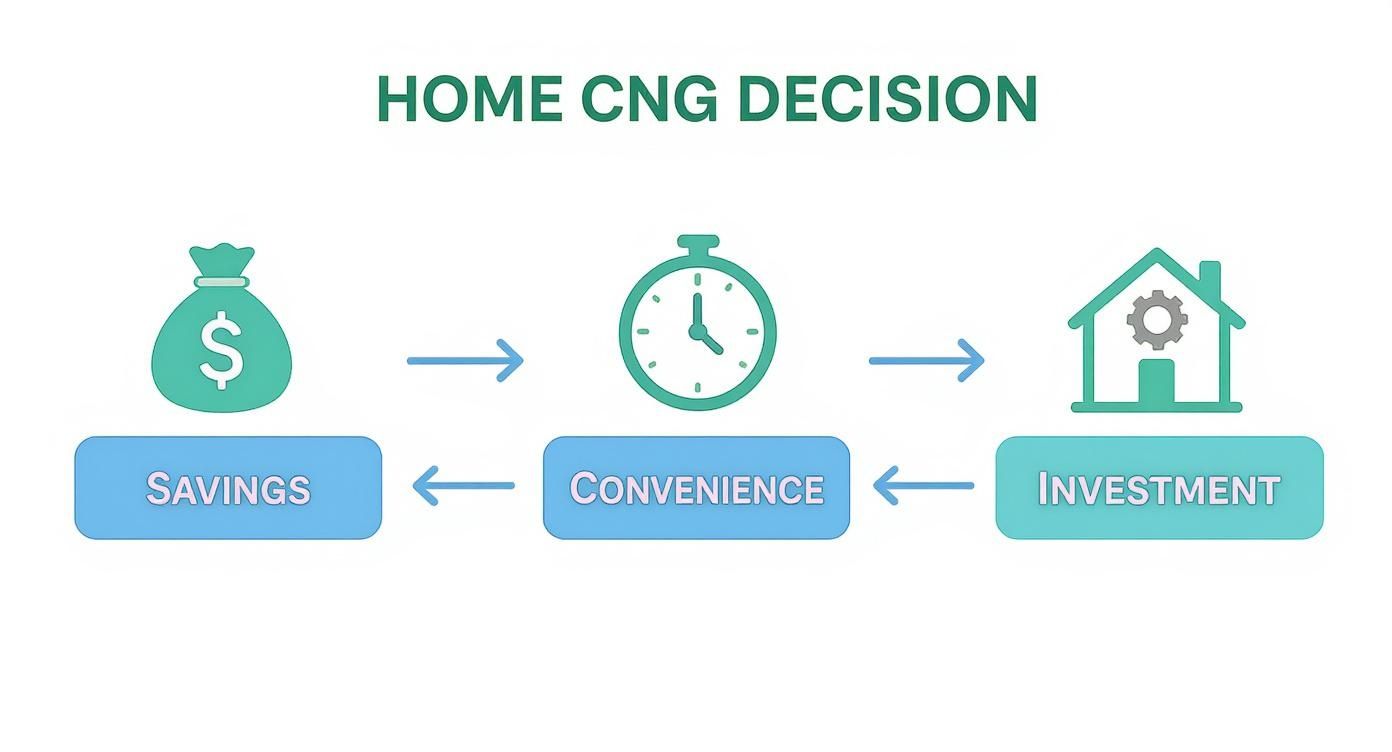
As you can see, the upfront investment is what unlocks the long-term savings and day-to-day convenience that make these systems so appealing.
The Slow-Fill Method Explained
Nearly every residential CNG unit on the market uses what's called the slow-fill method. This isn't like pulling up to a commercial station and filling up in five minutes. Instead, a home unit takes its time, usually between 5 to 10 hours, depending on how empty your tank is and its total capacity. This deliberate pace is a critical design choice, not a limitation.
By filling slowly, the compressor avoids generating a dangerous amount of heat. It also means you don't need a massive, high-pressure storage cascade on your property like a commercial station would. Your vehicle's tank becomes the only storage vessel. You simply plug the hose into your car, and the compressor runs until it senses the tank is full, then shuts off automatically. Simple and safe.
Key Takeaway: The slow-fill approach is the heart of home CNG refueling. It’s designed for overnight convenience and safety, ensuring your vehicle is ready to go every morning without needing complicated, industrial-grade equipment in your garage.
For most people with a daily commute, this is perfect. You come home, connect the car, and forget about it.
Inside the Compressor: A Step-by-Step Journey
To really get a feel for what’s happening, let’s trace the path of the natural gas from your utility line all the way to your vehicle.
- Gas Inlet and Filtration: First, the low-pressure gas from your home's line is pulled into the compressor unit. The very first thing it hits is a series of filters that scrub out any moisture, oils, or tiny particles. You only want pure, dry gas going into the next stage.
- Multi-Stage Compression: This is where the real work gets done. The gas enters the first of several compression cylinders, often called "stages." A piston compresses the gas, which dramatically boosts its pressure. Then, it’s pushed into the next, slightly smaller cylinder, where the process repeats.
- Inter-Stage Cooling: Compressing gas creates heat—a lot of it. To keep things safe and efficient, the hot, pressurized gas is routed through a cooling system between each compression stage. This step is absolutely crucial.
- Final Pressurization and Delivery: After going through the final stage, the gas finally hits its target pressure of 3,600 PSI. From there, it flows through a reinforced, high-pressure hose and a special nozzle that locks securely onto your vehicle’s fill port.
This cycle continues until the pressure in your vehicle's tank matches the compressor's output, triggering an automatic shutdown. This reliable, methodical process is what's driving the growth of the home refueling market. Globally, the CNG compressor market was valued at around USD 5.4 billion and is expected to climb to about USD 7.18 billion by 2031. This isn't just a niche hobby; it reflects a serious demand for making alternative fuels easier for everyone to access. You can explore more about this market's trajectory and what's behind its growth.
Navigating Installation and Safety Codes
When you're dealing with high-pressure natural gas, safety isn't just a suggestion—it's the absolute bedrock of your entire home fueling system. You're bringing serious gas lines and high-voltage electricity into the picture, which makes installing a cng compressor home unit a job strictly for licensed professionals. Honestly, the most important part of this whole process is successfully navigating the maze of local codes and permits.
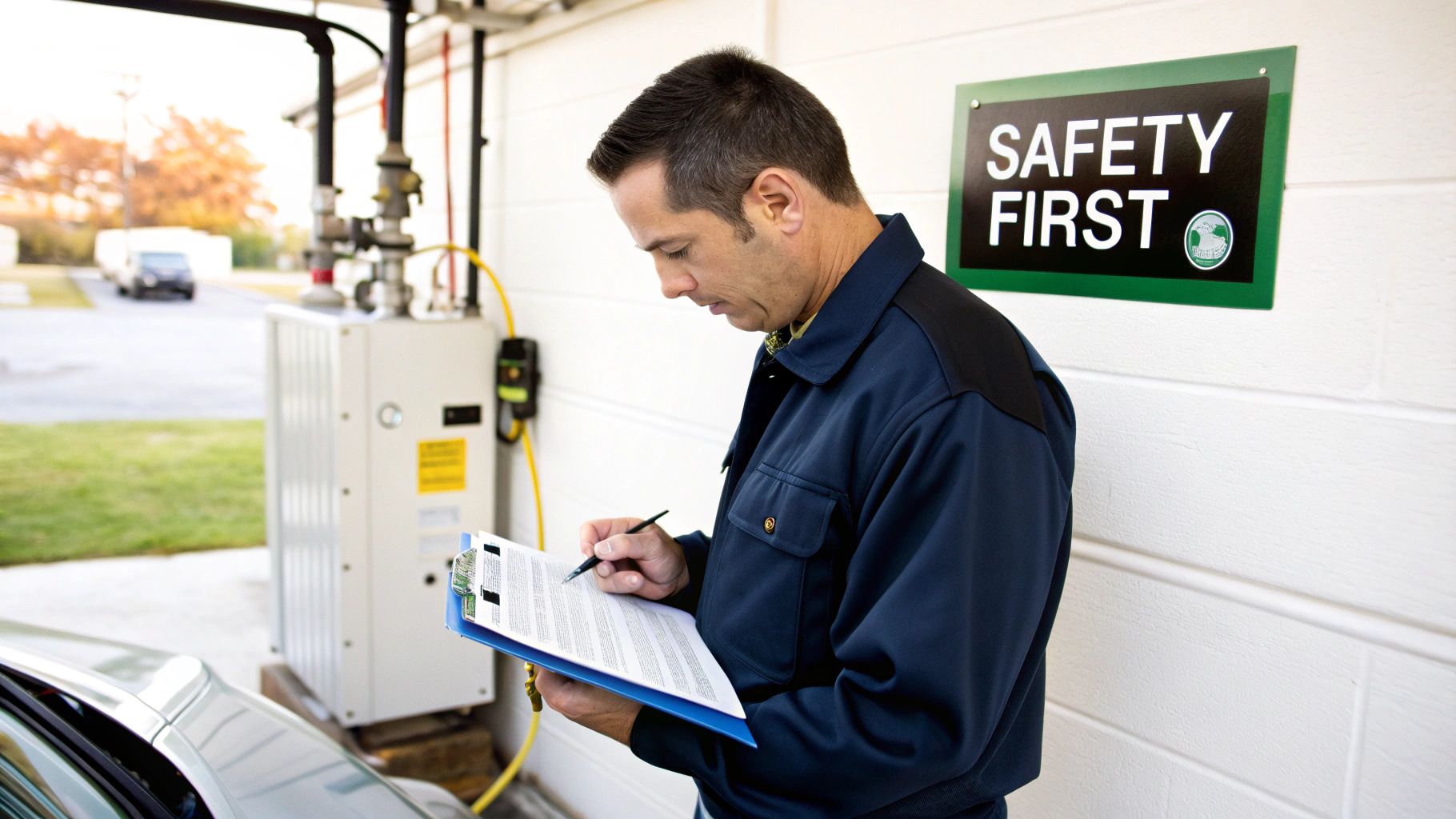
Before you even think about buying a compressor, your first calls should be to your local building authority, the fire department, and your gas utility. Getting ahead of this prevents huge headaches and costly surprises down the road. They are the ones who will give you the specific, non-negotiable rulebook you have to play by.
Assembling Your Professional Team
Let me be perfectly clear: this is not a DIY project. Not under any circumstances. Trying to install a CNG compressor yourself is incredibly dangerous, will instantly void any warranty, and is flat-out illegal just about everywhere. You need to hire a team of certified pros who know exactly what they're doing.
Your installation crew will almost always include:
- A Licensed Gas Fitter: This is the expert who will safely tap into your home's natural gas line, run new piping to the compressor, and triple-check that every connection is leak-free and built to code.
- A Certified Electrician: This pro handles the electrical side, installing the required 240V circuit and ensuring all the wiring from the compressor to your home's panel is safe and compliant.
These two professionals will work in tandem to pull the necessary permits. Once their work is done, a local building official will come out for a final inspection—that's your official seal of approval that the system is safe and up to snuff.
Understanding Key Code Requirements
While the fine print can vary from one town to the next, a few universal safety rules apply to nearly every residential CNG setup. Think of them as the fundamental laws of physics for keeping your home and family safe. Proper placement and ventilation are always at the top of the list.
Clearance is a big one. The compressor must be installed with specific minimum distances from walls, property lines, and any potential ignition sources like your furnace or water heater. For a typical garage installation, this might mean keeping the unit at least three feet away from other appliances and giving it plenty of room to breathe.
Crucial Takeaway: Codes aren't just suggestions; they are legally required safety protocols developed over decades of experience. Following them to the letter is the only way to guarantee a safe and reliable home fueling station for the long haul.
Ventilation is the other major piece of the puzzle. If you're installing the unit in an enclosed space like a garage, the code will demand a way for gas to escape if there's ever a leak. This could be as simple as passive vents or as sophisticated as a mechanical system that kicks on automatically if it detects gas.
Built-In Safety Features of Modern Compressors
Beyond the installation rules, today's home CNG compressors are packed with an impressive array of built-in safety features. These aren't optional upgrades; they are integrated, automatic systems that are constantly watching over the unit's operation.
You can expect to find key safety tech like:
- Automatic Pressure Shut-Off: The compressor knows to stop filling once your vehicle's tank hits the target pressure of 3,600 PSI. It monitors the process and shuts itself off automatically.
- Methane Leak Detectors: A built-in sensor sniffs the air around the unit. If it ever detects even a small amount of natural gas, it will immediately shut down the system and sound an alarm.
- Thermal Overload Protection: This protects the electric motor from burning itself out. Proper electrical safety involves using protective devices like overload relays to prevent the motor from getting damaged by overheating.
- Emergency Stop Button: A big, obvious "E-Stop" button is always there for an instant manual shutdown, no questions asked.
When you combine these advanced features with a professional, code-compliant installation, you get multiple layers of safety. This is what ensures that fueling your vehicle at home is not only convenient and cheap but also exceptionally safe.
Choosing the Right Compressor for Your Vehicle
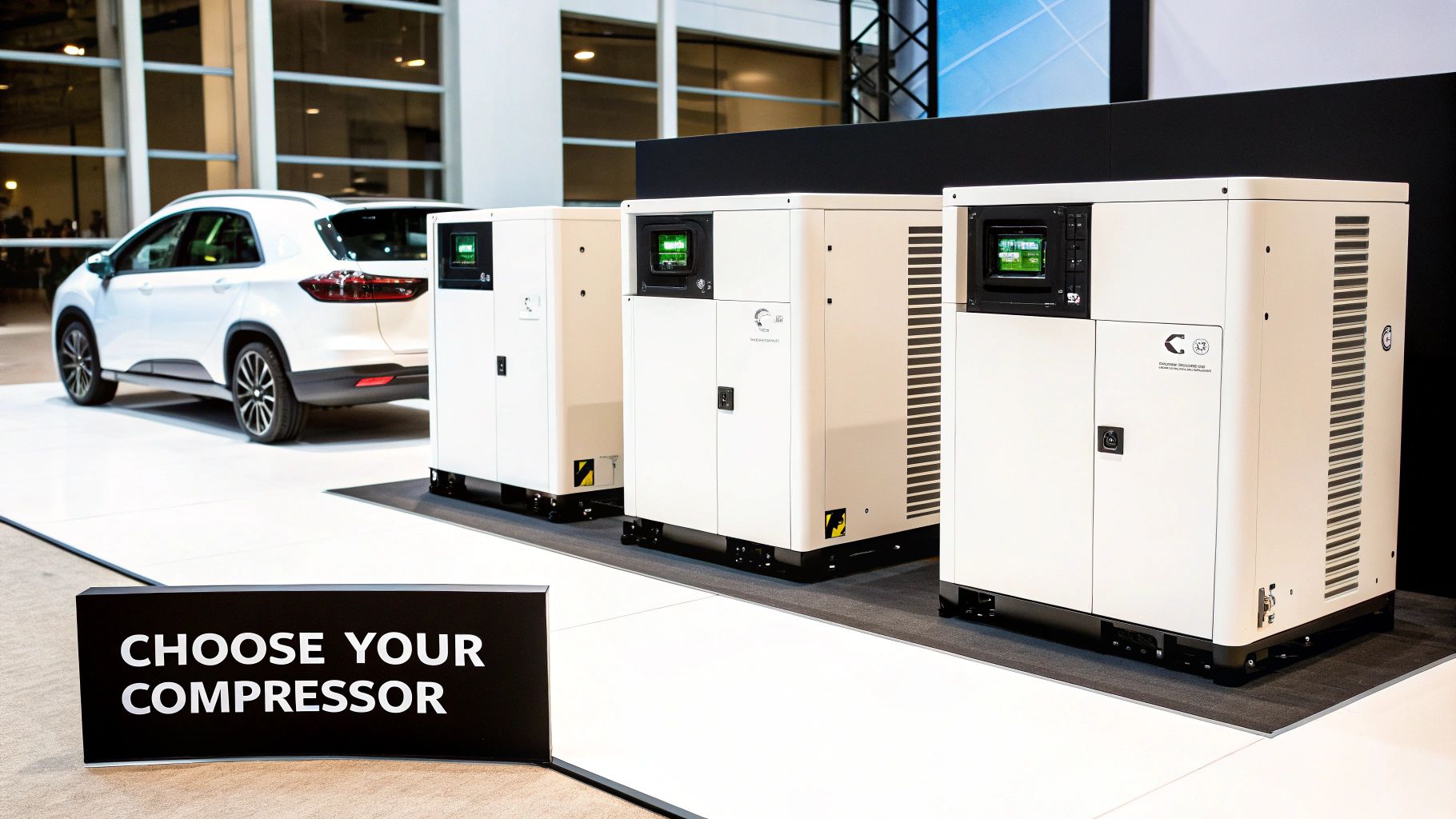
Stepping into the market for a cng compressor home unit can feel a little intimidating. You’ll see terms like flow rate, PSI, and horsepower thrown around, and it's easy to get lost in the technical jargon. But don't worry—you don't need an engineering degree to pick the right machine. It’s really just about matching the compressor's performance to your vehicle and your daily routine.
Think of it like choosing a phone charger. A small, low-wattage block works perfectly fine to charge your phone overnight. But if you tried to power up a high-performance laptop with it, you'd be waiting a long time. In the same way, a smaller compressor is ideal for a daily commuter car that can refuel overnight, while a bigger truck or a need for a quick top-off calls for a more powerful unit.
Decoding the Technical Specifications
To make a smart choice, you really only need to get a handle on three key metrics. These numbers tell you everything you need to know about how fast the compressor works, what kind of vehicle it can handle, and what it needs to run.
- Flow Rate (GGE/hr): This is the big one. It tells you how much compressed natural gas the machine produces per hour, measured in Gallon Gasoline Equivalents (GGE). A higher GGE/hr means a faster fill-up. Simple as that.
- Output Pressure (PSI): This number should always be 3,600 PSI. It’s the non-negotiable industry standard for CNG vehicles, so pretty much every home compressor is built to hit this target. This ensures your tank gets a complete, proper fill every time.
- Motor Power (HP): This is just the horsepower of the electric motor running the show. More horsepower generally means a higher flow rate, but it also dictates your electrical requirements—which almost always means a 240V outlet is a must.
These specs are all tied together. A more powerful motor (higher HP) lets the compressor work faster, which produces a higher flow rate (more GGE/hr), getting your tank full sooner. The trick is to find the right balance for your budget and lifestyle.
Matching Compressor Power to Your Needs
So, how do we connect those specs to the real world? It all comes down to the size of your vehicle’s CNG tank and how quickly you need it filled. A typical commuter car might have an 8 GGE tank, whereas a larger work truck or van could easily have a 20 GGE tank or more.
If you drive a sedan and have a predictable schedule, a smaller unit with a lower flow rate (around 0.5 GGE/hr) is often the most cost-effective option. It will reliably fill your tank while you sleep. But if you’ve got a bigger vehicle or your schedule is all over the place, investing in a model with a higher flow rate (say, 1.0 GGE/hr or more) will make your life a lot easier.
Expert Insight: Nearly all home compressors you'll find are reciprocating compressors. This design is incredibly well-suited for the stop-and-start, high-pressure job of filling a vehicle, which is why it dominates the market. Units with power ratings up to 500 kW have found the sweet spot, offering a great mix of compact size and energy efficiency for residential use. You can learn more about trends in the natural gas compressor market to see how this technology is scaling.
The table below breaks down the typical compressor tiers, giving you a clear picture of how these specs translate into actual refueling times.
Comparing Home CNG Compressor Specifications
This breakdown of typical compressor sizes will help you match performance metrics with your specific vehicle and fueling needs.
| Compressor Tier | Typical Flow Rate (GGE/hr) | Refuel Time (8 GGE Tank) | Electrical Needs | Best For |
|---|---|---|---|---|
| Entry-Level | 0.4 – 0.6 GGE/hr | 13 – 20 hours | 240V, 20-30 Amp | Standard commuter cars with consistent overnight refueling schedules. |
| Mid-Range | 0.8 – 1.2 GGE/hr | 7 – 10 hours | 240V, 30-40 Amp | Larger sedans, smaller SUVs, or users who need more flexibility. |
| High-Performance | 1.5 – 2.0+ GGE/hr | 4 – 5.5 hours | 240V, 40-50+ Amp | Work trucks, vans, or multi-vehicle households needing faster turnarounds. |
With this table, you can easily cross-reference your car's tank size and your daily driving habits with the performance you can expect from different models. This practical approach helps you avoid overspending on a unit that's overkill for your needs, while also preventing the frustration of buying a compressor that just can't keep up.
Getting to the Bottom Line: Costs and Return on Investment
Let's get down to brass tacks. The idea of having your own private fuel station is fantastic, but for most people, the decision to install a home CNG compressor ultimately comes down to the dollars and cents. Before you jump in, it’s critical to understand the total cost of ownership and figure out when you'll start seeing a real return on your investment.
This isn't as simple as buying a new appliance off the shelf. Think of it more like a small infrastructure project for your home—the compressor is the main event, but it's part of a bigger picture.
What's the Real Upfront Cost?
Your initial investment is more than just the price of the compressor unit. The professional work needed to get it installed safely and legally is a major part of the budget.
Here’s a realistic breakdown of what you'll be paying for:
- The Compressor Unit: This is your biggest line item, typically running between $3,000 and $7,000. The price depends heavily on the flow rate (how fast it fills) and the brand you choose.
- Professional Installation: You can't DIY this. You'll need a licensed gas fitter to handle the plumbing and a certified electrician for the wiring. Expect labor for this specialized work to add $1,500 to $4,000, sometimes more.
- Permits and Inspections: Your local city or county will want to sign off on the work. Budget anywhere from $100 to $500 for the necessary gas and electrical permits.
That initial outlay can be a hurdle. To make it more manageable, many people look into equipment financing loans which can spread the cost over several years instead of requiring one large payment.
How to Calculate Your Payback Period
Once you have a handle on the upfront costs, the next question is simple: how long until the fuel savings pay for everything? This is your payback period, and you can get a surprisingly accurate estimate with just a bit of simple math.
The whole calculation hinges on comparing your current gasoline bill to what you'll spend on natural gas. For vehicles, natural gas is measured in a Gallon Gasoline Equivalent (GGE)—it's just the amount of CNG that packs the same punch as a gallon of regular gasoline.
Here’s how to figure it out in three easy steps:
- Find Your Current Monthly Fuel Cost:
(Miles you drive per month / Your car's MPG) x Price per gallon of gas = Monthly gas bill - Estimate Your Future Monthly CNG Cost:
(Miles you drive per month / Your car's MPGe) x Price per GGE of natural gas = Monthly CNG bill - Calculate Your Savings and Payback Time:
Monthly gas bill – Monthly CNG bill = Your monthly savings
Total upfront cost / Your monthly savings = Payback period in months
Let's run a quick example:
Imagine you drive 1,500 miles a month and your car gets 25 MPG. If gas is $3.50 a gallon, you're currently spending $210 a month on fuel.Now, let's say natural gas from your utility costs $1.50 per GGE. Your new monthly fuel cost would drop to just $90.
That's a solid $120 in savings every single month. If your total installation cost was $7,000, your system would pay for itself in just under five years (7000 / 120 ≈ 58 months).
Don't Forget About Long-Term Maintenance
Finally, remember to pencil in a little for upkeep. Just like any other piece of hardworking machinery, your compressor will need some basic care to keep it running smoothly and safely. This usually just means changing out filters and, depending on the model, compressor oil.
Setting aside $100 to $200 per year for these parts is a smart move and gives you a truly complete financial picture.
Thinking long-term is key here. The entire CNG compressor market is growing steadily—globally, it was valued at around USD 4.1 billion and is expected to hit USD 6.4 billion by 2035, thanks largely to environmental rules favoring natural gas. You can discover more insights about the CNG compressor market and see where the industry is headed.
Common Questions About Home CNG Fueling
So, you're considering a personal CNG fueling station. It's natural to have questions about what it's actually like to live with one. Once you get past the technical specs and installation process, how does this piece of equipment fit into your daily routine?
Let's walk through some of the most common questions we hear from homeowners. Getting these day-to-day details sorted out is key to feeling confident about making the switch.
How Loud Is a Home CNG Compressor When It's Running?
This is probably the number one concern for anyone thinking about installing a compressor in their garage, and for good reason. The good news is, modern units are designed with your (and your neighbors') peace and quiet in mind.
Most residential CNG compressors run at about 55-70 decibels—roughly the same sound level as a standard outdoor air conditioning unit. It's a low, consistent hum, not a disruptive racket. You can easily run it overnight in the garage without it bothering anyone inside the house.
Can I Install a Home CNG Compressor Myself?
Let me be crystal clear on this one: absolutely not. Installing a cng compressor home unit isn't a weekend DIY project. This is a job that involves tapping into high-pressure natural gas lines and dealing with high-voltage electrical circuits.
For your safety, your family's safety, and to comply with the law, this work must be done by licensed and certified professionals. Trying to do it yourself is incredibly dangerous, will immediately void your warranty, and is illegal pretty much everywhere. You'll need a qualified gas fitter and a certified electrician, period.
"Safety in a home fueling setup is a system, not a single component. It begins with professional, code-compliant installation and is maintained through routine checks and the compressor's own automated safety features. There are no shortcuts."
What Kind of Maintenance Does a Home CNG Unit Need?
Just like any other major appliance in your home, your CNG compressor needs a little bit of routine care to keep it running safely and efficiently for years to come. Thankfully, the upkeep is straightforward and manageable for any homeowner.
Here’s what you can typically expect:
- Replacing Inlet Filters: These filters are the first line of defense, cleaning the natural gas before it gets compressed. You'll just need to check and swap them out based on the manufacturer's schedule.
- Changing Compressor Oil: If you have an oil-lubricated model, it's a lot like changing the oil in your car. Your owner's manual will tell you how often it needs to be done.
- Inspecting Hoses and Connections: It's a smart habit to give the high-pressure fueling hose a quick visual inspection every so often. Look for any cracks, wear, or damage—it’s a critical safety check.
Your owner's manual is your best friend here; it will lay out the exact maintenance schedule to keep your unit in top shape.
How Much Will a Home Compressor Raise My Utility Bills?
Yes, you'll see a bump in your natural gas and electricity bills. But don't let that scare you off—the increase is a drop in the bucket compared to what you'll save on fuel. The electricity needed to fill your car overnight is similar to running a large appliance, like an electric dryer, for a few hours.
Even when you factor in the cost of that extra gas and electricity, the total cost per Gallon Gasoline Equivalent (GGE) is still 50-70% cheaper than paying for gasoline at the pump. The math works out in your favor every single time you fill up, leading to serious savings month after month.
What if you need natural gas but a permanent line isn't an option? For construction sites needing temporary gas for inspections or businesses dealing with a utility outage, Blue Gas Express provides mobile CNG and LNG solutions. Our rapid-deployment units can deliver the gas you need to keep your project on track. Learn more about our temporary natural gas services.