

Ever found yourself staring at your gas bill, wondering why the meter on the side of your house measures gas in cubic meters (m³), but the bill charges you in kilowatt-hours (kWh)? It’s a common point of confusion, but the answer is simple: you’re paying for the energy you use, not just the volume of gas that flows through the pipes.
Why Your Gas Bill Converts Cubic Meters to Kilowatt Hours
Think of it like buying firewood. You might purchase a full cord of wood, which is a standard measure of volume (just like a cubic meter of gas). But what you really care about is how much heat that wood will produce to warm your home. A cord of dense, dry oak will give off far more heat than a cord of softer, greener pine.
Natural gas is no different. The gas delivered to your home or business isn't perfectly uniform. Its composition, and therefore its energy content, can fluctuate slightly depending on where it was sourced and how it was processed. To bill you fairly, suppliers need a way to measure the actual amount of heat energy you consumed, not just the space the gas occupied.
The Role of Calorific Value
This is where a crucial factor called the Calorific Value (CV) comes in. The CV is the "secret ingredient" in the calculation—it's the official measurement of how much heat energy is released when a specific amount of gas is completely burned. It’s the key that turns a simple volume reading into the precise energy figure on your bill.
In essence, you aren't just buying gas; you are buying the potential heat locked inside it. The conversion from cubic meters to kilowatt-hours is the process of calculating that exact amount of heat energy.
Getting your head around this concept is the first step to truly understanding your energy bill. Of course, before you can even think about the conversion, you need to know where that initial cubic meter reading comes from. If you're not familiar with it, learning how to read your gas meter is a great starting point. Once you grasp why this conversion happens, you'll be much better equipped to understand how your usage is calculated and what you're really paying for.
The Core Formula: From Gas Volume to Usable Energy
Ever wondered how the volume of gas flowing through a pipe gets turned into the energy units on your bill? It all comes down to a standard formula that engineers and utility suppliers use every day. It might look a little intimidating at first, but it’s actually quite logical.
Think of it like a recipe. You have your main ingredient (the gas), a measure of its quality (how much heat it can produce), and a couple of final adjustments to get the perfect result.
The calculation itself is:
Energy (kWh) = [Volume (m³) × Calorific Value (CV) × Correction Factor] / 3.6
Let's break down what each of those pieces really means in practice.
Decoding the Components
First up is Volume, measured in cubic meters (m³). This one is simple—it’s the physical amount of gas that’s passed through your meter. If you're checking your own usage, you just subtract your last meter reading from the current one to find this number.
Next, we have the Calorific Value (CV). This is easily the most important variable in the whole equation. It tells you how much energy is packed into the gas. Think of it as the "potency" or "strength" of the fuel. A higher CV means you get more bang for your buck from every cubic meter. Since natural gas is a raw product, its exact composition and energy content can vary slightly, which is why this value is so critical.
Then there's the Correction Factor. This is a small but crucial adjustment that accounts for the physics of gas. Gas expands when it's warm and contracts when it's cold; its volume is also affected by atmospheric pressure. This factor standardizes the volume measurement to ensure that a cubic meter of gas is treated the same, whether it's being measured on a cold mountaintop or in a warm coastal area. It levels the playing field for fair billing.
This simple diagram shows how the gas you use is converted into the energy you pay for.
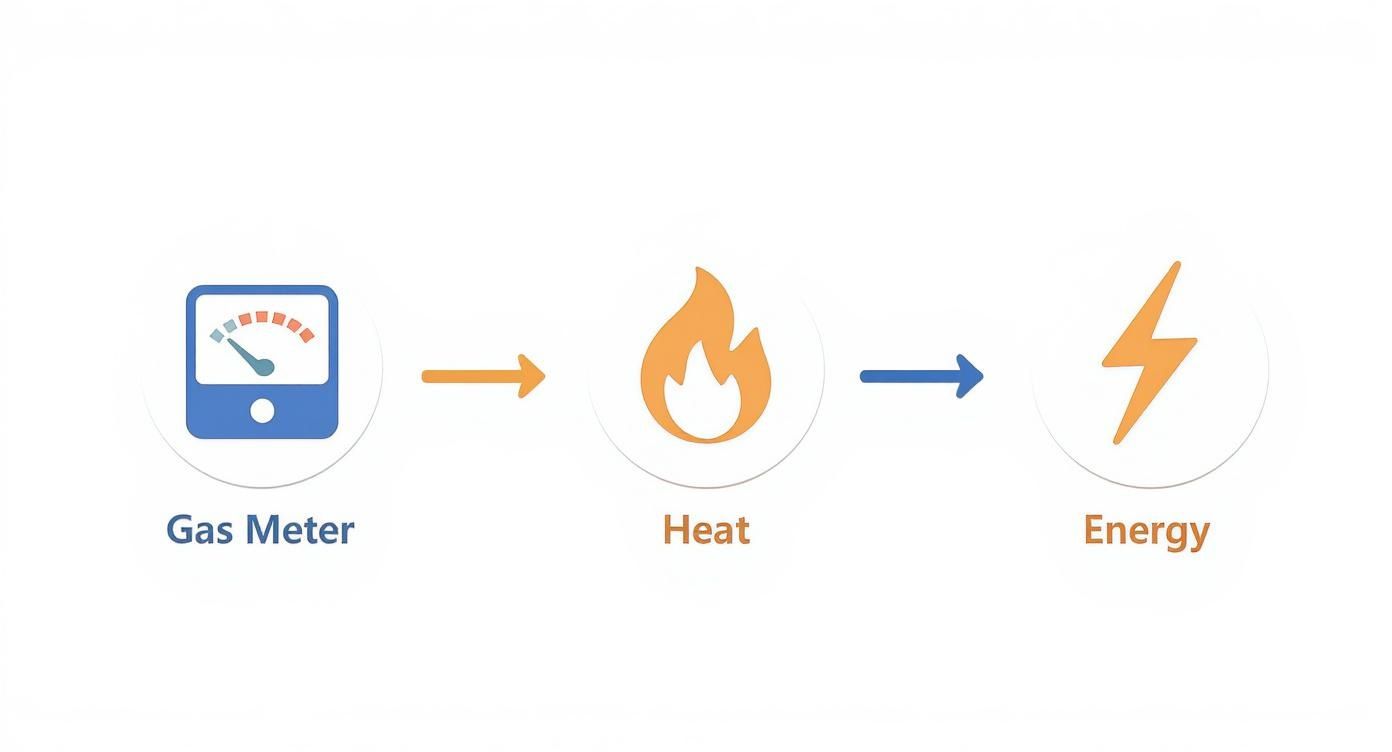
It’s a clear path from a physical volume, to a heat value, and finally to the standard energy unit on your bill.
The Final Step: Making the Units Match
So, what’s that final division by 3.6 all about?
The first part of the formula (Volume × CV × Correction Factor) actually calculates the energy in a unit called megajoules (MJ). That’s a standard scientific unit for energy, but it’s not what we typically use for billing electricity and gas. We use kilowatt-hours (kWh).
The division by 3.6 is simply a unit conversion. One kilowatt-hour is equivalent to exactly 3.6 megajoules. This last step translates the energy from the scientific unit (MJ) into the familiar billing unit (kWh) that appears on your utility statements.
And there you have it. By understanding these four parts—Volume, Calorific Value, the Correction Factor, and the 3.6 divisor—you can see exactly how the gas flowing into your building is converted into the energy you use.
Understanding Calorific Value: The Secret Ingredient in Your Gas Bill
When you look at the formula for converting natural gas from cubic meters to kilowatt-hours, the Calorific Value (or CV) is the most important variable. It’s the official measure of the energy packed into your gas supply. Put simply, it tells you exactly how much heat is released when a specific amount of gas is completely burned.
Think of it like different types of wood for a fire. A log of dense, dry oak will burn hotter and longer than a similar-sized log of softer pine. They both take up the same space, but their energy output is completely different. Natural gas is the same—its Calorific Value can change depending on its exact chemical makeup.
Where Does the Calorific Value Figure Come From?
The CV of natural gas isn't a single, universal number. That’s because natural gas isn’t a pure, factory-made substance. It's a natural mixture of different gases, mostly methane, but with varying amounts of other hydrocarbons like ethane and propane. The precise blend depends entirely on the geological field it was pulled from.
A higher percentage of energy-dense gases like ethane means a higher Calorific Value. This means every cubic meter of that gas delivers more energy. Gas from one field can have a slightly different chemical recipe than gas from another—and it can even change from the same source over time.
Gas network operators are constantly sampling and testing the gas flowing into your home to get a precise, up-to-date CV. This ensures their conversion from volume (m³) to energy (kWh) is accurate, so you’re billed fairly for the actual energy you use. You’ll usually find this value printed right on your utility bill.
Gross vs. Net Calorific Value: What’s the Difference?
Dig a little deeper, and you’ll run into two specific terms: Gross Calorific Value (GCV) and Net Calorific Value (NCV). The distinction boils down to how they handle the water vapor that’s created when gas burns.
Gross Calorific Value (GCV): This is the total heat produced when gas is burned, including the latent energy captured when the resulting water vapor is condensed back into liquid water. It's the maximum theoretical energy you could possibly get, measured under ideal lab conditions.
Net Calorific Value (NCV): This measures the usable heat that's actually released, excluding the energy tied up in the water vapor, which usually just escapes as steam from your boiler's flue or stove top. NCV is often seen as a more realistic measure of the energy you can practically access.
For billing, UK utility companies use the Gross Calorific Value (GCV) because it represents the total amount of energy they are supplying to the network. Getting these measurements right is crucial. For context, total primary energy consumption rose by 2% in 2023 compared to the previous year, showing just how much global demand relies on accurate energy accounting. You can dive into more figures by reading the complete statistical analysis of world energy. Using GCV ensures that the calculations are standardized for everyone.
Step-by-Step Practical Conversion Examples

The theory is great, but let's be honest—it’s seeing the numbers in action that really makes it all click. Putting the formula to work in real-world situations is the best way to get a feel for how to convert cubic meters of gas into the energy you actually use.
We’ll stick to the core formula we've been using:
kWh = [Volume (m³) × Calorific Value (MJ/m³) × Correction Factor] / 3.6
Let's run through a couple of common scenarios you might find yourself in.
Example 1: Double-Checking Your Home Gas Bill
Ever looked at your gas bill and wondered where the final kWh number came from? It’s a simple calculation once you know where to find the figures on your statement.
First, you need to determine how much gas you used in cubic meters.
- Previous Meter Reading: 2150 m³
- Current Meter Reading: 2300 m³
- Gas Volume Used: 2300 – 2150 = 150 m³
Next, your bill will specify the Calorific Value (CV) for the billing period and the Correction Factor.
- Calorific Value (CV): 39.5 MJ/m³
- Correction Factor: 1.02264
Now, just plug those numbers into the formula:
kWh = (150 m³ × 39.5 MJ/m³ × 1.02264) / 3.6
kWh = 6065.15 / 3.6
kWh ≈ 1684.76 kWh
This number should line up almost perfectly with the kWh total on your bill. It’s a great way to confirm everything is accurate and understand precisely what you're paying for.
Example 2: Fuel Planning for a Commercial Generator
Imagine you’re a site manager on a construction project, and you need to commission a brand-new gas generator. The manufacturer’s spec sheet says it needs 5,000 kWh to run its full testing sequence. Your job is to order enough gas to get it done.
This time, we're flipping the formula around to solve for the volume of gas needed. You’ve already called your supplier, who confirmed the expected CV for the delivery.
- Required Energy: 5,000 kWh
- Calorific Value (CV): 38.0 MJ/m³ (standard for this supply)
- Correction Factor: 1.02264
To solve for volume, we just need to rearrange the formula:
Volume (m³) = (kWh × 3.6) / (Calorific Value × Correction Factor)
Let's pop in the numbers:
Volume (m³) = (5,000 kWh × 3.6) / (38.0 MJ/m³ × 1.02264)
Volume (m³) = 18,000 / 38.86
Volume ≈ 463.2 m³
To be safe, the site manager should order at least 464 cubic meters of natural gas. This kind of forward planning is essential in construction and industrial settings to prevent expensive delays and ensure projects stay on schedule.
To illustrate how these factors play out in different contexts, let's look at a few scenarios side-by-side.
Example Calculation Scenarios M³ to kWh
| Scenario | Volume (m³) | Calorific Value (MJ/m³) | Calculated Energy (kWh) |
|---|---|---|---|
| UK Domestic User | 120 | 39.2 | 1,323 |
| Industrial Furnace | 1,500 | 38.5 | 16,270 |
| CNG Vehicle Refuel | 15 | 42.0 | 177 |
| LNG Shipment | 25,000 | 40.5 | 285,150 |
This table shows just how much the final energy output can vary based on the gas quality (CV) and the volume being used. From a simple tank of vehicle fuel to massive industrial shipments, the same fundamental calculation applies. It’s the inputs that change, reflecting the specific type and use of the gas.
What Affects Your Gas Conversion Rate?
The basic formula for converting cubic meters to kilowatt-hours is simple enough, but the real world adds a few wrinkles. A question I get all the time is, "Why did my conversion factor change from last month's bill?" The short answer is that the gas itself isn't a perfectly consistent, factory-made product.
Think of natural gas less like a manufactured good and more like a natural harvest. Just like coffee beans from different regions have unique flavors and caffeine kicks, gas from different wells has a slightly different chemical makeup. This mix of methane, ethane, and other hydrocarbons determines its energy density.
Your conversion rate isn't fixed because the gas itself isn't fixed. It's like a baker adjusting a recipe based on the strength of their yeast. Utility companies are constantly measuring the gas's "energy recipe" to make sure your bill is accurate.
This "energy recipe" is officially known as the Calorific Value (CV). A gas supply with more energy-packed compounds has a higher CV, meaning every cubic meter you use can produce more kilowatt-hours of heat. Your supplier regularly tests the gas flowing through the network to update this value, ensuring the conversion factor reflects the actual energy you’re getting.
It's Not Just What's in the Gas, but Where It Is
Beyond its chemical makeup, we have to remember we're dealing with a gas. Its volume is incredibly sensitive to temperature and atmospheric pressure. A cubic meter of gas on a chilly morning in the mountains is denser and packs more molecules than a cubic meter on a hot, humid day at sea level.
To keep things fair for everyone, utility companies apply a correction factor. This clever bit of math standardizes every cubic meter of gas back to a set of baseline conditions—typically 15°C and standard sea-level pressure. It’s a small but crucial tweak that ensures you're billed for the same standardized amount of energy, no matter what the local weather or altitude is doing.
The Energy You Buy vs. The Energy You Use
Finally, there’s a big difference between the energy delivered to your meter and the heat that actually warms your building. The kWh figure on your bill represents the potential thermal energy available in the gas. It doesn't, and can't, account for how efficiently your equipment turns that gas into useful output.
- Older Boilers: An old, inefficient boiler might only convert 70% of the gas's energy into useful heat, venting the other 30% straight out the flue.
- Modern Condensing Boilers: These high-efficiency units are a different story, often capturing over 90% of the potential energy.
Getting these conversions right is vital on a global scale. In 2023, the world's primary energy consumption reached a staggering 619.63 exajoules. But how that energy is used varies wildly; for instance, North America's per capita consumption is nearly three times the global average. You can explore more about these worldwide energy consumption patterns on Statista.
These figures show why precise, standardized energy conversions are so important, from your local utility bill to international energy policy. The gas composition, the local environment, and your equipment's efficiency all come together to explain why converting cubic meters to kilowatt-hours is a dynamic calculation, not just a simple, static number.
Putting This Knowledge Into Practice
Theory is great, but what does it mean in the real world? Now that you have a handle on the formula and the variables that can tweak the m³ to kWh conversion, you can use this knowledge to make smarter decisions. It doesn't matter if you're managing a household budget or a massive construction project.
This is all about bridging the gap between seeing numbers on a meter and truly understanding the energy you're consuming and paying for. It gives you the power to check your bills, plan fuel needs, and talk to suppliers with confidence.
For Homeowners and Business Managers
Your utility bill shouldn't be a mystery you just passively accept. Understanding the numbers puts you back in control. Once you know how to read it, you can spot trends in your energy use and find real opportunities to save money.
Next time you get in touch with your gas company, you’ll be ready. Here are the key questions to ask to get the full picture of your energy usage:
- Where can I find the Calorific Value (CV) on my bill? Ask them to point out the exact MJ/m³ figure they used for your last billing cycle.
- How often do you update the CV? This explains why the conversion factor can seem to change from one bill to the next.
- What is the standard Correction Factor you apply? Knowing this number is the final piece of the puzzle to double-check their math.
- Can you explain any big jumps or drops in the CV over the last year? This can give you a clue about the consistency of the gas supply in your area.
Once you know how your gas usage translates into actual energy, you can make much better decisions about improving your home or business's energy efficiency practices, which is the fastest way to lower your bills.
For Engineers and Construction Professionals
In the technical world, "close enough" doesn't cut it. Precision is everything. The conversion from cubic meters to kilowatt hours isn't just an academic exercise; it's a vital tool for planning and getting the job done right.
For engineers, this is way more than just billing. It’s about operational integrity. Getting the conversion right is fundamental for load calculations, specifying the right equipment, and making sure a project has the energy it needs to run without hitting costly snags.
Think about commissioning a big gas-powered generator. You need to calculate the exact volume of CNG or LNG required to produce a specific kWh output for testing. Or, when you're designing the heating system for a new building, you have to convert the building's heat load (in kWh) into a required gas volume (in m³) to size the infrastructure correctly.
Nailing this calculation means you won't over-order fuel, and you can guarantee that expensive equipment will operate exactly as it was designed to.
Your Questions Answered
Let's tackle some of the most common questions that come up when converting natural gas from cubic meters to kilowatt-hours.
Why Does the m³ to kWh Conversion Factor Change?
It all comes down to the simple fact that natural gas isn't a manufactured product—it's a natural one. Its energy content, what we call the Calorific Value (CV), can and does change.
Think of it like batches of firewood. Wood from a dense, dry oak tree will burn hotter and longer than the same volume of lighter, damper pine. Natural gas is similar; its exact chemical makeup varies slightly depending on its source. To keep things fair, utility companies constantly test the gas in their network and update the CV. This ensures you're billed for the actual energy you use, not just the volume that flows through the meter.
Is There One Magic Number to Convert m³ to kWh?
While there's no single, universal number that's always correct, a good rule of thumb for a quick estimate is to multiply your cubic meters by 10.5. This will get you a ballpark figure for kWh.
But, and this is important, that's just an estimate.
For anything that needs to be precise—like engineering specs, generator commissioning, or simply checking your bill—you have to use the exact Calorific Value provided by your gas supplier. Using a general estimate for critical work can lead to some serious miscalculations.
Can I Use This Conversion for Other Gases Too?
The principle is the same, but the numbers are completely different. Gases like propane, butane, or biogas have their own unique Calorific Values.
Propane, for instance, packs a much bigger energy punch than natural gas. A cubic meter of propane will yield a far higher kWh value. Always, always use the specific CV for the exact gas you're working with to guarantee your calculations are accurate and, more importantly, safe.
When your project can't wait for a permanent gas line, Blue Gas Express delivers reliable, temporary natural gas solutions directly to your site. Ensure your construction timelines stay on track and avoid costly delays by visiting https://bluegasexpress.com to learn how we keep your operations running.