

When you're dealing with natural gas for industrial, construction, or commercial projects, getting your numbers right isn't just important—it's everything. A solid natural gas conversions calculator is the key to moving between energy units like BTUs, therms, cubic feet, and the specific volumes for LNG and CNG. This is how you ensure accurate project planning, realistic cost estimates, and smooth logistics management.
Why "Good Enough" Isn't Good Enough for Natural Gas Conversions

In energy, a small miscalculation can snowball into a massive problem, throwing your budget and timeline completely off track. The line between a successful project and a costly one often comes down to the precision of your initial energy calculations.
Think about a major construction site needing a temporary LNG supply for winter heating. If you miscalculate the conversion from liquid LNG gallons to the gaseous cubic feet your heaters will burn, you could run out of fuel in the middle of a cold snap. This isn't just a hypothetical; it’s a real-world headache that can stop work, delay inspections, and lead to huge cost overruns.
It’s the same for a plant manager looking over a utility bill. If you can't accurately convert BTUs to therms, you might miss a billing error or a chance to optimize your energy spend. Over months and years, these small oversights can add up to a significant financial drain.
Getting a Handle on the Core Units
To work with natural gas effectively, you need to speak its language. The different units of measurement can seem confusing, but each serves a distinct purpose, from how you're billed to how fuel is delivered. A reliable natural gas conversions calculator should make switching between them effortless.
To help you get started, here's a quick reference table for the units you'll see most often.
Common Natural Gas Units and Their Primary Uses
| Unit | Abbreviation | Primary Use Case |
|---|---|---|
| British Thermal Unit | BTU | The basic unit of heat energy. It's the foundation for nearly all other energy calculations. |
| Therm | — | A billing unit used by utility companies, equal to 100,000 BTUs. |
| Cubic Foot | cf | Measures gas volume. The energy content (heating value) can vary, making it a critical variable. |
| LNG Gallon | — | Measures the volume of Liquefied Natural Gas, common for bulk transport and temporary supply. |
| CNG Kilogram | kg | Measures the mass of Compressed Natural Gas, often used for vehicle fueling and smaller-scale mobile supply. |
Understanding when and why each unit is used is the first step toward mastering your energy logistics.
How Market Changes Make Precision Even More Crucial
The need for accurate conversions is amplified by the ever-changing global energy market. Fluctuations in supply chains and production levels directly impact the numbers you're plugging into your formulas.
For example, global natural gas production recently jumped by about 50 billion cubic meters (bcm). To understand what that means for your business, you have to be able to convert massive figures like bcm into the cubic feet or therms that matter for your operations. As you can learn more about on WorldBank.org, these market dynamics make precise conversions essential for smart planning.
In our experience, the most common point of failure isn't the math itself, but using outdated or generic conversion factors. The energy content of natural gas from one pipeline can differ from another, which is why a flexible natural gas conversions calculator that allows you to input specific heating values is a game-changer.
Ultimately, getting your conversions right is the bedrock of good energy management. It gives you the power to plan logistics confidently, check invoices for accuracy, and make informed decisions that keep your project on time and on budget.
Getting a Handle on Gas Conversion Math
Let's be honest, diving into the formulas behind energy calculations can feel like you're back in a high school physics class. But the math is actually more straightforward than you might think, and getting comfortable with it is the key to mastering your energy logistics. It’s what separates blindly trusting a utility bill from being able to verify every single charge yourself.
This section breaks down the practical formulas for the most common conversions you’ll face out in the field. We're moving past generic numbers to show you how these calculations solve real-world operational problems. Sure, our handy natural gas conversions calculator makes it quick, but knowing the "why" behind the numbers is what really empowers you to catch costly errors and plan with total precision.
The Basics: From BTUs to Therms
Your utility company probably bills you in therms, but the actual energy you're using is measured in British Thermal Units (BTUs). This is the first and most fundamental conversion to get right because it hits your bottom line directly.
A therm is simply a unit of heat energy that equals 100,000 BTUs. The formula is dead simple but incredibly powerful for auditing your energy bills.
- Formula:
Total BTUs / 100,000 = Total Therms
Let’s put it to work. Say your facility burned through 15,500,000 BTUs last month. To double-check your bill, you’d run this quick calculation:
15,500,000 BTUs / 100,000 = 155 Therms
If your bill comes in charging you for 170 therms, you know it's time to pick up the phone. This one little check can literally save you thousands of dollars over the course of a year.
Converting Gas Volume to Pure Energy: Cubic Feet to BTUs
While therms are for billing, the actual volume of gas you receive is measured in cubic feet (cf). Here’s the catch, though: not all natural gas is created equal. The energy it packs can vary depending on its source and composition, which is where the "heating value" becomes critical.
The heating value (sometimes called calorific value) is the amount of energy stored in a specific volume of gas. It's usually expressed as BTUs per cubic foot (BTU/cf). Your gas supplier will provide this number, and it's the secret ingredient for truly accurate conversions.
- Formula:
Total Cubic Feet (cf) x Heating Value (BTU/cf) = Total BTUs
Imagine a big industrial boiler on your site consumes 5,000 cubic feet of natural gas over a 24-hour period. You look at your supplier's data sheet and see the heating value for that day's delivery is 1,030 BTU/cf.
5,000 cf x 1,030 BTU/cf = 5,150,000 BTUs
Now you know the actual energy your boiler consumed. That’s a much more useful number for tracking efficiency than just the volume of gas that went through the pipe.
The heating value isn't a fixed constant. It can fluctuate daily based on the gas blend in the pipeline. Always use the specific value from your supplier for the most accurate calculations, as using a generic estimate like 1,000 BTU/cf can introduce significant errors in large-scale operations.
Sizing for the Big Jobs: From Therms to Mcf
When you get into large-scale purchasing or reporting, you'll constantly see the term Mcf, which just means one thousand cubic feet. Converting your energy needs from therms into Mcf is an essential skill for procurement and long-term planning. It's a simple two-step process using what we've already covered.
You’ll start by converting your therms into the total BTUs needed, then use the heating value to figure out the volume in Mcf.
Let's walk through a real-world scenario. A manufacturing plant needs to budget for 2,500 therms of natural gas for its upcoming production quarter. They know their supplier's average heating value is 1,025 BTU/cf.
First, they figure out the total energy they need in BTUs:2,500 therms x 100,000 = 250,000,000 BTUs
Next, they calculate how much gas volume that represents:250,000,000 BTUs / 1,025 BTU/cf = 243,902 cubic feet
Finally, they convert that volume to Mcf for their procurement order:243,902 cf / 1,000 = 243.9 Mcf
By getting a feel for these core formulas, you can confidently navigate supplier quotes, verify invoices, and plan your energy needs with a high degree of accuracy. While a digital tool like our natural gas conversions calculator does the heavy lifting, understanding the logic puts you firmly in control of your energy data.
Handling LNG and CNG for Temporary Fuel Supply
When a pipeline goes down for maintenance or you need to power a remote construction site, Liquefied Natural Gas (LNG) and Compressed Natural Gas (CNG) become your best friends. These temporary fuel sources are logistical lifelines, but their conversions are a completely different animal compared to standard pipeline gas. Getting the math right is the key to avoiding expensive supply problems.
Unlike pipeline gas measured in cubic feet, LNG and CNG are transported and measured differently—liquid gallons for LNG and kilograms for CNG. A solid natural gas conversions calculator is absolutely essential for translating these delivery units into the gaseous volume and energy output your equipment actually needs to run.
The Unique Challenge of LNG Conversions
Liquefied Natural Gas is simply natural gas that’s been chilled to a frigid -260°F (-162°C), causing it to shrink dramatically. This makes it incredibly efficient to transport, but it also means you have to account for its massive expansion when it’s vaporized back into a gas.
The biggest mistake we see people make is underestimating this expansion. One gallon of LNG is nowhere near one cubic foot of gas. Not even close.
- LNG Expansion Ratio: On average, 1 liquid gallon of LNG expands into roughly 850 standard cubic feet (scf) of natural gas.
Let’s walk through a real-world example. Imagine a remote mining operation needs a steady supply of 50,000 scf of natural gas per day. Your job is to calculate how much LNG they need delivered.
- The Formula:
Required Gaseous Volume (scf) / 850 scf per gallon = Required LNG Volume (gallons) - The Calculation:
50,000 scf / 850 = 58.8 gallons of LNG per day
It looks simple, but this calculation is the cornerstone of your entire logistics plan. It dictates how many tanker trucks you'll need and helps you schedule deliveries to prevent a fuel shortage that could halt the whole operation.
Decoding CNG for Mobile Supply
Compressed Natural Gas (CNG) is another fantastic mobile solution, typically delivered in tube trailers. Instead of being liquefied, it's stored under immense pressure and measured by its mass—usually in kilograms (kg). The conversion here is all about the gas's density.
While density can vary a bit, a reliable rule of thumb is that 1 kilogram of CNG equals about 53.4 standard cubic feet of natural gas.
- The Formula:
Total CNG Mass (kg) x 53.4 scf per kg = Total Gaseous Volume (scf)
Now, picture a construction project that needs 100,000 scf to get through a planned pipeline shutdown over a weekend. You need to make sure you order the right amount of CNG.
- The Calculation:
100,000 scf / 53.4 scf per kg = 1,872.7 kg of CNG
Knowing this exact number allows you to work with your supplier to ensure the tube trailer they send has enough capacity, saving you from a mid-project scramble for more fuel.
A critical tip for both LNG and CNG: Always confirm the specific conversion factors with your supplier. The exact energy content and density can vary, and using their precise numbers ensures your calculations align perfectly with their delivery metrics, preventing billing discrepancies and supply miscalculations.
To help you quickly compare the two for planning purposes, here's a handy reference table with the key factors.
LNG vs CNG Quick Conversion Factors
This table breaks down the essential conversion numbers for LNG and CNG, which are crucial for any logistical planning or sizing of temporary fuel supplies.
| Conversion | LNG Factor (Approximate) | CNG Factor (Approximate) |
|---|---|---|
| Gaseous Volume from Liquid/Mass | 1 gallon ≈ 850 scf | 1 kg ≈ 53.4 scf |
| Energy Content (BTU) | 1 gallon ≈ 82,600 BTU | 1 kg ≈ 50,000 BTU |
| Energy Content (Therms) | 1 gallon ≈ 0.826 Therms | 1 kg ≈ 0.50 Therms |
| Common Transport Unit | Liquid Gallon | Kilogram (kg) |
Remember, these are industry-standard approximations. Always refer to your supplier's specific product data sheet for the most accurate figures.
The reliance on these flexible fuel sources is only growing. Global natural gas demand is projected to hit around 4,193 billion cubic meters (bcm), with LNG trade expanding to a record 555 bcm. This trend highlights just how important accurate conversions are in a connected global market. You can dive deeper into these trends by reading the full IGU report on BOE Report.
This diagram shows how any gas source is typically converted from its measured volume into its energy content and, finally, its cost.
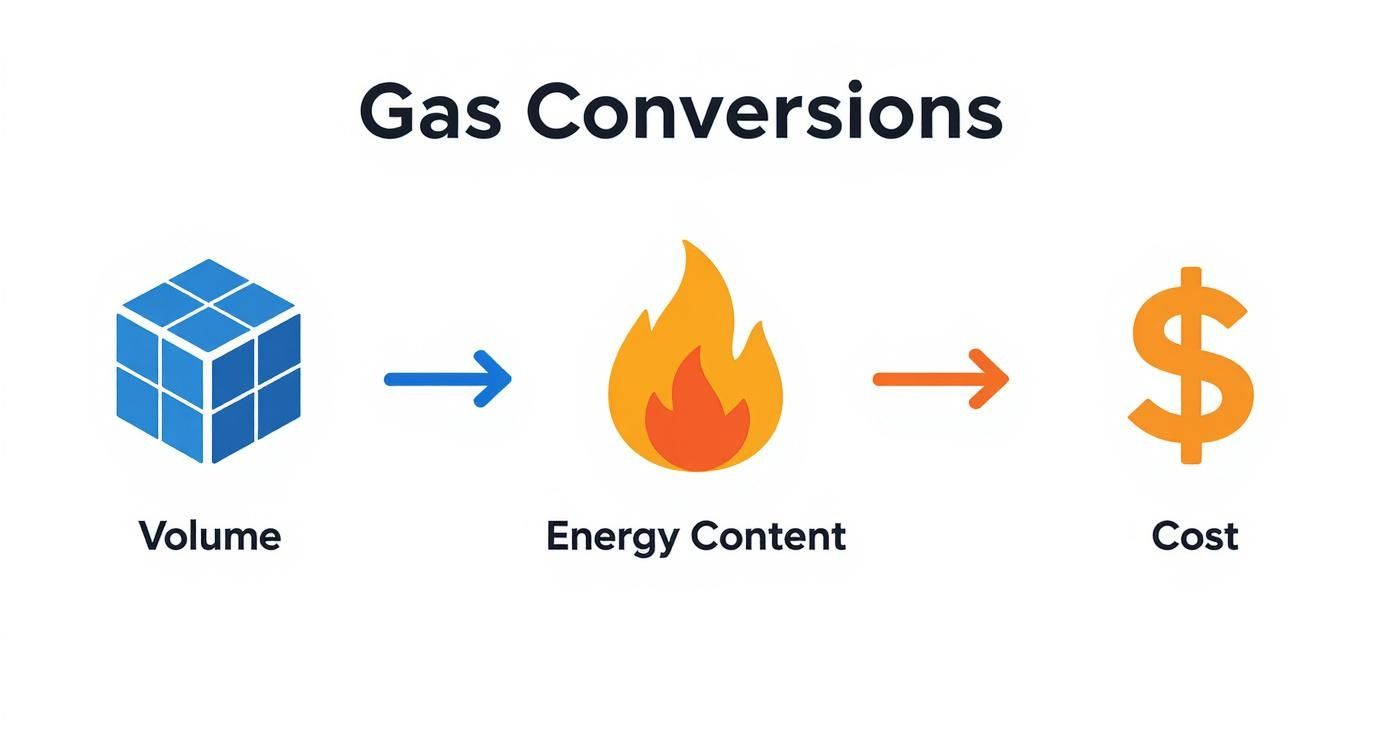
As you can see, you can't get to an accurate cost analysis without first correctly translating the physical volume into usable energy units like BTUs or therms.
Planning Logistics for Temporary Supply
Once you have a handle on these conversion principles, you can confidently plan for any temporary fuel scenario. The secret is to work backward: start with your operational energy demand, then calculate the physical quantity of LNG or CNG you need delivered to your site.
Whether you're dealing with a short-term pipeline interruption or fueling a remote project for months, a precise natural gas conversions calculator takes the guesswork out of these critical steps. It ensures your energy supply chain stays reliable, cost-effective, and perfectly matched to what your operation actually needs.
Real-World Scenarios With a Conversion Calculator
Formulas are one thing, but their real value shows up when you apply them to the messy, high-stakes situations you face on the job. A reliable natural gas conversion calculator isn't just for double-checking your math; it's a strategic tool for making critical business decisions that can make or break a project.
Let's walk through a few scenarios I’ve seen time and time again. These aren't just hypotheticals—they're based on the real problems that project managers and plant operators have to solve every day. Moving from a rough guess to a precise calculation can be the difference between a project running smoothly and a costly disaster.
Sizing an LNG Supply for a Major Construction Project
Imagine you’re running a large commercial construction project. It’s a four-month job, right through the winter, but the permanent natural gas line won't be active until spring. To keep the industrial heaters running and stay on schedule, you need a temporary LNG supply. The big question is: how much do you order?
First, you have to get a handle on the total energy demand. You talk to your HVAC contractor and estimate the daily heating load in BTUs:
- Months 1 & 4 (Milder Weather): 5,000,000 BTUs/day
- Months 2 & 3 (Deep Winter): 8,500,000 BTUs/day
A quick run through a natural gas conversions calculator shows the total energy need for the 120-day project is 780,000,000 BTUs. From there, you just need to convert that energy requirement into a practical delivery volume. Since one gallon of LNG provides about 82,600 BTUs, the math is simple:
780,000,000 BTUs / 82,600 BTU per gallon = 9,443 gallons of LNG
That number, 9,443 gallons, is your logistical foundation. Now you can confidently schedule tanker deliveries, ensuring you have enough fuel to get the job done without tying up capital by over-ordering.
This kind of planning is becoming more important every year. In the United States, natural gas consumption is projected to hit a record average of 91.4 billion cubic feet per day, with 45% of homes now using it as their primary heating source. You can dig into these trends in this energy report.
Comparing Costs During a Pipeline Shutdown
Here’s another common situation. A plant operator is facing a planned three-day maintenance shutdown of their main gas pipeline. They have a critical boiler that must keep running, and it burns 200 therms a day. The choice is between a temporary pipeline connection at a steep flat rate or bringing in a CNG tube trailer. To make the right call, the operator needs to compare the cost of CNG against the revenue loss from a full shutdown.
The first step is figuring out how much CNG is needed.
- Daily Energy:
200 therms/day x 100,000 BTU/therm = 20,000,000 BTUs/day - Total for Shutdown:
20,000,000 BTUs/day x 3 days = 60,000,000 BTUs - CNG Mass Needed: Knowing 1 kg of CNG contains about 50,000 BTUs, the calculation is:
60,000,000 BTUs / 50,000 BTU/kg = 1,200 kg of CNG.
With that 1,200 kg figure, the operator can get a precise quote from a CNG supplier like Blue Gas Express. This allows for a clear cost-benefit analysis, weighing the CNG delivery cost against the huge losses from three days of downtime. Our conversion calculator is a key part of this process, and it also plays a role in using data analysis to slash fuel costs across the board.
Benchmarking Annual Energy Efficiency
Finally, let's look at a facility director who needs to benchmark her plant's energy efficiency against new industry standards. Her utility bills show annual consumption in thousand cubic feet (Mcf), but the standards are all in therms. Last year, the plant used 15,000 Mcf of natural gas.
To compare apples to apples, she has to convert that volume into energy. She confirms with her utility that their average heating value for the year was 1,028 BTU/cf.
- Total Cubic Feet:
15,000 Mcf x 1,000 = 15,000,000 cf - Total Energy in BTUs:
15,000,000 cf x 1,028 BTU/cf = 15,420,000,000 BTUs - Total Energy in Therms:
15,420,000,000 BTUs / 100,000 BTU/therm = 154,200 therms
Now she has an accurate conversion—154,200 therms—and can properly benchmark her facility's performance. She can see where efficiency upgrades are needed and report progress to stakeholders in a language they all understand. In every one of these cases, the natural gas conversions calculator is the bridge between raw data and smart, actionable decisions.
Using Our Natural Gas Conversion Tool
Doing the math by hand is a great way to wrap your head around the formulas, but let's be realistic. On a busy construction site or in a fast-moving industrial plant, you don't have time for a notepad and pen. You need fast, reliable answers. That’s why we built a tool to take the guesswork and potential for human error out of the equation.
The Blue Gas Express natural gas conversions calculator is designed to be dead simple. Whether you're in the office mapping out logistics or standing on-site needing a quick number, it gets the job done. It handles everything from basic BTU-to-therm conversions to the more complex calculations you need for sizing temporary LNG and CNG fuel supplies.
How to Get Instant Answers
We built the tool to be intuitive because you shouldn't have to memorize conversion factors to get your job done. You just need to know what you have and what you need.
It all comes down to a few simple inputs that mirror the questions you’re already asking:
- Start with your known value: Just type in the number you have. Maybe it's the LNG gallons you're thinking of ordering or the cubic feet of gas your equipment is set to burn through.
- Pick your starting unit: Use the first dropdown to tell the calculator what that number represents—therms, BTUs, Mcf, LNG gallons, or CNG kilograms.
- Choose the unit you need: In the second dropdown, select what you want to convert to. This is where you turn raw data into a practical answer, like figuring out how many total BTUs you'll get from a tanker of LNG.
The interface is clean and straightforward, built for quick answers when you're under pressure.

As you can see, it's all about clarity. You get an immediate result without any clutter, which lets you run different scenarios in seconds and make smart decisions on the fly.
Advanced Features for Greater Precision
While the basics are simple, we included features for those who need more precise calculations. One of the most important is the ability to adjust the heating value. As we've covered, the energy content (BTU per cubic foot) of natural gas isn't always the same.
Our calculator lets you enter the exact heating value from your utility or fuel supplier's spec sheet. This makes sure your conversions aren't just ballpark estimates—they're based on the specific gas you're actually using. The result is far more accurate project costing and fuel ordering.
Think about it. If you're converting Mcf to therms, using a precise heating value of 1,028 BTU/cf instead of the standard 1,000 BTU/cf can swing your final energy calculation by nearly 3%. On a large-scale project, that difference can represent thousands of dollars. Moving from manual math to a dedicated tool ensures every number is dialed in, giving you complete confidence in your planning.
Common Questions We Hear in the Field
Even with the best tools at your disposal, real-world projects always throw a few curveballs. When you're on-site trying to manage fuel supply, engineers and project managers often bump into the same tricky questions. Let's tackle some of the most common ones we hear to help you nail your energy calculations every time.
Think of this as your field guide for the details that matter. Getting these right can be the difference between a smooth operation and a costly delay.
Why Does the BTU Value of Natural Gas Seem to Change?
This is probably the number one point of confusion we encounter. Why isn't the heating value—the BTUs packed into each cubic foot of gas—always the same? The short answer is that natural gas isn't a perfectly uniform product. Its energy content changes slightly depending on its source.
Gas from different wells or regions will have a slightly different recipe. While it's mostly methane, it also contains other hydrocarbons like ethane, butane, and propane. These other components have their own energy densities, so a batch of gas with more of them will naturally have a higher BTU value. This is why you must use the specific heating value provided by your supplier for any given delivery. Relying on a generic average can easily leave you short on fuel or paying for more than you needed.
The biggest mistake we see in LNG conversions is forgetting the massive expansion that occurs when the liquid turns back into a gas. One gallon of LNG expands to become roughly 850 cubic feet of natural gas. Forgetting this or using an incorrect factor will lead to a critical underestimation of your fuel supply needs.
Can I Use an Online Calculator for Official Billing?
This is a critical question, especially for anyone managing project budgets or dealing with compliance. While a natural gas conversions calculator like ours is fantastic for planning and estimating, you should never rely on it for official billing or reporting.
Here's why: Official billing documents must use the exact conversion factors provided by your utility or fuel supplier. Their numbers are based on the actual measured quality and energy content of the specific gas delivered to you during that billing cycle.
Here’s how to think about it:
- For Planning: A calculator is your best friend for sizing a temporary CNG delivery or forecasting project costs.
- For Billing: Always, always use the numbers on your utility's statement. This is non-negotiable for contractual accuracy.
- For Verification: Use the calculator as a sanity check. It's a great way to double-check their math and spot any potential errors.
Treat an online tool as your go-to guide for making smart decisions upfront. But when it's time for the official paperwork, your supplier's data is the final word. This simple distinction keeps your operations running and your accounting clean.
Need a reliable, temporary natural gas solution for your project in North Carolina, South Carolina, Tennessee, or Virginia? Blue Gas Express provides fast deployment of CNG and LNG units to keep your operations running without interruption. Don't let a pipeline delay stop your progress—get in touch with us today.